SHA built its name on macrobiotic cooking and early nights in the hills above the Costa Blanca. In 2026 it sells something rather louder: “measurable health engineering,” biological-age assessments and, in Mexico, stem-cell infusions. We looked at what the Advanced Longevity program actually contains, what a week costs and which parts have evidence behind them.
I had read about SHA in Spain before, but what initially stood out to me was the food. A lot about healthy eating, special diets and changing your lifestyle. All sensible things, of course, but not necessarily what I was looking for in a longevity clinic.
I’m more interested in the medical side. What can we actually measure about aging? Which treatments might help us stay healthier for longer? And is there anything genuinely new beyond the usual advice about eating better, exercising and getting enough sleep?
Having visited Chenot and Clinique La Prairie in Switzerland, I’ve already experienced two rather different approaches. One was particularly strict about food, while the other involved more medical consultations and tests.
SHA now offers its own advanced longevity programs, with everything from biological markers and metabolic assessments to regenerative treatments and recovery technologies.
That sounds much closer to what interests me. But it also raises more questions.
What exactly are they measuring? What happens if a result is abnormal? And do any of these treatments actually slow aging, or do they simply change a few laboratory numbers?
I wouldn’t mind spending a week eating good, healthy food somewhere beautiful in Spain. But if I’m paying for longevity medicine, I’d want to know what the medicine is actually doing.
DailyStoke has not stayed at SHA, so this is a research-led review based on SHA’s own program documents, published research and independent reporting, checked in October 2026.
Verdict: SHA is a polished, well-staffed health resort whose most defensible assets are unglamorous: anti-inflammatory food, daily movement, sleep and a doctor who reviews your numbers. Its Advanced Longevity program bundles those with a long list of tests and elective treatments, several of which (IV “energizing” drips, ozone, chelation, intermittent hypoxia) have little or no evidence for healthy adults. Book it for the structure and the kitchen, and ask hard questions before adding anything injected.
SHA Spain at a glance
- Location: L’Albir, near Alicante, on the Costa Blanca, Spain
- Operator: SHA, part of the Bataller family’s AB Living Group; founded by Alfredo Bataller Parietti, opened in 2008
- Size: 93 suites and 11 private residences at the Spanish site (Spa Business, 2023)
- Other sites: SHA Mexico at Costa Mujeres, near Cancún; a UAE site announced for early 2028
- Featured program: Advanced Longevity, from 4 nights
- Program price: €1,200 per guest per night in Spain, health program only; the program page says accommodation is not included (checked October 2026)
- Minimum stay: every 2026 program can be booked from 3 nights, though Advanced Longevity starts at 4
- Medical model: in-house doctors and specialists; an international Scientific Advisory Board was announced in April 2026
- Firsthand evidence: not visited
What the SHA Method is, and how it has changed
SHA’s founder came to the idea through his own illness, recovering, as the company tells it, with a doctor who took nutrition seriously. The clinic blended macrobiotic cooking with natural therapies and preventive medicine.
The 2026 relaunch reframes all of it. In a March 2026 press release, co-founder Alejandro Bataller called the new lineup “measurable health engineering,” adding: “This is not medical wellness.” The programs were simplified, made shorter and, in SHA’s words, more therapeutically intense. There are now eight: Advanced Longevity, Detox & Optimal Weight, an Intensive version of it, Executive Health & Performance, Rebalance & Energize, Tailor-Made, Stay Your Way, and Cellular Regeneration, which is sold only in Mexico.
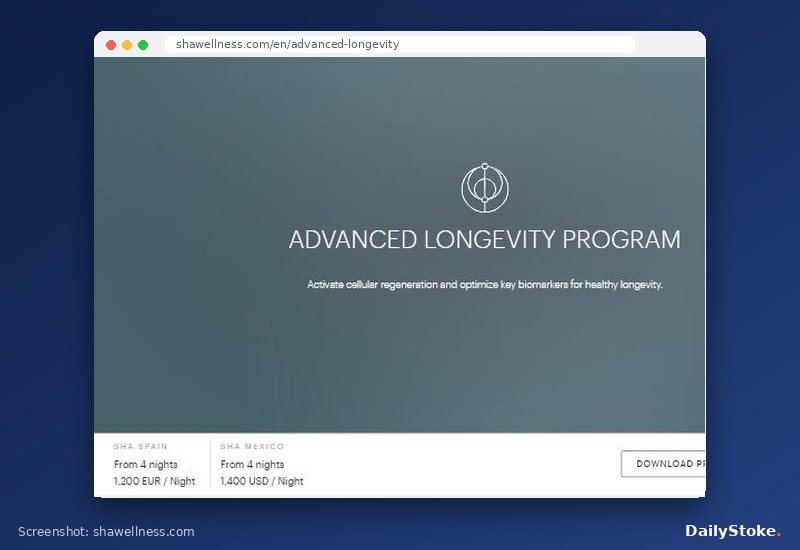
The Advanced Longevity page is direct about its premise: “While chronological age is fixed, biological age can be modified.” Its headline promises to “activate cellular regeneration and optimize key biomarkers.” No study is cited for either claim on the page.
What Advanced Longevity includes
SHA’s own program page is thin on detail. It lists “next-generation proactive diagnostics,” a full-board meal plan, more than ten daily activities, hydrotherapy and transfers, and a “personalized longevity roadmap” for after the stay. It does not itemize tests or sessions.
The itemized list comes from Healing Holidays, a UK specialist agent that sells the program. According to its October 2026 listing, the four-night version includes:
- Diagnostics: a health check and a preventive diagnostic circuit covering body composition, a 3D body scan, vital signs, cognitive function, cardiovascular and nervous-system activity, advanced glycation end products (AGEs) and facial and hair scanning, plus VO2 max and a 3D dental assessment. A “core health biomarker panel” and an “Oxytest” oxidative-stress test.
- Consultations: initial and post-stay longevity consultations, plus revitalizing, regenerative, sleep and cognitive assessments, and an anti-inflammatory nutrition consultation.
- Treatments: neurofeedback, an “energizing” IV, “targeted cellular health optimisation,” intermittent hypoxia therapy, cryotherapy, “advanced cellular regeneration” and two sessions of red light or hyperbaric oxygen.
Longer stays add more. Seven nights bring a “longevity panel,” an omega fatty acid test, a hormonal consultation, a branded supplement and one chelation session. Ten nights add an overnight sleep study, ozone therapy, platelet-rich plasma (PRP), vagus nerve stimulation and extra IV, hypoxia and cryotherapy sessions.
The diagnostics: useful, interesting or neither?
More testing is not automatically better. The useful question for each result is the one a good GP would ask: would it change what we do next?
VO2 max is the strongest item on the list. In a Cleveland Clinic cohort of 122,007 adults who had treadmill tests, higher cardiorespiratory fitness tracked with lower long-term mortality, with no upper limit to the benefit (Mandsager et al., JAMA Network Open, 2018). The study was observational and cannot prove cause, but a measured baseline gives you a number you can train against at home.
Body composition, vital signs and a standard biomarker panel are ordinary preventive medicine. Useful, if a doctor uses them to decide something.
AGEs, oxidative stress, facial and hair scans are research measures or cosmetic tools. We found no evidence that an “Oxytest” score in a healthy adult leads to a treatment that improves outcomes.
Biological age. SHA calls its assessment a foundation of the method but does not publish which test it uses, how it is validated or how much a repeat result varies. Our guide to longevity clinic tests and which biomarkers are useful explains why a lower score after a week of good food and sleep is not the same as years gained.
The optional Health Optimization Check-Up pack (from €1,650 with a program, €3,650 without, checked October 2026) adds cardiology with echocardiography, carotid Doppler, thyroid and abdominal ultrasound, testicular ultrasound, VO2 max and spirometry. Some of that is valuable for the right person. Some is the kind of screening independent panels advise against in people without symptoms: the US Preventive Services Task Force recommends against carotid ultrasound screening in the general adult population because false positives and follow-up procedures cause more harm than good (USPSTF, 2021), and against thyroid cancer screening in adults without symptoms because it leads to overdiagnosis (USPSTF, 2017).
That is the “what happens if a result is abnormal” problem in practice: find a small thyroid nodule on holiday and you have bought a biopsy conversation at home.
The treatments, rated against the evidence
We graded each treatment on its own, using six categories: established for a defined indication; promising but preliminary; plausible mechanism, uncertain benefit; subjective wellness benefit; insufficient evidence; and evidence of limited or no benefit.
| Treatment | In which stay | What the evidence supports | Our rating |
|---|---|---|---|
| Anti-inflammatory, mostly plant-based food; daily exercise | All | Higher cardiorespiratory fitness tracked with lower mortality in 122,007 adults (Mandsager et al., 2018); regular exercise and a good diet are the core of standard preventive advice | Established for a defined indication (as long-term habits, not a one-week cure) |
| Whole-body cryotherapy | All | Too few good trials even for post-exercise soreness (Costello et al., Cochrane, 2015) | Subjective wellness benefit; insufficient evidence for recovery |
| Red light or hyperbaric oxygen | All | Red light is established for one use, preventing oral mucositis in cancer care (Zadik et al., Supportive Care in Cancer, 2019). HBOT has accepted hospital uses such as decompression sickness; the main “anti-aging” study had no control group (Hachmo et al., Aging, 2020) | Plausible mechanism, uncertain benefit (for longevity) |
| Intermittent hypoxia therapy | All | A systematic review found eight small studies, mostly in older patients with heart, metabolic or cognitive conditions, with “first hints” of benefit (Behrendt et al., Sports Medicine Open, 2022) | Promising but preliminary (in those patients); insufficient evidence in healthy adults |
| “Energizing” IV therapy | All | Ingredients and doses not published; no trials in healthy adults | Insufficient evidence |
| Neurofeedback | All | Even in ADHD, no significant effect when raters were probably blinded (Cortese et al., 2016); no longevity data | Insufficient evidence |
| EDTA chelation | 7 nights+ | TACT2, a 1,000-patient placebo-controlled trial, found no reduction in heart events (Lamas et al., JAMA, 2024) | Evidence of limited or no benefit (for heart prevention) |
| Ozone therapy | 10 nights+ | US federal rules call ozone “a toxic gas with no known useful medical application” (21 CFR 801.415) | Insufficient evidence, with safety questions |
| Platelet-rich plasma | 10 nights+ | Studied mainly for specific joint and tendon problems; we found no studies of PRP for aging | Insufficient evidence (for aging) |
| Vagus nerve stimulation (non-invasive) | 10 nights+ | Under study for mood and inflammation; no longevity data | Plausible mechanism, uncertain benefit |
The chelation line deserves a sentence more. In TACT2, adults with diabetes and a previous heart attack received 40 weekly EDTA infusions or placebo and were followed for about four years. Blood lead fell by 61 percent in the chelation group. Heart attacks, strokes and deaths did not, according to the NIH summary of the trial. One session in a holiday week is even further from that evidence.
None of this means guests will not feel better. Most will, after a week of early dinners, swimming and walks, which is exactly why it is hard to credit any single machine.
Stem cells: the Mexico-only program
SHA’s most ambitious product is not available in Spain. Cellular Regeneration, launched at SHA Mexico in 2026, is a four-night stay built around donor-derived mesenchymal stem cells “derived from umbilical cord, placenta or dental pulp,” a 100-million-cell IV infusion, ultrasound-guided injections and nebulized and IV exosomes, followed by reassessments at three, six and twelve months. SHA says the therapies are “fully authorized by COFEPRIS,” Mexico’s health regulator, and that each lot is tested for sterility and potency. The page also says, fairly, that stem cells are “not a permanent cure.” It cites no outcome studies. No price is published.
For US readers the regulatory context is blunt. The FDA says the only stem-cell products approved in the US are blood-forming cells from umbilical cord blood, for blood disorders, and that “there are currently no FDA-approved exosome products” (FDA consumer alert). Authorization to operate in one country is not evidence that a treatment slows aging. We would treat this as an experimental medical procedure that belongs in a specialist conversation, not a holiday add-on.
What a week at SHA costs
Pricing is where SHA’s own pages disagree with each other, which is reason enough to get a written quote.
- The program page lists Advanced Longevity at €1,200 per guest per night in Spain, with the note “Accommodation is not included in this price.” Seven nights of program alone come to €8,400 per guest.
- The programs overview page says the “fixed nightly rate already includes accommodation in a Deluxe Suite,” full board and the program.
- SHA’s March 2026 press release said programs start “from $1,350 per room, per night,” including a deluxe suite, food, transfers and hydrotherapy.
- Healing Holidays, the UK agent, lists seven nights of Advanced Longevity from £9,389 per person sharing in low season (November and December 2026), or £11,569 single, including transfers, accommodation and full board.
Extras sit on top: specialized packs such as the Health Optimization Check-Up (from €1,650), treatments beyond the program and suite upgrades.
What we liked, and what we did not
The best of SHA is the least exotic: food with real evidence behind it, VO2 max and body composition as standard, a post-stay consultation, and shorter stays from 2026 that lower the cost of trying it. The worst is the mismatch between that and the sales pitch: contradictory prices across SHA’s own pages, a public program page that does not list its tests or its biological-age method, chelation and ozone sold inside a “longevity” package, and carotid and thyroid scans offered to people without symptoms.
SHA vs Lanserhof, Chenot and Clinique La Prairie
Compared with Chenot Palace Weggis, SHA is gentler on the stomach: no 850-calorie week unless you choose a detox program. Compared with Lanserhof Tegernsee, it is more of a resort and less of a German medical institution, with a broader menu of elective technology. Clinique La Prairie costs more and leans harder on medical consultations and its own proprietary extract. All four are compared in our guide to longevity retreats in Europe.
Who SHA suits, and who should think twice
SHA makes sense for someone who wants a structured, comfortable week of good food, exercise and sleep in a warm climate, plus a doctor to look over a sensible set of baseline tests. It makes less sense if the reason you are booking is the promise of a younger biological age.
People with chronic conditions, pregnant women, anyone with an eating-disorder history and anyone on diabetes or blood-pressure medication should speak to their own doctor before any detox or weight program, and tell SHA’s doctors about every medication. If you plan to try the stem-cell program in Mexico, ask for the product details and the clinic’s adverse-event record in writing, and check your travel insurance, which usually excludes elective treatments.
Whether the bill makes sense against ordinary preventive care is the subject of our analysis of whether longevity retreats are worth it.
SHA in 2027: Shorter Stays, Cell Therapy in Mexico and an Advisory Board
In 2027 SHA sells itself as a clinic first and a resort second. The program lineup launched in 2026 lets guests book any program from three nights, a shift away from the long stays that once defined the brand. The most experimental product, Cellular Regeneration, with donor-derived stem cells and exosomes, is offered only at SHA Mexico under Mexican regulatory authorization, while the Spanish site sticks to diagnostics, nutrition and elective technologies. An international Scientific Advisory Board, announced in April 2026, now advises on protocols across both sites, and the group has announced a third destination in the United Arab Emirates for early 2028.
SHA Wellness Clinic: your questions answered
How much does SHA Wellness Clinic cost?
SHA’s Advanced Longevity page lists €1,200 per guest per night in Spain for the program, with accommodation excluded, from four nights. A UK agent quotes seven nights from £9,389 per person sharing with accommodation and full board. Ask SHA for a written total that includes room, program and any packs.
Does SHA offer stem-cell treatment in Spain?
No. SHA’s Cellular Regeneration program, with mesenchymal stem cells and exosomes, is offered only at SHA Mexico. The FDA has not approved any exosome product, and the only approved stem-cell products in the US are for blood disorders.
Will SHA lower my biological age?
SHA claims biological age “can be modified,” but it does not publish its test or validation. A change in an aging score after a week of better food and sleep is not evidence of longer life.
Is SHA a strict fasting retreat?
Not by default. Advanced Longevity uses a tailored full-board meal plan. The Detox & Optimal Weight programs are more restrictive, and anyone with diabetes, an eating-disorder history or pregnancy should check with their own doctor first.