
Few words have done more for the luxury wellness business than autophagy. It sounds like science because it is science, and it gives a week of hunger a noble purpose: your cells are cleaning house.
The trouble is that “autophagy” has become a sort of password. Say it at check-in and the mud wrap, the hydro-jet and the near-infrared capsule all seem to belong to the same biological project.
The Chenot Method is unusual because its diet now has a randomized trial behind it. So we read that trial, plus two other human autophagy studies published since, and asked a narrower question than the brochure does: which parts of the Chenot Method are supported by human clinical research, and which are not?
What the week actually feels like is in our Chenot Palace Weggis review. This article is the lab notebook.
The Short Answer
- The diet has real, short-term human evidence. In a 2025 randomized trial of 46 healthy adults, seven days of an 850-calorie Chenot-style diet lowered weight, fasting glucose and IGF-1 compared with a normal diet.
- Autophagy markers moved, but that is a long way from “slower aging.” The measurements came from blood, not organs, and nobody followed participants after they started eating again.
- There is no fixed day when autophagy “starts.” Any timetable you see is a story, not a finding.
- Nobody has tested the full program. No trial compares the diet with and without the massages, baths and mud, so every measured effect belongs to the food.
- “Detox” in the sense of flushing unnamed toxins is not supported. Your liver and kidneys already do that job, free of charge.
What Is the Chenot Method?
The Chenot Method was developed by Henri Chenot and is sold by the Chenot Group at Chenot Palace Weggis in Switzerland, Chenot Palace Gabala in Azerbaijan and Chenot Espace centers in hotels including One&Only Portonovi in Montenegro and L’Albereta in Italy. It has three parts.
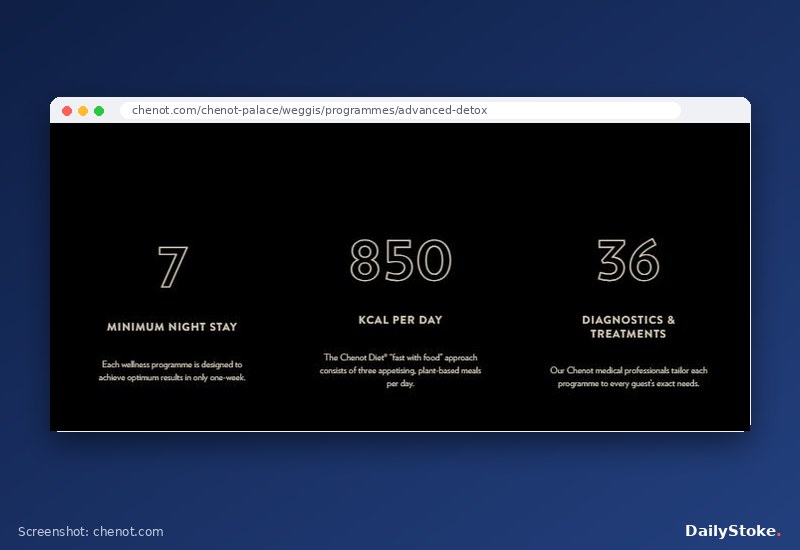
The Chenot Diet. A plant-based “fast with food” of three small meals a day at about 850 calories, with no snacks, alcohol, coffee or added sugar. Chenot says it triggers “the body’s fasting response.”
The treatments. The Advanced Detox program at Weggis lists six energetic massages, six hydro-aromatherapy baths, six phyto-mud treatments each followed by a hydro-jet, and a bio-energetic check-up. Other programs add near-infrared light, cryotherapy and “neuro-acoustic” relaxation.
The diagnostics. Medical and nutritional consultations, a body composition analysis and the Chenot Lifestyle Biomarkers: vascular age, minerals and heavy metals, advanced glycation end products and skin collagen thickness, rolled into a “vitality score” said to reflect the rate of biological aging.
Autophagy, Explained Without the Marketing
Autophagy (Greek for “self-eating”) is how cells wrap up damaged proteins and worn-out parts and send them to the lysosome, the cell’s recycling plant, to be broken down and reused. It runs all the time, in every tissue.
It is tightly regulated by nutrient sensors. When food and growth signals are plentiful, a protein complex called mTOR keeps autophagy turned down. When energy runs low, a sensor called AMPK and falling insulin and amino acid levels let it rise. Exercise and some drugs push in the same direction.
So “fasting increases autophagy” is not a fringe claim. In yeast, worms and mice, boosting autophagy can extend lifespan, and blocking it shortens it. The leap is from those models to a paying guest on Lake Lucerne.
Four distinctions matter.
Markers versus flux. Autophagy is a process, so a single snapshot can mislead. More of the protein LC3B-II in a cell could mean more autophagy is starting, or that the recycling plant is backed up. The field’s consensus guidelines (Klionsky and a large international group, Autophagy, 2021, doi.org/10.1080/15548627.2020.1797280) say the reliable approach is to measure flux: compare cells with and without a drug such as chloroquine that blocks the final step. A marker tells you something changed. Flux tells you the conveyor belt actually moved faster.
Which tissue. Researchers can easily sample blood. They cannot easily sample your liver, brain or heart, which is where longevity claims are aimed.
During versus after. Changes measured on day seven of a fast tell you about day seven.
Molecules versus outcomes. Even a solid increase in flux is a mechanism. It is not evidence of fewer heart attacks, less dementia or a longer life.
Chenot’s own blog says that on days four to five “cellular repair intensifies, including autophagy.” No human study we found pins autophagy to a particular day of a fasting-mimicking diet, and none measured it in the tissues that matter for aging. Autophagy rises gradually with the depth and length of the energy shortfall, and the curve almost certainly differs between people.
Calorie Restriction, Protein Restriction and Fasting Are Not the Same Thing
These terms get blended in retreat marketing, and the difference matters for reading the Chenot trial.
- Calorie restriction means eating less energy overall, often for months or years. It is the intervention with the deepest animal literature on lifespan.
- Protein restriction means cutting protein specifically, on the theory that amino acids keep growth signals such as IGF-1 and mTOR switched on.
- Fasting means stretches with little or no food: a day, a few days or a daily eating window.
- A fasting-mimicking diet sits in between: a few days of very low calories, low protein and mostly plant foods, designed to produce some of the biology of a fast while still serving meals. The idea was developed by Valter Longo’s group in California and sold commercially as ProLon.
The Chenot Diet is a fasting-mimicking diet. The interesting question is whether its benefits come from the calories, the protein or both. One trial has now tested that.
The Chenot Diet Trial: What Clinical Nutrition Found in 2025
The key study is a University of Nottingham trial published in Clinical Nutrition in 2025 (Sarmad, Di Mauro, Cooper, Tsintzas, Burns, Funke and Gaitanos, volume 52, pages 299 to 312; doi.org/10.1016/j.clnu.2025.08.004), registered as NCT06560996. Chenot has promoted it on its own site, describing the low-protein arm as the Chenot Diet.
Design. 46 healthy adults, mostly in their thirties and early forties with normal to slightly raised BMI, were randomized to one of three seven-day diets:
- a low-protein fasting-mimicking diet (LP-FMD): 850 kcal a day, 10% protein, plant-based whole foods;
- a high-protein version (HP-FMD): 850 kcal a day, 30% protein, less fat;
- a control diet with enough calories to maintain weight.
Results versus control. Both 850-calorie diets cut body weight (about 2.4 kg on low protein and 2.7 kg on high protein) and fat mass measured by DEXA. Both lowered fasting glucose by roughly 10% and IGF-1, a growth hormone linked in animal studies to aging, by roughly 35%. Ketones rose more on the low-protein version. Only the high-protein diet reduced visceral fat, lowered diastolic blood pressure, improved heart rate variability, triglycerides and saturated fatty acids, and increased gut microbiome diversity. Both diets “induced autophagy at the molecular level.”
What it does not show. Seven days, healthy people, no reported follow-up after normal eating resumed, and autophagy assessed with molecular markers in blood rather than tissue flux. A linked University of Nottingham master’s thesis on the same diets concluded that the high-protein version “did not appear to inhibit the induction of autophagy.”
Diet only. Participants ate the diet. They did not get the Chenot treatments, the lake or the hotel. This is a trial of food, not of a stay at Chenot Palace.
Conflicts of interest. The trial was sponsored by the University of Nottingham, but its authors include George Gaitanos, Chenot Group’s chief operating and scientific officer. That does not invalidate the results. It does mean an independent replication would carry more weight.
The surprise. If protein restriction were the magic ingredient, the low-protein arm should have won. Instead the higher-protein diet did at least as well on most measures and better on several. That points to the calorie deficit doing much of the work, and it complicates the idea that only one proprietary formula delivers the benefits.
Two Newer Studies on Measuring Autophagy in Humans
Time-restricted eating and autophagic flux (Journal of Physiology, 2025)
Bensalem, Heilbronn, Sargeant and colleagues at the University of Adelaide and the South Australian Health and Medical Research Institute published an exploratory analysis in The Journal of Physiology in 2025 (volume 603, pages 3019 to 3032; doi.org/10.1113/JP287938). They took blood from 121 adults with obesity in a six-month trial comparing intermittent fasting with time-restricted eating, calorie restriction and standard care, and measured LC3B-II flux in white blood cells.
At two months there was no difference between groups. At six months the fasting group differed from standard care (P = 0.04), but the authors note this was a post hoc analysis and partly reflected autophagy falling in the standard-care group. Calorie restriction did not differ from standard care. Their own title is careful: intermittent time-restricted eating “may increase” autophagic flux.
Fasting-mimicking diet and autophagy (GeroScience, 2026)
Espinoza, Musi and colleagues at the University of Texas Health Science Center at San Antonio published a pilot randomized trial in GeroScience (2026, volume 48, pages 7083 to 7093; doi.org/10.1007/s11357-025-02035-4). Thirty healthy adults with an average age of 49 were assigned to one of two commercial fasting-mimicking diets (ProLon or a second formulation) or to their usual diet, and autophagic flux was measured in white blood cells treated with chloroquine in the lab.
By the end of the six-day diet, the groups differed in changes in weight, fasting glucose, ketones, insulin resistance and autophagic flux. The differences were not significant at every time point, including two days after the diet ended. The trial was sponsored by L-Nutra, the company that sells ProLon.
This is the closest anyone has come to measuring true flux during a fasting-mimicking diet in people. It is also 30 people, in blood cells, for about a week.
Fasting-Mimicking Diet Studies Compared
| Study | Design | Participants | Intervention | Comparator | Main endpoints | Results | Limitations | Conflicts of interest |
|---|---|---|---|---|---|---|---|---|
| Sarmad et al., Clinical Nutrition 2025 | Randomized, parallel, 3 arms, 7 days | 46 healthy adults | 850 kcal plant-based FMD, 10% or 30% protein | Weight-maintaining diet | Fasting glucose (primary); DEXA, IGF-1, BP, HRV, lipids, microbiome, autophagy markers | Weight −2.4 to −2.7 kg; glucose about −10%; IGF-1 about −35%; extra benefits on high protein | One week; healthy people; no reported post-diet follow-up; blood markers, not tissue flux; diet only | Co-author is Chenot Group’s chief operating and scientific officer |
| Bensalem et al., J Physiol 2025 | Exploratory, post hoc analysis of 6-month RCT | 121 adults with obesity | Intermittent fasting plus time-restricted eating | Calorie restriction; standard care | LC3B-II autophagic flux in blood cells | No difference at 2 months; fasting vs standard care P = 0.04 at 6 months | Post hoc; partly driven by decline in control group; blood cells only | Not stated in the sources we could access |
| Espinoza et al., GeroScience 2026 | Pilot randomized trial, about 8 days | 30 healthy adults, mean age 49 | Two commercial FMDs for six days | Usual diet | Autophagic flux (LC3B, blood cells with chloroquine); glucose, insulin, IGF-1, ketones | Between-group differences at end of diet; not at all time points | Small; healthy people; ex vivo blood cells; short | Sponsored by L-Nutra, maker of ProLon |
| Wei et al., Sci Transl Med 2017 (doi.org/10.1126/scitranslmed.aai8700) | Randomized, then control group crossed over | About 100 enrolled, generally healthy, aged 20 to 70 | Three monthly 5-day cycles at about 750 to 1,100 kcal | Usual diet | Weight, BP, IGF-1, glucose, cholesterol, CRP | Weight down about 6 lb; systolic BP −4.5 mmHg; some effects persisted 3 months later | Not all enrolled participants completed; diet cannot be blinded; risk markers, not disease | Meals supplied by L-Nutra |
What the four studies share: they are short, mostly involve healthy volunteers, measure risk markers rather than illness, and none tested massages, baths or mud. What they suggest: a few days of very low, mostly plant-based calories reliably shifts metabolism, and some of that shift resembles what animal studies link to slower aging.
Do the Effects Last?
This is the gap that matters most, and the evidence is thin.
The Chenot-linked trial reported no follow-up after refeeding. In the GeroScience pilot, differences had faded two days after the diet. The longest data come from Wei and colleagues, where three monthly cycles were needed, and some changes in weight, blood pressure and IGF-1 were still visible three months later. That is a repeated protocol, not a single week once a year.
On weight specifically, the 2025 trial recorded real fat loss by DEXA. But a week cannot remove much fat in absolute terms, and the US National Center for Complementary and Integrative Health notes that weight lost on short detox and juice diets tends to return once normal eating resumes. A smaller number on the scale is not a longer life.
The Chenot Treatments: What the Evidence Says
The diet has a trial. The rest of the timetable mostly does not. We classify each component on the six-point scale used across this series.
| Component | What it involves | Claim | Our evidence classification |
|---|---|---|---|
| Chenot Diet (850 kcal, 7 days) | Plant-based meals | Short-term metabolic changes | Promising but preliminary |
| “Activates autophagy” | Same diet | Cellular renewal, slower aging | Plausible mechanism, uncertain benefit |
| Hydro-aromatherapy | Warm bath with essential oils, seaweed wrap, hose-down | Detoxification, circulation | Subjective wellness benefit |
| Phyto-mud and hydro-jet | Mud wrap followed by high-pressure water | Toxin removal | Insufficient evidence |
| Energetic massage | Deep pressure-point massage with cupping | Rebalancing energy | Subjective wellness benefit |
| Bio-energetic check-up | “Resonance” screening of vital functions | Assessing energy balance | Insufficient evidence |
| Whole-body cryotherapy | Chambers down to −110°C for a few minutes | Recovery | Insufficient evidence |
| Near-infrared light capsule | About 20 minutes of light | Cell repair | Insufficient evidence |
| Neuro-acoustic relaxation | Headphones with brainwave-style sounds | Relaxation, sleep | Subjective wellness benefit |
| “Detox” diets as toxin removal | The concept behind the program name | Eliminating toxins | Evidence of limited or no benefit |
A few notes. A Cochrane review of whole-body cryotherapy by Costello and colleagues in 2015 (doi.org/10.1002/14651858.CD010789.pub2) found only four small trials and called the evidence for muscle soreness insufficient. More in does cold exposure really improve recovery?
On detox, the NCCIH found “no compelling research” supporting detox diets for weight management, says existing studies are often low quality, and notes there have been no studies of the long-term effects of detoxification programs. A warm bath and a strong massage on a hungry day can feel wonderful. That is a fine reason to enjoy them. It is not detoxification.
Chenot Lifestyle Biomarkers: Useful Data or Fasting Snapshots?
Chenot’s biomarker suite runs to 14 assessments in its fullest form, from arterial stiffness and VO2 max to “bio-resonance” and mRNA gene-expression panels. Some, such as blood pressure, pulse wave velocity, body composition and VO2 max, are standard measures with clear meaning. Others, like heavy-metal “bioavailability” readings, thermal imaging and resonance analysis, are not validated tools for screening healthy people. The company’s page cites no validation studies, and we found none for the “vitality score.”
There is also a timing problem. A week of very low calories changes glucose, insulin, ketones, lipids and body water. Measurements taken during the program describe a body on a fast, not your everyday baseline. Chenot now sells a separate testing-led program, Body Insights & Optimisation, which it calls its first non-detox program, with balanced vegan meals. If testing is your main goal, that is the more logical choice. For which tests are worth paying for anywhere, see Longevity Clinic Tests: Which Biomarkers Are Actually Useful?
How Does This Compare With Ordinary Lifestyle Changes?
A week of fasting-mimicking food produces fast, visible changes. Ordinary habits produce slow, boring ones with far better evidence behind them.
Fitness is the clearest example. A meta-analysis of 33 studies linked each one-MET gain in cardiorespiratory fitness to about a 13 percent lower risk of death from any cause (Kodama et al., JAMA, 2009). That is observational data, but it involves outcomes, not markers, and it accumulates over years.
Diet quality is another. In the DIETFITS randomized trial of 609 adults, both a healthy low-fat and a healthy low-carb diet produced weight loss over 12 months (Gardner et al., JAMA, 2018). No retreat, no cryotherapy chamber, a year of follow-up.
None of this makes a Chenot week pointless. It does put it in its place: a short, supervised metabolic intervention that may be a useful kick-start, not a substitute for the habits that have actual outcome data.
Our Verdict on the Chenot Method’s Claims
Supported by human evidence (short term): an 850-calorie, plant-based week lowers weight, fat mass, fasting glucose and IGF-1 in healthy adults. Higher protein seems to work at least as well.
Plausible but unproven: that these changes, or the autophagy markers behind them, translate into slower aging, lower disease risk or a longer life. That a single annual week leaves any lasting trace.
Primarily wellness marketing: “detox” as toxin removal, bio-energetic resonance checks, a proprietary vitality score without published validation, and any fixed day on which autophagy “switches on.” The massages and baths are pleasant. They are not part of the evidence.
Who Should Not Do a Fasting-Mimicking Diet
Chenot’s doctors take a medical history at intake, and you should still talk to your own doctor before booking. The risk statement for ProLon, the best-known commercial fasting-mimicking diet, says not to fast if you have an eating disorder, an active infection, are underweight, pregnant or breastfeeding, or are under 18 or over 70, and that anyone with a medical condition or on prescription medication should consult a professional first. People with diabetes on glucose-lowering drugs face a real risk of low blood sugar when calories fall sharply, and the NCCIH warns that fasting can cause headaches, fainting, weakness and dehydration.
Headaches, hunger-driven irritability and broken sleep are commonly reported and usually pass. Dizziness, fainting or palpitations are reasons to stop and tell the medical team.
This article explains research. It is not a protocol to copy at home.
Fasting Retreats in 2027: What the New Trials Changed
The evidence base for retreat-style fasting is thicker this year than it has ever been, and more nuanced. Chenot’s diet now has a peer-reviewed randomized trial in Clinical Nutrition, and GeroScience published a separate fasting-mimicking diet pilot in its October 2026 issue, both measuring autophagy in blood cells. The finding that a higher-protein version worked at least as well has weakened the old idea that protein restriction is the single magic ingredient. Retreats have followed the research toward flexibility: Chenot now sells a diagnostics program without its detox diet, and Austria’s MAYRLIFE offers a GLP-1 & Lifestyle Integration program for guests already on weight-loss injections. What is still missing in 2027 is a trial of any complete retreat program with long-term health outcomes.
Chenot Method and Autophagy: Common Questions
Does the Chenot Diet trigger autophagy?
A 2025 randomized trial found that 850-calorie Chenot-style diets “induced autophagy at the molecular level” in healthy adults over seven days. It was measured in blood samples, not organs, and nobody has shown how long it lasts or whether it changes health outcomes.
On which day of a fast does autophagy start?
There is no established day. Autophagy runs constantly and rises gradually as energy runs short. Claims that it begins on day three or four are not based on human tissue measurements.
How many calories is the Chenot Diet?
About 850 kcal a day across three plant-based meals, according to Chenot’s Advanced Detox program page.
Is the Chenot Method the same as ProLon?
No. Both are fasting-mimicking diets, but ProLon is a packaged five-day product from L-Nutra, while the Chenot Diet is fresh food served at a retreat alongside treatments. The 2025 Chenot-linked trial also tested a higher-protein version that performed at least as well.
How much weight do you lose on the Chenot Diet?
In the 2025 trial, participants lost about 2.4 to 2.7 kg more than the control group in seven days, including measurable fat. Part of early weight loss is water and glycogen, and some typically returns.
Do the Chenot treatments detox the body?
There is no published evidence that hydrotherapy, mud or massage remove toxins. They may help you relax during a demanding week, which has value of its own.
Is it worth doing the Chenot Method for longevity?
No study shows the Chenot Method extends life. It offers a well-supervised, short metabolic intervention in a beautiful setting. Whether that justifies the price depends on what you do with the week afterward. Our wider analysis is in Are Luxury Longevity Retreats Worth It?
More on DailyStoke
Longevity retreats in Europe compared · Chenot Palace Weggis review · Chenot Espace Portonovi review · Clinique La Prairie Revitalisation: What Is CLP Extract? · Stelo vs Lingo glucose sensors · The health metrics worth tracking