The short answer: Dexcom’s Stelo and Abbott’s Lingo are well-made, regulator-cleared sensors that will show you, accurately, how your glucose moves after meals, exercise and sleep. For people with prediabetes or type 2 diabetes not using insulin, that feedback can be motivating. For healthy adults, the evidence that watching glucose curves improves health is thin, and the UK choice is simple for now: only Lingo is sold here, although Dexcom plans to bring Stelo to Britain.
If you have diabetes, these are not the devices for you. Follow your diabetes team’s advice; NHS-prescribed sensors have alarms and clinical support that these consumer products deliberately lack.
Stelo and Lingo at a glance
| Dexcom Stelo | Abbott Lingo | |
|---|---|---|
| Maker | Dexcom (San Diego, US) | Abbott (Illinois, US), based on its FreeStyle Libre sensor technology |
| US status | FDA cleared March 2024 as the first over-the-counter CGM | FDA cleared for over-the-counter use in June 2024 |
| UK availability | Not yet; Dexcom plans a UK launch between late 2026 and 2027 | Sold in the UK since January 2024 |
| Intended users | People aged 2 and over not using insulin, including adults with type 2 diabetes or prediabetes (adults only until June 2026) | Adults 18+ not using insulin, aimed at general wellness |
| Sensor wear | Up to 15 days | Up to 14 days |
| Low glucose alarms | No | No |
| Price | $99 for a month (two sensors), or $89 a month on subscription | UK from £59 for two weeks; US from $54 |
What these sensors do
Both are continuous glucose monitors (CGMs): a coin-sized sensor sits on the back of your upper arm, with a thin filament just under the skin measuring glucose in the fluid between your cells. Readings stream to a phone app, so you can see how a bowl of porridge, a late dinner or a run changes your levels.
They borrow the sensor technology used by millions of people with diabetes, but with deliberate differences. Neither is designed to alert you to dangerously low glucose, and neither is intended for decisions about insulin. That is why both are labelled for people not using insulin.
Dexcom Stelo: built for prediabetes and type 2
Stelo was the first CGM the US Food and Drug Administration cleared for sale without a prescription, in March 2024. Dexcom aims it at adults with type 2 diabetes who do not use insulin, people with prediabetes, and health-conscious adults. The FDA’s clearance specifically excludes people with problematic hypoglycaemia (low blood sugar), because Stelo has no low alarms. In June 2026 Dexcom said the FDA had extended Stelo’s clearance to children aged 2 and over who do not use insulin.
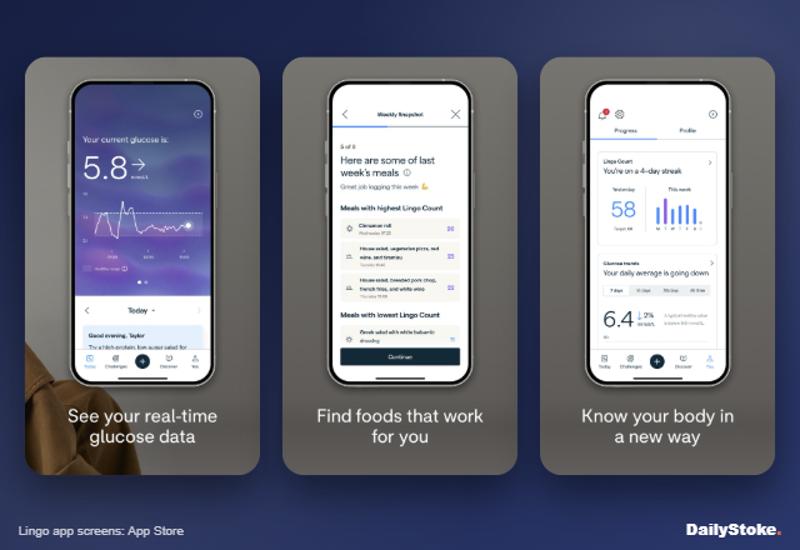
The app shows glucose trends, the effect of meals and activity, and daily summaries. In the US, Stelo also feeds Oura’s Glucose feature, launched in May 2025, which sets your glucose curve alongside the ring’s sleep, activity and stress data and its photo-based Meals log. Oura sells Stelo through its US website.
Stelo is sold in the US only for now. In June 2026 Dexcom announced plans to launch it in the UK, Australia, New Zealand and South Korea, starting later in 2026 and continuing into 2027. Until then, Dexcom’s UK sensors (such as the Dexcom G7 and Dexcom ONE+) are aimed at people with diabetes and often supplied through the NHS.
Abbott Lingo: a wellness product first
Abbott launched Lingo in the UK first, in January 2024, months before the FDA cleared it for US over-the-counter sale in June 2024. Its pitch is general wellness: understanding how food, sleep and stress affect your glucose, with coaching to reduce spikes. The app’s Lingo Graph colours spikes purple and steadier periods blue, and a Lingo Count sets a daily target for significant spikes.
Lingo is for adults aged 18 and over who do not use insulin, and is not intended to diagnose disease, including diabetes. Abbott’s UK launch material also advises against using it in pregnancy.
Price: how much does each cost?
Both are sold as one-off packs or subscriptions, with each sensor lasting about two weeks. Continuous use adds up quickly; most people use a sensor or two to learn their patterns and then stop. These are the prices on each brand’s own store in late October 2026.
- Dexcom Stelo (US): $99 one-off for a month’s supply (two sensors), $89 a month on a monthly subscription, or $252 every three months (six sensors).
- Abbott Lingo (UK): £59 for two weeks (one sensor), £99 for four weeks (two sensors), or £289 for a 12-week subscription (six sensors, sent monthly).
- Abbott Lingo (US): $54 for two weeks, $89 for four weeks, or $249 for a 12-week subscription.
In the US, both Stelo and Lingo are listed as eligible for HSA and FSA spending on their official stores.
What the evidence says about glucose monitoring without diabetes
Here is where we would urge caution.
Healthy glucose is remarkably stable. A multicentre study of 153 healthy participants aged 7 to 80 wearing CGMs (Shah et al., Journal of Clinical Endocrinology and Metabolism, 2019) found they spent a median 96 per cent of the day between 70 and 140 mg/dL (3.9 to 7.8 mmol/L), with average glucose of about 98 to 99 mg/dL in most age groups (JCEM, 2019). Brief rises after meals are normal.
People respond differently to the same food. A landmark Israeli study of 800 people (Zeevi et al., Cell, 2015) found large individual differences in glucose responses to identical meals (Cell, 2015). A Stanford study (Hall et al., PLOS Biology, 2018) identified “glucotypes”, found that some people considered normal by standard tests still spent time in the prediabetic range, and reported marked spikes in most participants after common foods such as cornflakes with milk (PLOS Biology, 2018).
But we do not know that flattening spikes helps healthy people. There are no large trials showing that people without diabetes who use CGMs to reduce spikes live longer or avoid disease. Two different CGMs worn at the same time can also disagree. In a small US National Institutes of Health study of 16 adults without diabetes (Howard, Guo and Hall, American Journal of Clinical Nutrition, 2020), a Dexcom and an Abbott sensor agreed only moderately on which meals caused the biggest rises (AJCN, 2020). A larger analysis from the ZOE PREDICT study (Merino et al., AJCN, 2022) found stronger agreement between devices (AJCN, 2022), but the lesson stands: do not put too much weight on any single curve.
There is a better established test. If you are worried about diabetes, an HbA1c blood test from your GP reflects average glucose over about three months. In the UK, an HbA1c of 42 to 47 mmol/mol indicates prediabetes (non-diabetic hyperglycaemia), and 48 mmol/mol or above suggests type 2 diabetes. The NHS Diabetes Prevention Programme supports people in the prediabetic range in England.
Who these sensors are for, and who should avoid them
Potentially useful for:
- Adults with prediabetes who want direct feedback on how meals and walks affect their glucose.
- Adults with type 2 diabetes not using insulin, ideally with their GP or diabetes nurse aware, who find real-time feedback motivating.
- Curious, healthy adults who want a few weeks of data, understand the limits and will not obsess over every rise.
Not for:
- Anyone with type 1 diabetes or using insulin. Use the CGM your diabetes team prescribes. NICE recommends real-time or intermittently scanned CGM for people with type 1 diabetes, and the NHS supplies them.
- People prone to low blood sugar. Neither device has low glucose alarms.
- Pregnant women with or at risk of gestational diabetes, who need clinical monitoring.
- People with a history of disordered eating, for whom constant food feedback can be harmful.
If you have symptoms of diabetes, such as being very thirsty, passing urine more often, unexplained weight loss, tiredness or blurred vision, see your GP rather than buying a sensor.
Stelo vs Lingo: which should you choose?
In the UK the choice is made for you, at least until Stelo arrives: Lingo is on sale and Stelo is not yet.
In the US, choose Stelo if you have prediabetes or type 2 diabetes without insulin, want a clinical-grade sensor from a diabetes specialist with a slightly longer 15-day wear, and like the idea of sharing data with your doctor or the Oura app. Choose Lingo if you are healthy and curious, and prefer a coaching-led app focused on habits rather than diabetes management.
Either way, we would suggest one or two sensors to learn your patterns, not a permanent subscription.
Stelo vs Lingo FAQs
Can I buy the Dexcom Stelo in the UK?
Not yet. Stelo is sold in the US, and Dexcom plans to launch it in the UK between late 2026 and 2027. For now, the over-the-counter option in the UK is Abbott’s Lingo.
Is Lingo accurate?
Lingo uses Abbott’s FreeStyle Libre sensor technology, which is widely used in diabetes care. Accuracy is good for trends, though readings lag blood glucose by several minutes because the sensor measures the fluid between cells.
Can people with diabetes use Lingo or Stelo?
Not if they use insulin. Stelo is cleared for people who do not use insulin, including adults with type 2 diabetes. Lingo is a wellness product. Anyone with diabetes should talk to their GP or diabetes team first.
Do glucose spikes matter if I don’t have diabetes?
Rises after meals are normal and usually short. There is no strong evidence that reducing them improves health in people without diabetes. Overall diet, activity, weight and sleep matter more.
How long does each sensor last?
Stelo sensors last up to 15 days and Lingo sensors up to 14 days.
Is a CGM better than an HbA1c test?
They answer different questions. HbA1c shows your average over about three months and is how diabetes is diagnosed. A CGM shows minute-to-minute patterns. For screening, ask your GP for an HbA1c.