A good travel magazine makes you want to go somewhere, then tells you which door to knock on when you arrive. The glossies excel at the first job; smaller independents are often better at the second. This list mixes both, from Condé Nast Traveller and Monocle to Softer Volumes and the free, contributor-led Locals Insider.
It is for readers who book boutique hotels rather than chains and want café tips from someone who drinks there. We ranked ten titles on the quality of their recommendations, how local their voices are and what they cost in the UK.
The best travel magazines at a glance
| Rank | Magazine | Price (UK) | Best for | Standout fact |
|---|---|---|---|---|
| 1 | Condé Nast Traveller (UK) | Digital £28.49 a year; cover price £5.99 | Luxury hotels and long reads | Website free to read |
| 2 | Monocle | £10 an issue | Cities, design and global affairs | 10 issues a year plus special editions |
| 3 | National Geographic Traveller (UK) | Cover price £5.12 | Experiential trips and photography | 10 issues a year |
| 4 | Wallpaper* | Free online; Travel Guides £15 | Design hotels and architecture | Pocket guides revived in 2026 |
| 5 | Softer Volumes | Books €75 at stockists | Design-led cafés, bars and hotels | No paid editorial |
| 6 | Travel + Leisure | Free to read online | Hotel news and award lists | One of the biggest US travel brands |
| 7 | Cereal | Per volume | Calm, minimalist city travel | Biannual, from Bath |
| 8 | Locals Insider | Free to read online | City places chosen by locals | English, Danish, Polish and Russian |
| 9 | AFAR | Free to read online | Thoughtful, culture-first travel | US title with a strong website |
| 10 | Kinfolk | Digital $40 a year; Premium $80 | Slow living with a travel thread | Archive back to Issue 14 |
How we chose these travel magazines
We checked every title was still publishing in October 2026, which ruled out Suitcase, liquidated in 2023. For each we read recent issues and the website, checked what is free and what is paywalled, and took prices from the publisher’s store or App Store listing, or from UK stockists and subscription agents where the publisher shows none.
We judged whether recommendations hold up, whether writers have real local knowledge and whether print is worth its price. We did not test every subscription for a full year. Locals Insider is published by the same team as DailyStoke, and Softer Volumes founder Joe Vuong has contributed to it; we have judged both on the same terms as the rest.
Our ranked travel magazine picks
1. Condé Nast Traveller (UK)
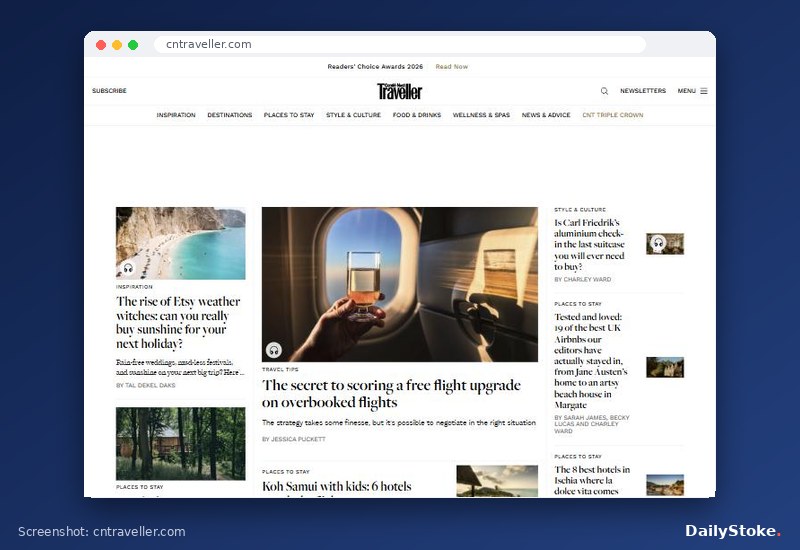
The British edition of Condé Nast Traveller remains the benchmark for luxury travel journalism. Hotels are the reason most people buy it: openings, the Gold List and Readers’ Travel Awards, by writers sent to stay rather than skim a press release. It also covers restaurants, rail and boat journeys, short breaks and budget ideas.
The website, cntraveller.com, is free to read, so you can try it properly before paying. The official app, sold by The Condé Nast Publications Limited, offers the digital edition at £3.99 a month or £28.49 a year (rated 4.4 from 261 UK App Store ratings). Print runs to eight issues a year at a cover price of £5.99.
Price: digital edition £28.49 a year or £3.99 a month (App Store); print cover price £5.99, 8 issues a year
Pros
- The strongest luxury hotel coverage in British publishing
- Generous free website
Cons
- Many featured hotels are firmly top-end
- Print subscriptions are sold through several agents, so prices vary
2. Monocle
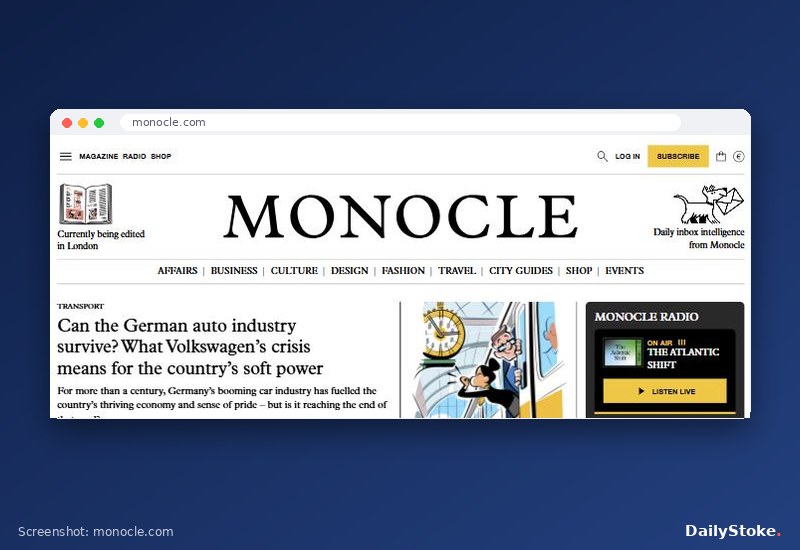
Monocle is not strictly a travel magazine, which is why it is so useful to travellers. Edited from London by Andrew Tuck, it covers cities, design, business and global affairs, and treats how a place works as seriously as where to eat in it. Travel, restaurants, the Monocle Concierge and city guides sit inside that picture.
It publishes ten issues a year, and subscribers on the Print & Digital and Premium tiers also receive special editions; in 2026 those included Med, Mountains & More and The Escapist. Subscribers can read new issues as a searchable, flippable PDF on monocle.com, but there is no app and issues cannot be downloaded, so you need a connection.
Single issues cost £10 at UK stockists and $20 on Monocle’s own shop.
Price: £10 an issue at UK stockists; subscriptions are priced on Monocle’s own shop
Pros
- Exceptional on cities, urbanism and design
- Special editions are included for subscribers
Cons
- No app and no offline reading
- Expensive per issue
3. National Geographic Traveller (UK)
Published under licence by APL Media in London, the UK edition of National Geographic Traveller is the most dependable all-rounder on this list. It is less about thread counts than what you do on arrival: walks, food, wildlife, city breaks and long weekends, plus an “ask the experts” strand. The photography is consistently excellent.
It is published ten times a year, with a UK cover price of £5.12. UK subscription agents were offering ten issues for £35 by Direct Debit or £40 by card in October 2026, and the official app, sold by APL Media, sells digital issues and subscriptions and rates 4.5 from 35 reviews on the UK App Store. The website lives at nationalgeographic.co.uk/travel.
Price: cover price £5.12; 10 issues a year from £35 through UK subscription agents
Pros
- Strong on experiences, food and the outdoors
- Good value per issue
Cons
- Less useful for luxury hotel hunting
- The app is basic next to the print edition
Visit National Geographic Traveller
4. Wallpaper*
Wallpaper*, owned by Future plc, is the design world’s magazine of record, and its travel coverage is the place to look for new hotels where the architect matters as much as the room service. The website, wallpaper.com, is free to read and updated daily across architecture, interiors, design and travel.
The big news for travellers is the return of the pocket guides. The original Wallpaper City Guides ran to 80 titles from 2006. In April 2026 Future relaunched them as Wallpaper Travel Guides, starting with London, Milan, New York and Paris, each curated by a Wallpaper writer living in that city. They cost £15 each from the Wallpaper store, or €20 in Europe.
The catch: if a place is not beautifully designed, Wallpaper* is unlikely to mention it.
Price: free to read online; Travel Guides £15 each
Pros
- Unrivalled on design hotels and architecture
- The new pocket guides are written by city-based writers
Cons
- Only four Travel Guide cities so far
- Little for travellers who care more about food than form
5. Softer Volumes
Softer Volumes is a Sydney-based design and travel publisher founded by Joe Vuong, and it does one thing with real discipline: it finds cafés, bars and hotels that are worth the trip for their design alone. It publishes linen-bound books, including Cafes Vol. 01 and 02, Bars Vol. 01 and Hotels Vol. 01, in print or as PDFs, plus a growing series of PDF city guides including Tokyo, Copenhagen, Madrid, Bangkok, Seoul, Berlin and Bali.
Hotels Vol. 01 runs to 240 pages and features 80 hotels in 29 countries. Softer Volumes says it does not accept paid editorial collaborations, and that independence shows in the selection. Architects and designers buy the books as reference as much as travellers do.
It is a curated shelf rather than a magazine you read every month, and the books are an investment. Read our full Softer Volumes review.
Price: books €75 each at stockists such as 1605 Collective; PDF city guides sold separately on the Softer Volumes shop
Pros
- Rigorous, independent curation with no paid placements
- Beautiful, long-lasting books
Cons
- Design first, so little on practicalities
- Not a regular periodical
6. Travel + Leisure
Travel + Leisure is one of the biggest names in American travel publishing, now part of People Inc. Its website, travelandleisure.com, is free to read and is a reliable source of hotel and airline news, destination guides and its annual World’s Best Awards, voted for by readers.
For a UK reader it is more website than magazine: the print edition targets US readers, and the deals coverage assumes an American wallet. The hotel coverage travels well, though, and the awards make a useful shortlist.
Price: free to read online; the print edition is a US magazine
Pros
- Huge, free archive of hotel and destination coverage
- Reader-voted awards are a good starting shortlist
Cons
- US-centric deals and advice
- Less distinctive writing than the British titles
7. Cereal
Cereal was founded in Bath in 2012 by Rosa Park and Rich Stapleton, and it remains the quietest, most deliberate travel magazine you can buy. It publishes twice a year, in a pared-back style of neutral photography and calm, reflective writing about places and the people who make things in them. Its 2025 volume took readers to Rajasthan.
Cereal’s city guides, launched in 2016 with London, Paris, New York, Los Angeles and Copenhagen, are the practical side of the brand, and the London, Paris and New York guides were reissued in book form by Abrams. Digital guides are sold on the Cereal website.
For hotel news, look elsewhere. For a magazine that slows you down before a trip, Cereal is hard to beat.
Price: sold per volume through Cereal’s shop and independent stockists
Pros
- Beautiful, unhurried print object
- City guides are short and well chosen
Cons
- Only two issues a year
- Light on practical detail
8. Locals Insider
Locals Insider is a free travel editorial site built on a simple idea: ask people who live somewhere where they actually go. Its contributors are artists, founders, chefs and designers, among them Marie Laurberg of Copenhagen Contemporary, Britt Kanja on Berlin nightlife and ballet dancer Vyacheslav Gnedchik on Budapest, and each piece pairs an interview with that person’s own places, published under their name. It runs in English, Danish, Polish and Russian, and selected stories, including Budapest and Berlin, come as free downloadable PDF city guides.
The best pieces have a voice no glossy can match, but coverage is uneven and the commercial pages, including eSIM, insurance and gambling guides with promo codes, sit alongside the editorial. Read our full Locals Insider review.
Price: free to read online
Pros
- Genuinely local voices, named and linked
- Free PDF guides for selected cities
Cons
- Coverage varies from city to city
- Commercial content mixed in with editorial
9. AFAR
AFAR, founded in San Francisco, built its name on “experiential” travel: trips shaped by people, culture and food rather than sights. Its website, afar.com, is free to read and has some of the most thoughtful long-form travel writing on the American side of the Atlantic, along with destination guides and a well-regarded podcast strand.
The print edition is aimed at US readers, so for UK readers it works best as a free website to dip into for a considered take on a place rather than a list of openings.
Price: free to read online; the print edition is a US magazine
Pros
- Thoughtful, culture-led writing
- Free website with deep archive
Cons
- US-focused practical advice
- Print is hard to get in the UK
10. Kinfolk
Kinfolk is a slow-living lifestyle quarterly rather than a travel magazine, but travel threads through every issue, from profiles of hoteliers to city portraits and design-minded places to stay. It publishes four issues a year and its subscription is unusually generous: both tiers include access to the Kinfolk.com archive from Issue 14 onwards, including web exclusives.
The Digital tier costs $40 a year with a seven-day free trial, and Premium costs $80 a year with four print issues and flat-rate shipping worldwide. The site lists prices in dollars only. New subscribers start with Issue Sixty-Two, published in December 2026.
It ranks last only because travel is a strand, not the point.
Price: Digital $40 a year; Premium (print) $80 a year
Pros
- Excellent digital archive included
- Free seven-day trial on Digital
Cons
- Travel is one theme among many
- Priced in dollars only
Buying guide: how to pick a travel magazine that suits you
Print or digital? Print suits the slow, picture-led titles: Cereal, Kinfolk, Monocle and the Softer Volumes books are designed as objects. Digital wins on price, especially Condé Nast Traveller, whose app edition costs £28.49 a year against £47.92 for eight issues at cover price. Check how it works first: Monocle’s online PDF needs a connection, while app editions usually download for a flight.
Local voices or glossy authority? Big titles have the access to review hotels properly. Contributor-led titles such as Locals Insider find the café round the corner a visiting journalist would miss. Most keen travellers use one of each. Our Spotted by Locals review covers an app built on the same idea.
Paywalls and free archives. Condé Nast Traveller, Wallpaper*, Travel + Leisure and AFAR put most of their journalism online free. Kinfolk keeps its archive for subscribers. Read a month of the free site before subscribing.
What to ignore. Instagram followings and long “hot lists”. Look for writers who say when they stayed and what was not perfect, and give credit to titles that refuse paid editorial, as Softer Volumes says it does.
Travel magazines in 2027: pocket guides, thinner search traffic and new border rules
In 2027 the travel magazine shelf looks more like a library than a newsstand. Publishers have leaned back into objects people keep: Wallpaper* revived its pocket guides in 2026 with London, Milan, New York and Paris, and independents such as Softer Volumes sell books and PDF guides rather than monthly issues. The numbers explain why. Chartbeat data published in the Reuters Institute’s 2026 trends report showed Google search traffic to publishers falling by about a third globally in the year to November 2025, so subscriptions, newsletters and loyal readers matter more than clicks.
The practical pages have changed too. The EU’s Entry/Exit System has been fully operational since 10 April 2026, so every good Europe guide now explains biometric border checks alongside the hotel picks.
Travel magazine questions, answered
What is the best travel magazine in the UK?
For luxury hotels and long reads, Condé Nast Traveller UK is the strongest all-rounder, and its website is free to read. For experiences, food and the outdoors, National Geographic Traveller UK is better value at £5.12 an issue.
What is the best magazine for luxury travel?
Condé Nast Traveller for hotels, Monocle for cities and Wallpaper* for design-led stays. If you want the most rigorous design curation in book form, Softer Volumes’ Hotels Vol. 01 covers 80 hotels in 29 countries.
Are there good free travel magazines online?
Yes. Condé Nast Traveller, Wallpaper*, Travel + Leisure and AFAR publish most of their journalism free online. Locals Insider is free to read in full, including its downloadable PDF city guides.
Is a print travel magazine subscription worth it?
For titles designed to be kept, such as Monocle, Cereal and Kinfolk, yes. If you mainly want hotel news, the free websites and a digital edition are cheaper.
Is Suitcase magazine still published?
Suitcase went into liquidation in 2023, which is why it does not appear in this list.
More on DailyStoke
Travel essentials · Softer Volumes review · Locals Insider review · The best new boutique hotels in Europe · Best luxury yacht magazines · Atlas Obscura review