Would I let a robot look after my mother? After watching Ann Droid, I’m not entirely sure. In theory, it sounds wonderful. Someone to help around the house, keep her company and make sure she’s doing all right. But would I really trust a robot with that responsibility?
I also remember the Swedish series Real Humans, where humanoid robots become part of everyday life. Some are helpers, others become friends or even romantic partners. And I can see how that could happen. Imagine having someone who remembers everything you tell them, shares your interests and is always happy to talk.
But would your partner become jealous? What if someone fell in love with a robot, or wanted to have sex with one? And what about people abusing them? I know they’re machines, but I think I’d still find it disturbing to watch someone mistreat something that looks and behaves like a person. It’s a strange thought, really. Can you feel sorry for something that doesn’t actually have feelings?
Then there are the more practical things. Would I trust a €20,000 robot to wash my Josephine champagne glasses? Probably not. I’d be standing next to it, worried it would break one of those delicate stems. Which rather defeats the point of having a robot to do the housework.
So while it’s impressive to see humanoid robots dancing, doing backflips or folding laundry in demonstrations, I’m more curious about what they can actually do in a normal home.
Can they clean, cook, help an older person or just keep you company? How much can they do on their own, and how much still requires someone controlling them remotely?
And perhaps most importantly, can you actually buy one?
The short answer, at the end of October 2026: barely, and none will reliably do your housework on its own. Only 1X is taking orders for a humanoid designed as a household helper, and its NEO is for US buyers only, with no independently confirmed delivery to a customer’s home as we write. Unitree will sell you a humanoid today in the UK and the US, but what arrives is a demonstration machine or a developer kit, not a butler. Figure, Tesla, Apptronik and Agility build remarkable machines that no household can buy.
Home humanoid robots at a glance
| Rank | Robot | Price | Best for | Standout fact |
|---|---|---|---|---|
| 1 | 1X NEO | $20,000 (about £15,000) or $499 a month; US only | Early adopters who want a home helper | The only humanoid sold for household chores |
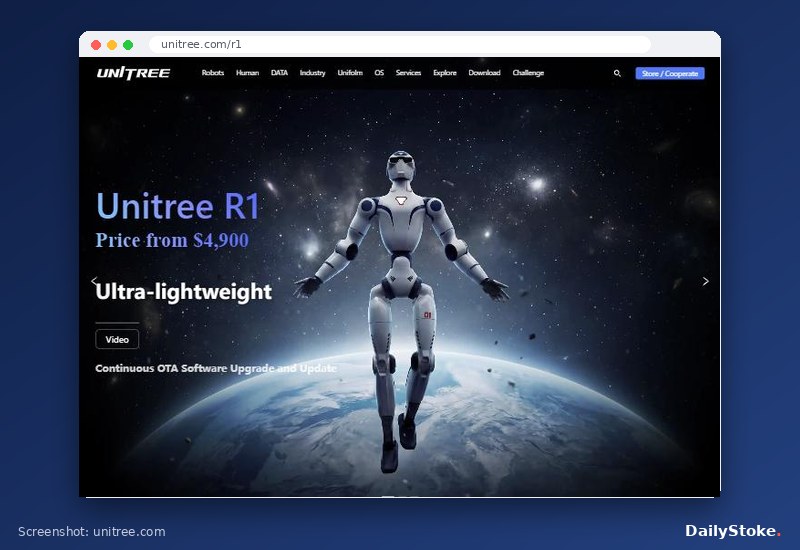
| 2 | Unitree R1 | From $4,900 (Unitree US store); UK guide price from £4,799.99 | Curious buyers and hobbyists | About 25kg and 1.21m tall |
| 3 | Unitree G1 | From $13,500 (Unitree US store); UK guide price £20,999.99 | Developers, universities, makers | Depth camera and 3D lidar as standard |
| 4 | Unitree H2 | $29,900 (Unitree US store); UK guide price £29,999.99 | Labs, showrooms and businesses | Full adult size at 1.82m |
| 5 | Figure 03 | Not for sale | Watching the race | Designed for homes, still in testing |
| 6 | Tesla Optimus | Not for sale | Tesla followers | Production line started in Fremont in 2026 |
| 7 | Apptronik Apollo | Not for sale to consumers | Factories and warehouses | Backed by Google and Mercedes-Benz |
| 8 | Agility Digit | Leased to businesses | Logistics firms | One of the few humanoids doing paid work |
UK guide prices are from UK dealer The Robot Group (July 2026); dollar prices exclude tax and shipping. Pound conversions use a rate of about $1.33 to £1 in late October 2026.
How we chose these robots
DailyStoke has not had any of these robots working in a home, and nobody outside the companies’ own trials has yet published a long-term home test of any of them. We ranked them on three questions: can an ordinary household in the UK or US order one today, what does it do when it arrives, and how much of what you see in the videos depends on a human operator.
Prices and specifications come from makers’ pages, official press releases and UK dealer listings. For what the robots really do, we relied on independent reporting from the Wall Street Journal, TIME, Forbes, TechCrunch and New Atlas, and on published security research. Where a figure is a company claim, we say so.
The humanoid robots you can and cannot buy, ranked
1. 1X NEO
NEO is the first humanoid sold as a household product rather than a research tool. Its maker, 1X Technologies, was founded in Norway in 2014 as Halodi Robotics and is now based in Palo Alto, California. NEO stands 5ft 6in (167cm), weighs 30kg and wears a machine-washable knitted suit over a soft polymer frame. 1X says it can fetch things, tidy up, open the door and walk to its charger when the battery runs low, all at 22 decibels.
The catch is autonomy. When the Wall Street Journal’s Joanna Stern tested NEO in October 2025, a remote operator in a VR headset performed most tasks. 1X is open about this: owners can book a “1X Expert” to guide NEO remotely through chores it cannot yet manage, and that footage helps train it. You approve each session, can set no-go zones and can have people blurred in the operator’s view. 1X began full production in Hayward, California, in April 2026 and says first customer shipments are planned for 2026. Orders are US only; at launch 1X said other markets would follow from 2027.
Price: $20,000 (about £15,000) to buy with priority delivery, or $499 (about £374) a month on subscription; $200 refundable deposit.
Pros
- Built for homes: soft, light and very quiet
- Charges itself; takes voice or app instructions
- Owners must approve every remote session
Cons
- Many tasks still rely on a remote human
- Not on sale in the UK or Europe
- No independent home test of a shipping unit yet
Read our full 1X NEO review.
2. Unitree R1
Unitree, based in Hangzhou, China, has made buying a humanoid almost as simple as adding one to a basket. The R1, announced in July 2025, is its lightest model: 1.21m tall and about 25kg, with up to 26 joints, binocular cameras, a four-microphone array and a speaker. Battery life is about an hour.
It is not a housekeeper. The basic version has no dexterous hands, and UK dealer RoboSavvy describes it as best for demonstrations and events, with no support for your own programming. To teach it anything new you need an EDU version, which adds onboard computing and, in higher trims, hands, plus real robotics know-how. Think of it as an agile and rather expensive conversation piece, or a starter platform for a university club. Our Unitree G1 vs R1 comparison explains the configurations.
Price: from $4,900 on Unitree’s US store; UK guide prices from £4,799.99 (R1 Air) and £6,998.99 (R1). EDU versions cost considerably more.
Pros
- On sale now in the UK and the US
- At 25kg, light enough to lift
- Among the cheapest humanoids from a major maker
Cons
- About an hour per charge
- The basic model cannot be programmed
- No household tasks out of the box
3. Unitree G1
The G1 is the robot you have probably seen boxing or doing kung fu on social media. Unitree lists it at 1.32m and about 35kg, with a depth camera, 3D lidar, 23 joints as standard (up to 43 on the EDU) and about two hours per charge. Each arm handles about 2kg, or 3kg on the EDU, so a full laundry basket is beyond it.
Unitree lists secondary development, meaning your own code, only for the G1 EDU, which is priced on request. Security is a further concern. In autumn 2025, researchers at Alias Robotics reported that the G1 sent data to servers in China every five minutes without notifying users, and that a flaw in its Bluetooth set-up could let someone nearby take control. Read our guide to home robot privacy before connecting one to your network.
Price: from $13,500 on Unitree’s US store; UK guide price £20,999.99, with EDU versions from £29,999.99.
Pros
- Proven hardware with a large research community
- Folds down for storage
- Two hours per charge
Cons
- Arms too weak for real chores
- Programming needs the pricier EDU version
- Documented data and security concerns
4. Unitree H2
Unveiled in October 2025, the H2 is Unitree’s full-size humanoid: 1.82m tall, about 70kg, with 31 joints, a battery rated for up to three hours and computing options up to NVIDIA’s Jetson Thor. There is a standard H2 with an eight-month warranty and an H2 EDU for research with 12 months.
At this size the H2 is a machine to supervise, not one to leave alone with children or pets, and it arrives without software for household jobs. It suits robotics labs, trade-show stands and businesses wanting a striking presence. In a home, it is a very large, very expensive statement.
Price: $29,900 on Unitree’s US store; UK guide prices £29,999.99 (H2) and £41,999.99 (H2 EDU).
Pros
- Adult-sized, so it can reach worktops and shelves
- Up to three hours per charge
Cons
- Heavy enough to cause real harm if it falls
- No home chore software
5. Figure 03
Figure AI unveiled Figure 03 in October 2025 as a robot designed for homes, with soft textile coverings, slimmer hands with tactile fingertips and a palm camera for delicate jobs. TIME’s preview showed it loading a dishwasher and handling laundry, while noting that engineers untangled towels and a human started the washing machine. Chief executive Brett Adcock told TIME: “We’re not there yet. We think we can get there in 2026, but it’s a big push.”
A year on, you still cannot buy one. Forbes reported in October 2026 that Figure, valued at $39 billion, had built roughly 1,000 humanoids with no confirmed home deployments, and that Adcock imagines leasing them for around $500 to $600 a month. A former head of product safety is suing, alleging that a Figure 02 generated impacts of more than twice the force needed to fracture an adult skull in a July 2025 test; Figure disputes his account.
Price: not for sale; no consumer price announced.
Pros
- Designed with homes in mind
- Sensitive hands with palm cameras
Cons
- No orders, price or delivery date
- Safety claims under legal challenge
6. Tesla Optimus
Optimus gets more attention than any other humanoid and is the least available. In its third-quarter 2026 shareholder letter, Tesla said it had started producing Optimus in Fremont, California, describing “the first production-quality bots that we have manufactured”. Elon Musk called it early production that would be “somewhat bumpy”, and said considerable AI work remained before the robot is “truly useful for open-ended tasks”.
Tesla has announced no consumer price, order book or sale date in the UK or US. Wait for a published price and specification sheet, then for independent reviews.
Price: not for sale.
Pros
- Backed by Tesla’s manufacturing scale
- Production has started
Cons
- No price, specification sheet or sale date
- Tesla says it is not yet useful for open-ended tasks
7. Apptronik Apollo
Apptronik, from Austin, Texas, built Apollo on nearly a decade of work and 15 earlier robots, including NASA’s Valkyrie. In February 2026 it said its Series A had passed $935 million, with backers including Google, Mercedes-Benz and John Deere. Apollo moves and sorts parts for partners such as Mercedes-Benz, GXO Logistics and Jabil, and Google DeepMind is working with Apptronik on robots powered by Gemini Robotics.
Apptronik names healthcare and the home as future markets, but for now Apollo is a business machine sold through commercial deals.
Price: not for sale to consumers.
Pros
- Serious funding and industrial partners
- Google DeepMind collaboration
Cons
- No consumer version or price
- Home use is only an ambition
8. Agility Digit
Agility Robotics’ Digit, with its backward-bending legs and simple gripper hands, is one of the few humanoids doing paid work. It moves plastic totes in warehouses run by GXO, and in February 2026 Agility announced a robots-as-a-service agreement with Toyota Motor Manufacturing Canada.
That focus is why it does not belong in your kitchen. Digit is leased to businesses, and Agility has announced no consumer model. It shows what humanoids do reliably today: one job, repeated, in a space designed around them.
Price: leased to businesses; not sold to consumers.
Pros
- Proven in commercial deployments
- Narrow, well-defined jobs
Cons
- No home version
- Hands built for totes, not teacups
Other home robots worth knowing about
Smaller humanoids exist but are hard to buy outside China. Noetix’s Bumi, a 94cm robot for education and family entertainment, went on presale on JD.com in October 2025 at ¥9,998 (about $1,400), for Chinese buyers only. Booster Robotics lists its 95cm K1 from $5,999, through a sales enquiry rather than a checkout.
If you want help with chores, a humanoid may be the wrong shape. Several start-ups are building wheeled robots with two arms; we look at them in home robots that actually do housework. For company rather than cleaning, see our AI companion robots guide, and for older relatives, companion robots for elderly people.
Buying a home humanoid: what matters and what to ignore
Who is really doing the work. Ask how much of a task the robot completes on its own. NEO openly uses remote operators for jobs it cannot yet do; Unitree’s consumer models mostly run pre-programmed moves or remote control. A video proves a robot did something once, in ideal conditions, not that it will manage your cluttered kitchen every day.
What arrives in the box. Unitree’s cheaper versions cannot be programmed and often have no hands. To experiment, you need an EDU model, a laptop and time.
Battery and strength. One to two hours per charge is common for small humanoids, and the G1’s arms handle about 2kg each.
Safety. A 30kg to 70kg machine moving around children and pets is not a robot vacuum. Rodney Brooks, co-founder of iRobot, told Forbes in October 2026: “I certainly wouldn’t have [a humanoid] around my grandkids.” We found no independent home-safety certification published by any maker on this list.
Privacy. These robots carry cameras and microphones, and some send data to company servers or let staff see through their eyes. Read the privacy policy before you pay.
Support and warranty. In the UK, Unitree robots come through dealers, so check whether a price includes VAT, delivery and support. Unitree’s warranty on the standard G1 is eight months, against 18 months for the EDU.
What to ignore. Backflips, kung fu and polished launch films. They prove balance and choreography, not usefulness.
Humanoid robots in 2027: factories open, rules tighten
This year the question is less whether humanoids can be built than whether they are safe and useful enough to live with. Factories are running: 1X began full production of NEO in Hayward, California, in April 2026, and Tesla started building Optimus in Fremont later that year, though Elon Musk himself admitted the robot was not yet useful for open-ended tasks.
Regulation has caught up too. In the EU, the new Machinery Regulation has applied since 20 January 2027, replacing the old Machinery Directive. For the first time it covers machines with self-learning safety functions: their behaviour must stay within limits set by the manufacturer, people must be able to step in, safety-critical decisions must be recorded, and an independent notified body must be involved in assessing them.
Home humanoid robot FAQs
Can you buy a humanoid robot for your home in the UK?
Yes, but only a limited kind. Unitree’s R1, G1 and H2 are sold through UK dealers, from guide prices of £4,799.99 for the R1 Air, but they are demonstration machines and developer platforms. 1X NEO, the one humanoid designed for chores, is not yet sold in the UK.
How much does a humanoid robot cost?
From $4,900 for Unitree’s smallest R1 to $29,900 for its full-size H2, before tax and shipping. 1X NEO costs $20,000 or $499 a month. Figure, Tesla, Apptronik and Agility do not sell to consumers.
Is Tesla Optimus for sale?
No. Tesla started producing Optimus in 2026 but has announced no consumer price or sale date.
Are home humanoid robots controlled by humans?
Sometimes. 1X says NEO works on its own by default, but owners can book a remote 1X Expert for tasks it cannot yet do, and in the Wall Street Journal’s October 2025 test most tasks were teleoperated.
Can a humanoid robot do housework?
Not reliably yet. Demonstrations show robots loading dishwashers and folding laundry, but those are curated clips, and no home humanoid has a long-term record in ordinary homes.
Are humanoid robots safe around children and pets?
There is no track record to judge by. Soft-bodied designs such as NEO aim to reduce risk, but a falling 35kg or 70kg robot can still hurt someone, so supervise it.
Can a humanoid robot look after an older relative?
No humanoid on sale is a carer or a medical device, and none should be relied on in an emergency. Company and reminders are not the same as supervision; our guide to companion robots for elderly people looks at the evidence.
More on DailyStoke
1X NEO review · Unitree G1 vs R1 · Home robots that do housework · Home robot privacy · Humanoid robots: what they can actually do · Home health robots