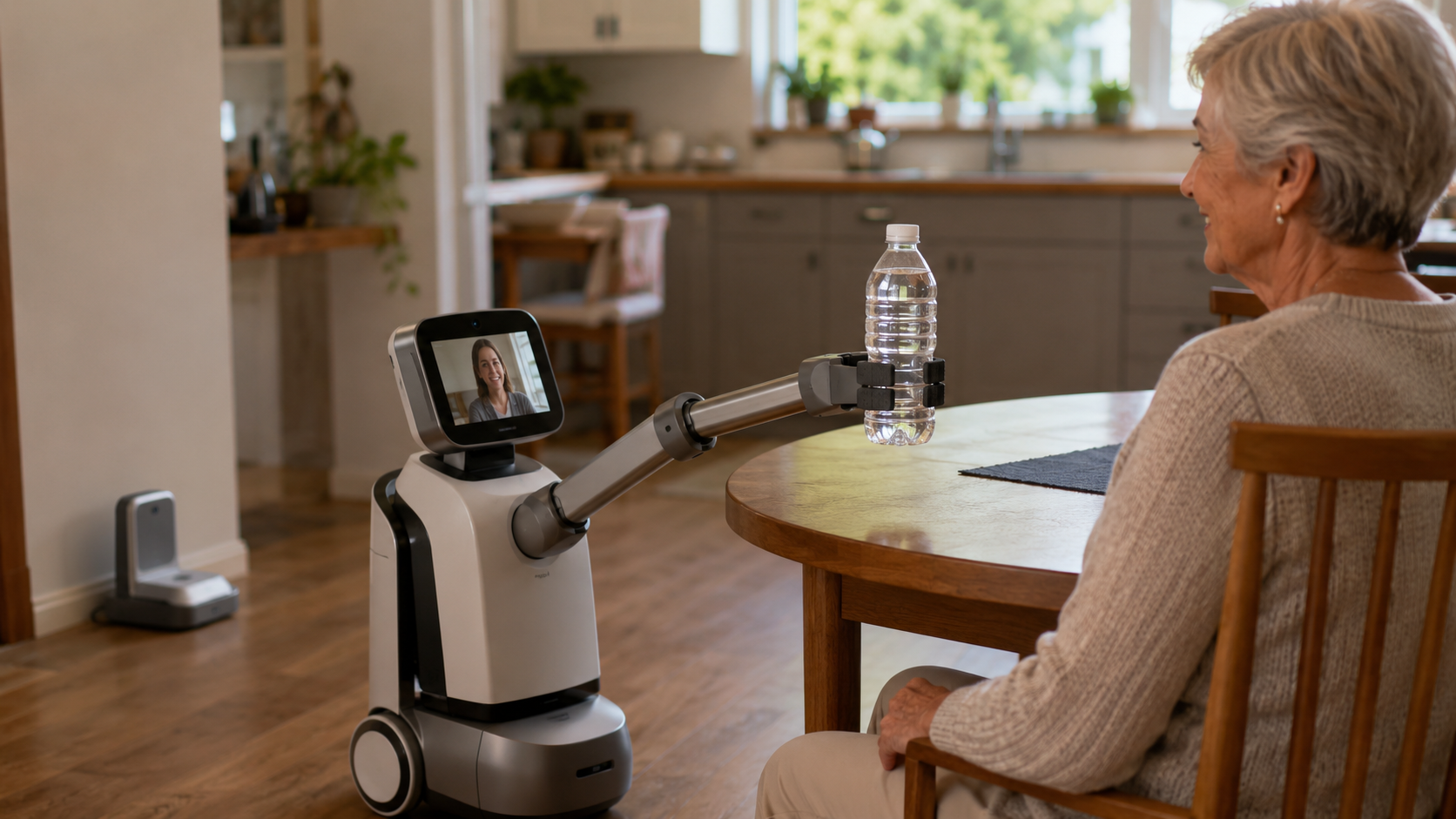
Home health robots can already provide companionship, prompt daily routines, connect family members, and, in carefully prepared settings, retrieve lightweight objects. They cannot safely replace a home health aide, monitor every medical emergency, prevent every fall, or provide dependable hands-on care.
For most households, the best option in 2026 is a specialized device chosen for one specific need. A stationary companion robot may suit someone who wants conversation and reminders. A mobile research robot may retrieve a water bottle or carry a prompt into another room, but it costs about as much as a new car and requires professional setup. A humanoid promises more general help, yet remains the least proven choice for health-related use.
DailyStoke has not tested these products directly. This guide is based on current pricing and availability, independent reporting, peer-reviewed research, and official safety information. Product status was checked on July 31, 2026.
What counts as a home health robot?
The label covers several very different products. Treating them as one category creates expectations that no single machine can meet.
- Companion robots start conversations, suggest activities, play games or music, and prompt routines. They do not provide physical assistance.
- Telepresence robots let a relative or care professional move a camera and screen through the home. Their value depends on reliable connectivity and the user’s comfort with remote access.
- Mobile assistive robots can carry items, retrieve selected objects, or bring a screen to the user. These remain expensive and are usually part of research or provider programs.
- Robotic pets aim to provide engagement and comfort without feeding, walking, or veterinary care. They should not be described as treatments unless supported and authorized for a specific medical use.
- General-purpose home robots are designed for chores and physical tasks, but current models are early-access products rather than proven care systems.
Which home health robots can you get in 2026?
| Product | Access and price | Designed to do | Important limitation |
| ElliQ | $249 initiation; $39-$59 monthly lease | Conversation, activities, routine prompts, caregiver app | Stationary; no physical help or emergency response |
| Stretch 4 | $29,950; laboratory and research use only | Object retrieval, teleoperation, mobile prompts | Not certified or sold for individual care use |
| Labrador Retriever Pro | Provider-focused; current public pricing unavailable | Carry items around the home on trays | Individual version has no public delivery date |
| Tombot Jennie | Waitlist; current public price and shipping date unavailable | Pet-like companionship and tactile engagement | Not a monitor, mobility aid, or physical assistant |
| 1X NEO | $20,000 early access; later $499 monthly plan | General household chores and communication | Preorder product; not validated as a care or medical device |
Status checked July 31, 2026. Sources: [1], [3], [6], [7], [8]
ElliQ is the clearest consumer option
ElliQ is a tabletop companion designed around conversation, activities, reminders, and contact with family. It is leased rather than sold. Current plans require a $249 initiation fee and cost $59 month to month, $49 per month when billed annually, or $39 per month when billed for 24 months. The membership includes the device, updates, support, warranty coverage, and access to its caregiver app.
That makes ElliQ accessible compared with mobile robots, but it also defines the limits. It cannot fetch a dropped phone, carry laundry, help someone stand, or inspect another room. Its value depends on whether the user enjoys proactive conversation and responds well to prompts. Someone who dislikes interruptions or voice assistants may find the same behavior irritating rather than supportive.
ElliQ has been studied as a tool for loneliness and social isolation, but no companion robot should become a reason to reduce human contact. The useful role is additive: creating structure between visits, encouraging an activity, or making it easier to contact family.
Stretch 4 shows what physical help could look like
Stretch 4 is a wheeled robot with a telescoping arm and gripper. In a University of New Hampshire research deployment reported by the Associated Press, a Stretch robot delivered routine prompts, displayed exercise instructions, retrieved simple objects, and helped read a prescription label. The household described meaningful relief from part of its daily caregiver workload.
The story is encouraging, but it is not a normal retail experience. Stretch 4 costs $29,950 before optional equipment, and Hello Robot says it is certified only for laboratory and research use. Its individual-assistance program describes selected remote tests and collaborative in-home pilots rather than ordinary consumer sales.
The practical lesson is not that everyone should buy Stretch. It is that physical assistance may arrive first through a simple wheeled base, one arm, and a short list of rehearsed tasks. That design is easier to stabilize and supervise than a walking humanoid.
Provider programs may matter more than retail sales
Labrador Systems designed Retriever robots to carry frequently used objects around a home on trays. Its public availability page prioritizes a Retriever Pro model for professional care organizations and says an individual version remains a longer-term plan. The same page still displays an older 2024 production target, so current delivery timing and pricing are reporting gaps that a care provider would need to confirm directly.
This provider-first model may be the more realistic route for expensive care technology. A health system, insurer, research program, or home-care agency can select users, configure the home, provide training, monitor problems, and maintain the hardware. Buying directly leaves those responsibilities with the household.
Robotic pets solve a different problem
A robotic pet does not need to navigate the home to be useful. Products such as Tombot Jennie are designed to respond to touch and create a familiar pet-like interaction for people who cannot safely care for a live animal. Tombot currently directs interested buyers to a waitlist and says it will provide pricing and availability closer to shipping.
The appeal is emotional and sensory, not medical or practical. A robotic pet cannot confirm medication, detect a stroke, or call for help unless a separate certified system provides those functions. Buyers should also consider what happens if the device breaks after someone has formed a strong attachment to it.
What the research supports, and what it does not
Research suggests care robots may improve engagement, mood, or quality of life for some users, but results vary by robot, setting, study length, and the people involved. A 2026 review of 39 real-home studies found that deployment remains limited; many projects used expensive, human- or animal-like robots and rarely involved users closely enough in design. Privacy, safety, household context, and long-term adoption were recurring concerns.
A separate review focused on older adults living with frailty found low perceived usability in much of the evidence, largely because of technical limitations. Some participants enjoyed or valued robots, but usefulness was not consistently better than a tablet or simpler technology.
That is the right level of confidence for a buyer: a robot may help one person build a routine or feel more engaged, but the evidence does not support promising that it will prevent decline, treat loneliness, reduce falls, or keep someone safely independent on its own.
Four risks that matter more than appearance
- Safety: A mobile machine can collide, tip, trap fingers, block a walkway, or fail while carrying something. Personal care robots have an international safety standard, but buyers still need evidence for the exact product and task.
- Privacy: Cameras, microphones, room maps, health routines, and remote-control features can reveal sensitive details about the user and everyone who visits.
- Dependence: A routine built around cloud software can disappear if a subscription ends, a server is unavailable, or the manufacturer closes.
- False reassurance: A friendly voice and moving body can make a system seem more capable than it is. Clear failure alerts and human escalation matter more than personality.
What to ask before bringing a robot home
- What single problem is it solving? Define a task such as morning prompts, family video calls, or carrying drinks. Avoid paying for a vague promise of independence.
- What happens when it fails? Ask who is alerted, how quickly a person responds, and whether the user can complete the task another way.
- Is remote operation involved? Find out when another person can see through the robot, how consent is shown, and whether access can be restricted by room or schedule.
- What is the complete cost? Include the device, installation, subscription, connectivity, home modifications, repairs, batteries, and return shipping.
- Can the intended user control it? Test speech recognition, hearing, vision, reach, dexterity, cognitive load, and tolerance for repeated prompts.
- Who owns the care plan? A robot should reinforce a plan created by the user and appropriate professionals, not invent health instructions.
Who should consider a home health robot
A companion robot may be worth considering for an adult who lives alone, enjoys voice interaction, wants more daily structure, and has family or caregivers who remain involved. A mobile assistive robot may be useful within a professionally supported pilot for someone with a clearly defined retrieval or prompting need.
Medical note: Home health robots are not substitutes for professional care, emergency services, or assessed medical and mobility equipment. If the main need is fall prevention, lifting, transfers, medication dispensing, diagnosis, or unsupervised dementia care, use certified task-specific equipment and qualified human support.
Buy now or wait?
Buy only for a narrow need that the available product already performs. ElliQ is the most straightforward consumer option if proactive companionship and routine prompts fit the user, and the ongoing fee is acceptable. Choose a plan with a trial period, and judge whether engagement continues after the first few weeks.
Wait for physical assistance. Stretch 4 provides an unusually concrete look at what is possible, but its price, certification limits, and research-oriented support make it unsuitable as a normal household purchase. Humanoids and general-purpose home robots require even more caution because their care capabilities remain largely unproven.
The best home health robot will not be the one that appears most human. It will be the one that performs a modest task reliably, respects privacy, fails clearly, and gives a person more control without quietly removing human support.