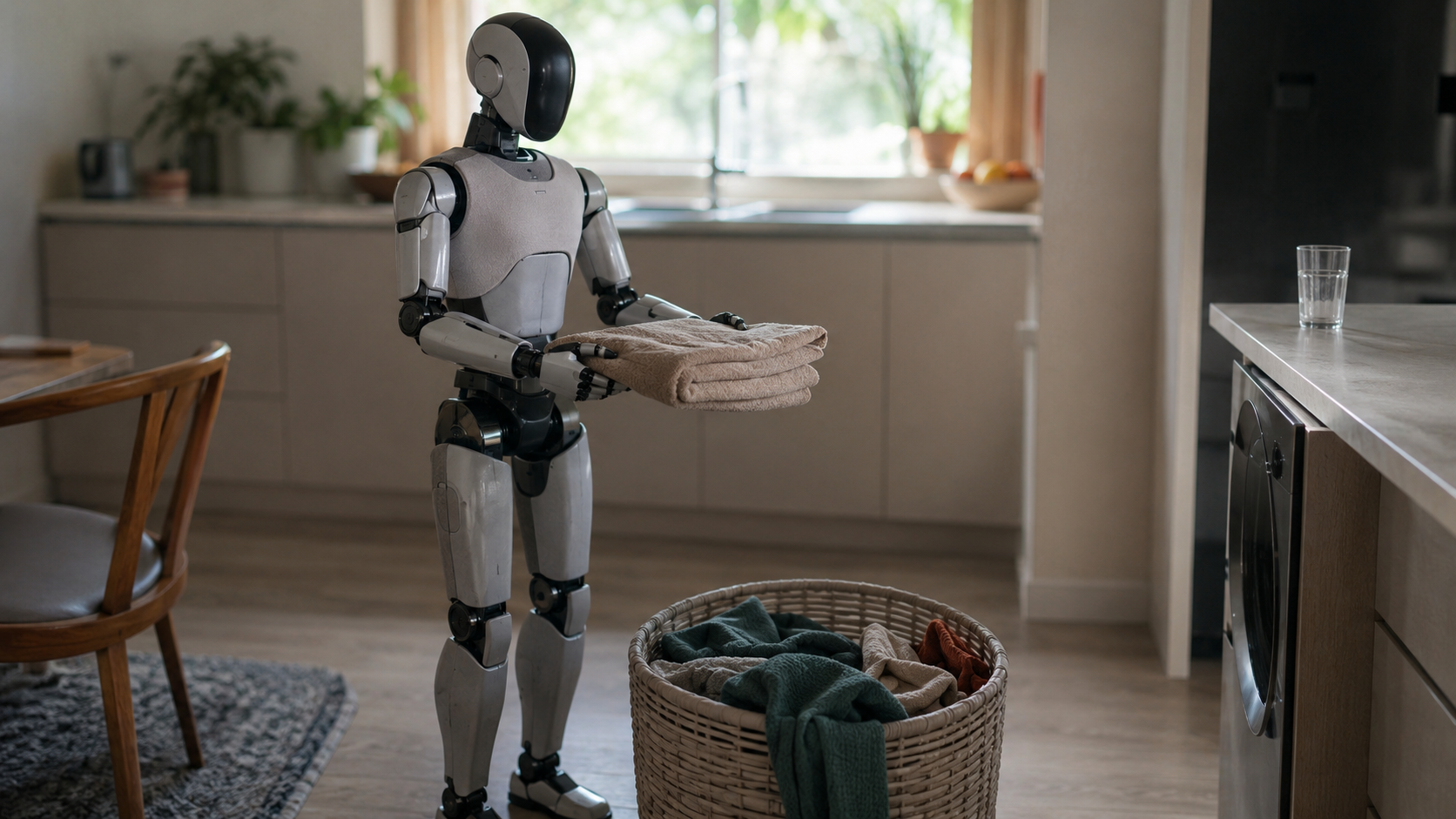
Humanoid robots have crossed an important line in 2026: a small number are doing paid, repetitive work in factories and warehouses, and consumers can now order early hardware. They have not crossed the more important line for most households. There is still no independently proven, general-purpose home robot that can reliably clean a kitchen, sort laundry, prepare food, and assist a person without close limits or occasional human help.
For ordinary buyers, the recommendation is to wait. The most credible progress is happening in controlled industrial spaces, where a task can be rehearsed, the floor can be mapped, and safety procedures can be built around the robot. A home contains stairs, pets, loose clothing, reflective surfaces, fragile objects, and people who move unpredictably. That turns a polished demonstration into a much harder reliability problem.
This article is based on current company documentation, customer deployment reports, safety guidance, independent reporting, and peer-reviewed research. DailyStoke has not tested these robots directly. Prices and availability were checked on August 6, 2026.
Yes, there are consumer humanoid robots, with major limits
Two products explain the state of the consumer market better than any promotional video: 1X NEO and Unitree G1. Both can be bought or reserved by individuals. Neither should be confused with a finished household appliance.
1X NEO is the closest thing to a consumer home humanoid. The company offers an early-access purchase for $20,000, with priority U.S. deliveries planned in 2026, and says a $499-per-month subscription will follow later. NEO is designed for domestic chores, but unfamiliar work may involve an authorized human operator controlling the robot remotely. That human-in-the-loop approach may help the system learn, but it also puts cameras, network access, company policy, and trust inside the most private rooms in your home.
Unitree lists the G1 from $13,500 before tax and shipping. That price makes a full-size walking robot sound surprisingly accessible, but G1 is better understood as a development and research platform. Unitree warns that humanoid robotics remains at an early stage, tells individual buyers to understand the limitations before purchasing, and advises users to keep a safe distance. Some functions shown on its product page are still being developed or tested. [2]
The distinction matters: NEO is an early-access attempt at a home service, while G1 is purchasable robotics hardware. Tesla Optimus, Figure 03, Apptronik Apollo, and Agility Digit may be more familiar names, but they are not general consumer products you can order for routine home use.
Which humanoid robots are actually available in 2026?
| Robot | Consumer access | Current status | What that means in practice |
| 1X NEO | $20,000 early access; later $499/month plan | Preorder; initial U.S. deliveries planned for 2026 | The clearest home-focused option, but autonomy and privacy remain open questions. |
| Unitree G1 | Listed from $13,500, excluding tax and shipping | Available development platform | Buyable hardware for skilled users, not a proven household helper. |
| Agility Digit | No | Commercial logistics deployment | A narrow workplace success: moving totes in a prepared facility. |
| Figure 03 | No | Industrial deployment and evaluation | BMW is using the platform for selected manufacturing and logistics tasks. |
| Apptronik Apollo | No | Commercial pilots and scaling | Manufacturing and logistics come first; home use is a later goal. |
| Tesla Optimus | No | Development and production preparation | An ambitious program, not a product with a consumer price or delivery date. |
Status and pricing checked August 7, 2026. Sources: [1], [2], [3], [4], [5], [6]
What humanoid robots can do reliably now
The strongest evidence is not a robot folding a shirt on stage. It is a robot repeating one useful job for hundreds of hours while a customer measures the result. BMW says Figure 02 worked ten-hour weekday shifts during a ten-month 2025 deployment at its Spartanburg plant. The robot moved more than 90,000 sheet-metal components and supported production of more than 30,000 BMW X3 vehicles. BMW has since brought Figure 03 into the same plant and is piloting Hexagon’s AEON platform in Leipzig.
Agility Robotics reports that Digit has moved more than 100,000 totes at a GXO facility. That is commercially meaningful, but it is also deliberately narrow: pick up a standardized container, walk through a known space, and place it where the workflow expects it. The environment and task are engineered together.
Apptronik is following a similar path with Apollo. Its current focus is manufacturing and logistics, including transporting, sorting, and kitting components. The company describes health care and the home as later applications, not present-day consumer uses.
These deployments prove that the humanoid shape can be useful where buildings, shelves, carts, and tools were designed for human bodies. They do not prove that one robot can be dropped into any workplace, much less any home, and figure out the day.
Why a home is harder than a factory
- Every home is different. A robot can encounter a new door handle, rug edge, laundry pile, pet bowl, or narrow passage within a few steps.
- Hands remain a bottleneck. Picking up a rigid tote is much easier than separating two damp towels, opening a thin plastic bag, or gripping a glass without breaking it.
- Small errors become expensive. A missed placement in a test cell can stop a line. In a home, the same error can damage a stove, spill hot liquid, knock over a person, or let a pet escape.
- Reliability must last for hours. A two-minute video can be selected from many attempts. A useful appliance must work on an ordinary Tuesday with no robotics engineer nearby.
- The robot needs a fallback. When autonomy fails, the practical choices are to stop, ask the owner for help, or bring in a remote operator. Each option reduces convenience or raises a privacy question.
Safety is not solved by making a robot look friendly
A walking machine that can lift household objects has enough mass, leverage, and stored energy to hurt someone. Soft covers, force sensing, slow modes, and compliant joints may reduce risk, but safety also depends on software, maintenance, network behavior, the environment, and what happens when power or balance is lost.
OSHA notes that many industrial robot accidents occur during non-routine work such as setup, testing, programming, and maintenance, and that the agency has no robotics-specific standard. Personal care robots have a dedicated international safety standard, ISO 13482, but compliance with a standard is not the same as evidence that a particular home robot is appropriate for unsupervised lifting, mobility assistance, or emergency response.
For a buyer, the useful questions are plain: What happens if the robot falls? Can it recognize a child or pet under poor lighting? Does it stop safely when the network drops? Who is liable if it breaks something or injures someone? Can a local technician service it, and how long will replacement parts remain available? If a seller cannot answer those questions in writing, the product is not ready to become a household appliance.
Privacy becomes physical when the camera can walk around
A home humanoid may need cameras, microphones, maps, object histories, and user preferences simply to do its job. Unlike a stationary speaker, it can move between rooms, open sightlines, and interact with belongings. If a person can remotely operate the robot, the privacy decision is no longer only about data collection. It is also about when another human may see through the robot and move it.
Before buying, read the privacy policy and the service terms, not only the hardware page. Check whether remote operation is optional, how consent is shown, whether people are blurred, which recordings are stored, how long data is kept, whether it trains company models, how deletion works, and what happens to core functions if you cancel a subscription or the company closes.
Could humanoid robots help older adults?
Eventually, physical assistance may be one of the strongest reasons to put a capable robot in a home. Carrying objects, fetching a drink, prompting routines, and connecting a person to family or a clinician could support independence. The current evidence does not justify treating a consumer humanoid as a caregiver, mobility aid, medical monitor, or substitute for human care.
Independent reporting in 2026 found a useful home-care example in Stretch 4, a wheeled robot with a telescoping arm rather than a walking human shape. In one household, it delivered reminders, displayed exercise prompts, and retrieved simple objects. Its narrow, task-specific design was part of the appeal. The system costs nearly $30,000 and still illustrates why a less human-looking machine can be more practical than a biped for some care needs.
A systematic review of care robots for older adults living with frailty found generally low perceived usability, largely because of technical limitations. That does not mean the category has no value. It means benefits depend on the person, the task, training, support, and the reliability of the complete care system, not the robot’s appearance.
Medical note: Consumer robots are not a replacement for professional care, emergency services, or a properly assessed mobility or medical device. Anyone considering robotic help for a health or disability need should involve the user, caregivers, and an appropriate health professional in the decision.
What a serious buyer should demand
- A live demonstration of your task. Ask the robot to handle the actual object, room layout, and repetition you care about, not a prepared showcase task.
- A written autonomy boundary. Find out which tasks work independently, which need supervision, and which can trigger remote human assistance.
- A complete cost. Include delivery, tax, subscription, teleoperation, training, repairs, replacement batteries, insurance, and any required home changes.
- A service plan. Confirm response times, technician coverage, parts availability, warranty exclusions, and what happens if the robot cannot complete its promised task.
- A privacy exit. You should be able to understand, restrict, export, and delete collected data without disabling every useful function.
- A safe failure mode. The seller should explain how the robot behaves during a fall, sensor fault, power loss, blocked path, network outage, or unexpected contact.
Who should consider one, and who should wait
Consider an early model if
- You are a robotics developer, educator, or researcher and want a platform rather than a finished appliance.
- You can afford an experimental purchase without depending on promised future features to justify the cost.
- You have one narrow, testable task and can supervise the robot, manage updates, and accept downtime.
Wait if
- You want a dependable housekeeper. No current humanoid has enough independent evidence to support that expectation.
- You need unsupervised care or mobility support. A failure could have health or safety consequences, and a consumer humanoid should not be the only safeguard.
- You are uncomfortable with remote access or in-home data collection. The most capable early systems may need both to improve or recover from unfamiliar tasks.
- You expect car-like ownership support. Service networks, resale markets, insurance, repair pricing, and long-term software commitments are still immature.
Buy now or wait?
Wait. The industry has produced credible workplace use and the first orderable home-focused machines, which makes 2026 a year worth watching. It is not yet a sensible time for most people to spend $13,500 to $20,000 on a humanoid robot.
Our take is that, in general, this tech is not mature at all, and we are still years from it. But then again, things can move fast.
The milestone to watch is not a lower price or a more lifelike walk. It is independent evidence that a robot can complete several ordinary household tasks, every day, across different homes, with clear safety limits, minimal remote intervention, and support that survives a hardware failure. Until then, task-specific products such as robot vacuums, lawn robots, smart-home sensors, and accessibility equipment will usually deliver more dependable help for far less money.