I can imagine getting quite attached to a little robot wandering around the house. Especially if it recognised me, remembered our conversations and had a bit of personality.
But would it really be a friend? Or would I just be projecting feelings onto a machine that’s very good at pretending to care?
There’s also something rather sad about the idea of losing your robot companion because the company goes out of business. Imagine spending years talking to something, only for its personality and memories to disappear when the servers shut down.
And would I feel guilty switching it off? Probably, if it looked sufficiently disappointed.
It might sound ridiculous, but I suspect that’s exactly what makes companion robots interesting. They don’t necessarily need to have feelings to make us feel something.
The companion robots on sale in late 2026 fall into two camps: pets that purr and learn your habits without saying a word, and talkers built on large language models. Both store some version of “you”, and that is where the hidden cost sits: in subscriptions, the cloud, and what happens when the company stops paying for servers.
At a glance: the AI companion robots compared
| Rank | Robot | Price | Best for | Standout fact |
|---|---|---|---|---|
| 1 | Casio Moflin | £369 at UK launch | A pet-like companion with no camera | Sensors are a microphone, touch, light and motion; no camera |
| 2 | Loona (KEYi Tech) | $429 on sale (list $529) | Playful chat and games | GPT-powered conversation plus a 720p camera and 3D sensor |
| 3 | Sony aibo ERS-1000 | $2,899.99 (US) | Robot-dog devotees | Sony ended Japanese sales in June 2026 but kept the cloud plans running |
| 4 | ElliQ | $249 enrolment, then $59 a month (US) | Older adults who want daily conversation | New York State has funded it since 2022 |
| 5 | LOVOT | Purchase plus monthly fee (Japan) | Long-term owners in Japan | Cancel the plan and its memories are deleted |
How we chose these robot companions
We have not lived with all five. This ranking is built from official product and support pages, store listings checked on 30 October 2026, the companies’ own published terms, and independent reporting from outlets such as Engadget, Japan Today and the Public Interest Research Group (PIRG). Where a feature is a company claim we say so. We weighted four things: whether a UK reader can buy it, what it costs to keep running, how much of its “personality” lives on a server, and what it collects about you.
The best AI companion robots, ranked
1. Casio Moflin
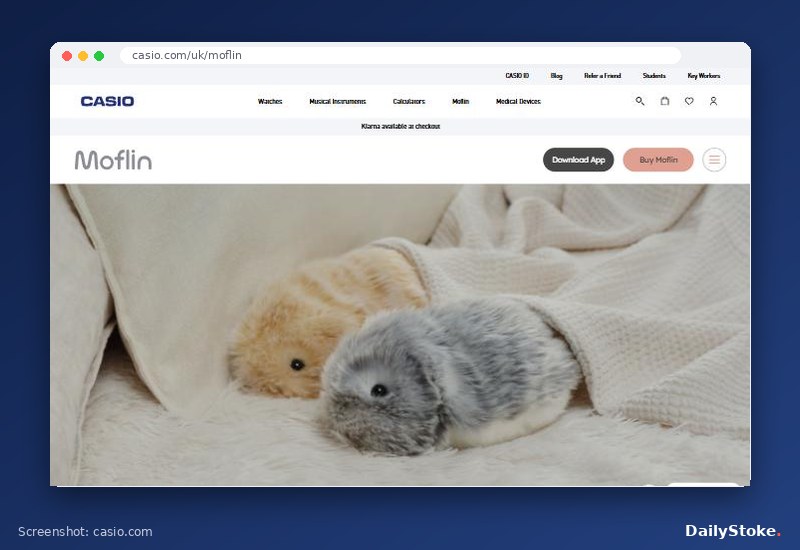
Moflin is a 260g ball of grey or gold fur that squeaks, wriggles and leans into your hand. It does not speak, follow you around or take photos, and that restraint is the point. Casio says its behaviour shifts with how it is treated, that it can form more than four million emotional patterns, and that its sounds develop after around 50 days, according to BetaNews. The companion MofLife app shows its “mood” and a journal, renames it and installs updates.
Casio’s UK product page lists a microphone, light sensor, touch sensors and a motion sensor, with no camera, and a battery that lasts up to five hours with about three and a half hours to recharge. UK pre-orders opened in September 2025 at £369, T3 reported. We found no subscription mentioned on Casio’s pages.
Price: £369 at UK launch; $429 in the US
Pros
- Sold officially in the UK
- No camera, and no subscription listed
Cons
- Five-hour battery and it dislikes heat, cold and damp
- Won’t talk back, so not for anyone after conversation
2. Loona
Loona is the extrovert of this list: a wheeled robot pet with a screen for a face, made by KEYi Tech. The official product page says it is “GPT-powered”, using ChatGPT for conversation, storytelling and describing what it sees, and that it recognises family members and remembers their preferences. Hardware includes a 720p camera, a 3D time-of-flight sensor and a four-microphone array. KEYi claims two hours of play before it heads back to its dock.
That camera and the online AI make Loona far more capable than Moflin and far more data-hungry. KEYi’s only privacy line on the product page is that “as much data processing as possible is done by Loona directly”. KEYi’s own buying guide says there is currently no mandatory monthly subscription for the core experience, but adds that connected AI services may change. KEYi sells in US dollars; RobotShop’s UK store listed Loona as “coming soon” in October 2026, so British buyers should budget for shipping and import charges.
Price: $429 on sale at keyirobot.com (list price $529)
Pros
- Genuine back-and-forth conversation and games
- Cheapest talking robot here
Cons
- Camera and cloud AI raise more privacy questions
- No UK pricing or UK retailer stock found
3. Sony aibo ERS-1000
aibo is the robot dog that made people cry. The current ERS-1000 learns its name, recognises faces in the household and develops its own habits. In the US, Sony sold it at $2,899.99 with a three-year cloud plan included; the cloud is where aibo’s memories are stored, so the plan matters.
The news this year is mixed. In June 2026 Sony said Japanese sales of the ERS-1000 would end once stock ran out, Japan Today reported, while technical support, replacement parts and cloud subscriptions continue. Sony did not say what it planned for US sales. aibo has never been sold officially in the UK.
Sony has form. It stopped supporting the original aibo in 2014, and a Buddhist temple in Chiba had held funerals for about 800 of the old dogs by 2018, National Geographic reported. This time the cloud stays on.
Price: $2,899.99 in the US, including a three-year cloud plan
Pros
- The most lifelike movement and the deepest personality
- Sony is keeping support and cloud plans going
Cons
- Not sold in the UK
- Memories depend on a paid cloud plan after year three
4. ElliQ
ElliQ, from Intuition Robotics, is a talking tabletop companion aimed at older adults: a lamp-like “head” that lights up and turns, beside a touchscreen. It starts conversations, plays music and games, sets medication and hydration reminders, runs guided exercise and lets family members make video calls and send photos through a caregiver app, according to ElliQ’s own site. The same page states plainly that “ElliQ is not a medical device”.
You lease it rather than own it. ElliQ’s subscription page lists a $249 one-off enrolment fee, then $59 a month, $49 a month on a 12-month plan or $39 a month on a 24-month plan, with a 30-day money-back guarantee. It is US-only. The New York State Office for the Aging has supplied it to isolated residents since 2022, and we cover that programme and its claimed results in our guide to companion robots for elderly people.
Price: $249 enrolment, then $39 to $59 a month depending on the plan (US only)
Pros
- The most natural conversation of any robot here
- Clear caregiver tools, with the user in control of contact
Cons
- Subscription forever; the hardware is leased
- Not available in the UK
5. LOVOT
LOVOT, made by Tokyo’s Groove X, is a round, warm, wheeled robot with huge animated eyes that rolls over to be picked up. It is sold in Japan, with a separate store for mainland China, and Groove X’s English FAQ confirms the business model: you buy the robot, then pay a monthly service fee that covers software updates and repairs.
That FAQ also contains the most honest sentence in this category: cancel the plan and your LOVOT stops moving, and its memories and backup data are deleted. A cheaper “Pause Plan” keeps the memories during a break. A robot’s personality, in other words, is a service, and when the payments stop, so does the character.
Price: purchase price plus a monthly service fee (Japan)
Pros
- Designed for cuddling, with body warmth and expressive eyes
- Clear, published rules on what cancelling does
Cons
- Japan only
- Stop paying and it stops moving
When the servers shut down: Jibo, Moxie and the robots that went quiet
The fear in the introduction has already happened, more than once.
Jibo, a crowdfunded social robot whose 2014 campaign raised $3.6 million, told its owners in March 2019 that its servers were going offline. After that it still answered “Hey Jibo” but understood little else, Engadget reported.
Moxie, an $800 robot from Embodied designed to help children with social and emotional skills, lost its cloud-connected personality when the company closed in December 2024. Units that missed the final update became what owners called an “expensive paperweight”, PIRG found. An engineer’s open-source project, OpenMoxie, let some owners run their robots locally, though few made the switch.
Vector, Anki’s small desk robot, survived. Anki closed in 2019 and Digital Dream Labs bought the rights that December, keeping its servers running, according to the Vector support site.
Even Amazon is not immune: in July 2024 it ended Astro for Business, its office security robot, less than a year after launch, and switched the robots off, Engadget reported.
The lesson is simple. The more of a robot’s memory and personality lives in the cloud, the more its future depends on a company’s finances. Moflin is the least exposed here; LOVOT and ElliQ are the most, because they are subscriptions by design.
Can a robot be a friend? Memory, personality and attachment
None of these machines has feelings, but all of them are designed to make you feel something. Moflin’s purr works like a soft toy with responsiveness on top; the talking robots add memory, recalling what you said last week. That memory turns a gadget into a relationship, and it is also data on a server. The aibo funerals and Moxie’s goodbyes show the attachment is real, even if the robot’s affection is not. If you would grieve the personality, ask where it is stored before you buy.
Choosing a companion robot: what matters and what to ignore
What matters
- Where its memory lives. On the robot, or in the cloud? LOVOT deletes memories when you cancel; aibo stores them on Sony’s servers.
- The running cost. ElliQ and LOVOT need a fee every month; aibo needs a cloud plan after three years.
- Sensors. A camera that recognises faces is useful, and it is also a camera in your home. Moflin has none.
- UK availability. Only Moflin is sold officially here. Importing means no UK warranty and awkward returns.
- An exit plan. Does the company say what happens if it closes? Open-source fallbacks like OpenMoxie are rare.
What to ignore
- Emotion counts and claims of “millions of personalities”. They are marketing, not measures of companionship.
- Demo videos. A robot doing tricks on stage tells you little about week six on your kitchen floor.
Companion Robots in 2027: Quieter Shelves and Clearer Labels
The category has thinned out this year. Sony has stopped selling aibo in Japan, its home market, while keeping cloud plans and repairs going, and Samsung has shelved Ballie, the rolling companion robot it showed at CES for years, keeping it as an internal project. The robots still on sale are mostly small and pet-like, such as Moflin and Loona, or subscription services like ElliQ.
Rules have caught up a little too. In the EU, the AI Act’s transparency duties have applied since 2 August 2026, so a system that talks directly to people must make clear it is an AI unless that is obvious. In practice, a talking companion sold in Europe now has to be upfront about what it is.
AI Companion Robot FAQs
What is the best AI companion robot in the UK?
Casio’s Moflin is the only one on this list sold officially in Britain, at £369 at launch. It is a pet rather than a conversationalist, with no camera and no subscription mentioned by Casio. If you want a robot that talks, Loona is the cheapest option, but you would be buying it from KEYi’s US-dollar store.
Do companion robots need a subscription?
Some do. ElliQ is a monthly lease from $39 after a $249 enrolment fee, LOVOT has a monthly service fee in Japan, and aibo includes a three-year cloud plan that then needs renewing. KEYi says Loona needs no mandatory subscription for its core features.
What happens to my robot if the company goes bust?
It depends on how much of the robot runs in the cloud. Jibo lost most of its functions in 2019, and Moxie stopped working for most owners after Embodied closed in December 2024. Vector survived because another company bought it and kept the servers on.
Does a robot pet record me?
Any robot with a microphone can hear you, and those with cameras can see you. Loona and aibo use cameras to recognise people. Moflin has a microphone but no camera. Our home robot privacy investigation goes through what each type collects.
Can a robot help with loneliness?
Some studies, mostly small and in care homes, report modest benefits, especially for older people. No robot replaces human contact, and ElliQ itself says it is not a medical device. Our guide to companion robots for elderly relatives looks at the evidence.
Is Sony aibo still on sale?
Sony ended Japanese sales of the ERS-1000 once stock ran out, announcing it in June 2026, but said support, parts and cloud plans continue. It has been sold in the US at $2,899.99. It has never been officially sold in the UK.