If I’m spending $20,000 on a robot, I’d expect it to make my life quite a bit easier. At that price, I don’t want another gadget that needs constant charging, software updates and troubleshooting. I’ve already got enough of those.
But what would I actually ask NEO to do? Empty the dishwasher? Change the bedsheets? Make dinner while I’m working? Or would I spend more time explaining what needs doing than it would take to do it myself?
And there’s the rather strange possibility that some tasks might still need a human operating the robot remotely. In that case, have I really bought a robot assistant, or just hired a very expensive cleaner with an unusual way of getting into my house?
I’m curious how much NEO can actually do today, rather than what its developers hope it will eventually learn.
NEO, from 1X Technologies, is the first humanoid robot sold to households as a home helper. It is soft, quiet and designed to live with people, and you can order one for $20,000 or $499 a month. But it is US only, and the most detailed independent test so far found that a remote human did most of the work. DailyStoke has not tested NEO at home; this review draws on 1X’s own specifications and statements, and on independent hands-on reporting.
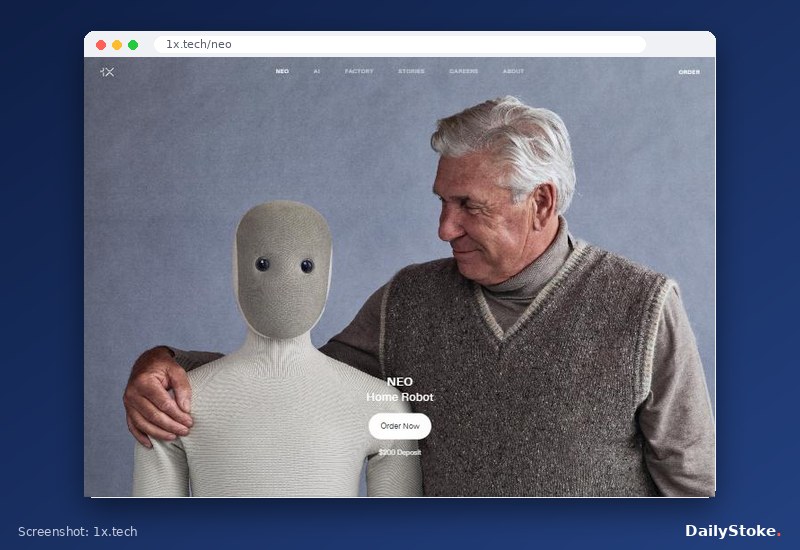
1X NEO Promo Code: None available
Best deal: a $200 refundable deposit reserves a NEO; buy for $20,000 or subscribe at $499 a month
| Offer detail | What you get |
|---|---|
| Promo Code | None. We found no public promo code for NEO |
| Early Access purchase | $20,000 (about £15,000), with priority delivery in 2026 |
| Subscription | $499 (about £374) a month; you keep paying until you return the robot |
| Who qualifies | US buyers only; 1X said at launch that other markets follow from 2027 |
| Key terms | $200 deposit, which 1X says is fully refundable until your robot is ready for delivery |
| How to claim | Reserve on 1x.tech, choose a colour (tan, grey or dark brown) and pay the deposit |
1X NEO at a glance
- Maker: 1X Technologies, Palo Alto, California; founded in Norway in 2014 as Halodi Robotics
- Preorders opened: 28 October 2025
- Price: $20,000 to buy, or $499 a month
- Availability: US only; first customer shipments planned for 2026
- Size: 5ft 6in (167cm), 30kg (66lb)
- Strength: lifts up to 70kg, carries up to 25kg (company figures)
- Battery: about 4 hours; finds its charger and plugs itself in
- Noise: 22 decibels, according to 1X
- Sensors: two 8-megapixel cameras, four microphones, three speakers
- Computer: NVIDIA Jetson Thor onboard
- Remote help: bookable “1X Expert” sessions, approved by the owner
- Ratings: no app store listing with ratings found
Our verdict
NEO is the most serious attempt yet to put a humanoid in an ordinary home, and 1X deserves credit for being upfront that remote operators are part of the package. The hardware choices are thoughtful: it is light, padded, quiet and charges itself. But at $20,000 you are paying to be part of the training process. Until independent reviewers have lived with a shipping unit, we would treat NEO as an expensive experiment rather than a reliable helper, and UK buyers cannot order one yet anyway.
Pros
- Designed for homes: 30kg, soft-bodied, washable suit, very quiet
- Charges itself and takes instructions by voice or app
- Owners approve every remote session and can set no-go zones
- Subscription option avoids the $20,000 up-front cost
- 1X is unusually open about what NEO cannot yet do
Cons
- Independent testing found most tasks were teleoperated
- Not sold in the UK or Europe
- No independently verified customer deliveries yet
- Data sharing is central to how it improves
- No published maintenance or repair prices that we could find
What 1X NEO does and who it is for
NEO is a two-legged humanoid that walks around your home, climbs stairs and uses its hands for household jobs. 1X lists examples such as emptying the dishwasher, answering the door, organising the entryway and tidying a bedroom, plus fetching items on request. You can give it a schedule of chores in the app or tell it what to do. It also talks, and 1X says it can answer questions using what it knows about the people and objects in your home.
The design is unusual. Instead of a hard metal shell, NEO has a soft 3D lattice polymer body under a knitted suit you can put in the washing machine. Its joints are driven by tendons, and 1X says its hands have 22 degrees of freedom.
Notice what is missing from 1X’s launch examples: cooking and changing the bedsheets. NEO is meant for indoor use, and 1X’s own FAQ tells owners that they “should remain attentive during operation”. This is not a robot you leave alone with a hob.
NEO suits a narrow group: US households with money to spare, who find the technology fascinating and are relaxed about a company’s employees occasionally seeing through its cameras.
1X NEO price: buying versus subscribing
There are two ways to pay, both after a $200 refundable deposit:
| Option | US price | About in £ | What you get |
|---|---|---|---|
| Early Access purchase | $20,000 | £15,000 | Priority delivery in 2026; you own the robot |
| Subscription | $499 a month | £374 a month | Standard delivery; return the robot when you stop paying |
Pound figures are conversions at about $1.33 to £1 in late October 2026; NEO is not sold in pounds.
Which is cheaper? The subscription costs $5,988 a year, so it passes the $20,000 purchase price after about three years and four months. If you are curious rather than committed, subscribing limits the risk. If you plan to keep NEO for years, buying works out cheaper, provided the robot keeps receiving software updates.
How much can NEO do on its own?
This is the heart of the matter. 1X describes NEO as autonomous by default, running AI on its onboard NVIDIA Jetson Thor computer rather than depending entirely on the cloud. In January 2026 it introduced the 1X World Model, which plans a task by generating video of how the scene should unfold, then converts that into movement. In 1X’s demonstrations, NEO packed a lunch box, opened a sliding door and ironed a shirt. These were company-curated clips, not independent tests.
For anything NEO cannot yet do, there is Expert Mode. You book a session in the app, a 1X employee connects, and they guide the robot through the task using its cameras while NEO learns. Experts cannot connect without your approval, and the session data helps train 1X’s models.
That answers the question in our introduction. In the early months, you have partly bought a robot and partly booked a remote helper. 1X argues this is how NEO gets better, and the company’s chief executive, Bernt Børnich, told the Wall Street Journal: “If we don’t have your data, we can’t make the product better.”
Privacy, data and safety
NEO’s two cameras, four microphones and remote operators make privacy the biggest question. 1X’s safeguards, as reported by New Atlas and PC Gamer, are:
- remote sessions only with the owner’s approval
- no-go zones the robot will not enter
- blurring of people in the remote operator’s video feed
- the option to see what NEO sees in the app
Børnich has been clear about the trade-off. “If you buy this product, it is because you’re okay with that social contract,” he told the WSJ, describing 1X as a “big sister” rather than “big brother”: “Big sister helps you. Big brother is just there to kinda monitor you.” Blurring faces does not hide everything, though: a remote operator can still see your rooms, your post and your mess. New Atlas also noted that 1X had not explained how it would protect owners against hacking.
On safety, 1X points to the soft body, enclosed joints and low weight. We found no independent safety certification for home use. For a fuller look at what home robots collect and who can see it, read our guide to home robot privacy.
What testers and critics say
The most revealing test so far came from Joanna Stern of the Wall Street Journal in October 2025. She found NEO was not ready to work on its own: tasks were slow, loading glassware into a dishwasher took about five minutes, and a teleoperator handled most of what she saw.
TechRadar’s Lance Ulanoff pointed out that launch videos show owners leaving the house while NEO cleans, and that it was unclear what happens if the robot gets stuck or falls. Abhimanyu Ghoshal at New Atlas put the privacy concern simply: “someone will have a view into your home through your robot’s eyes.”
None of these reviewers had a shipping unit to live with. As of late October 2026, 1X still describes first customer shipments as planned for 2026, and we found no independent report of a customer receiving one at home.
How to order 1X NEO
- Go to 1x.tech and choose Early Access purchase or the monthly subscription.
- Pick a colour: tan, grey or dark brown.
- Pay the $200 deposit. You need a US delivery address.
- Wait for 1X to contact you about delivery; it has not published individual delivery dates.
To cancel: 1X says the deposit is fully refundable until your robot is ready for delivery. Subscribers can return the robot when they stop paying. Check the order terms before committing.
1X NEO vs Unitree G1 vs Figure 03
| 1X NEO | Unitree G1 | Figure 03 | |
|---|---|---|---|
| Price | $20,000 or $499 a month | From $13,500 | Not for sale |
| Can you buy one? | Preorder, US only | Yes, including via UK dealers | No |
| Size | 167cm, 30kg | 132cm, about 35kg | Not published |
| Battery | About 4 hours | About 2 hours | Not published |
| Household chores | Yes, with remote help | No | In testing |
| Remote operation | Owner-approved Expert sessions | Remote control | Figure says demos are not teleoperated |
Pick NEO if you are in the US, want the robot most clearly designed for home life and accept remote help.
Pick the Unitree G1 if you want a humanoid now, in the UK or US, as a programmable platform rather than a housekeeper. See our Unitree G1 vs R1 comparison.
Wait for Figure 03 only if you are happy with no date and no price.
1X NEO alternatives
- Unitree R1: a 25kg humanoid from $4,900, on sale now, but a demonstration and development machine.
- Wheeled home robots: two-armed robots that skip legs entirely; see home robots that actually do housework.
- Companion robots: smaller, cheaper robots for conversation and company; see our AI companion robots guide.
Where 1X NEO stands in 2027
This year NEO is a product with a factory behind it rather than a prototype. 1X began full production at its 58,000 sq ft plant in Hayward, California, in April 2026, with capacity for 10,000 robots a year, and since January 2026 NEO has relied on the 1X World Model, which plans tasks by generating video of what should happen before it moves. Remote help is built into the product: owner-approved Expert sessions are part of how NEO learns.
The rules around it are tighter in Europe. The EU Machinery Regulation has applied since 20 January 2027, and machines whose safety functions learn and evolve must stay within limits set by the manufacturer, let people intervene, record safety-critical decisions and be assessed with an independent notified body.
1X NEO FAQs
How much does 1X NEO cost?
$20,000 to buy with priority delivery, or $499 a month on subscription, after a $200 refundable deposit.
Can I buy 1X NEO in the UK?
Not yet. Orders and deliveries are US only. At launch, 1X said other markets would follow from 2027, but it has not announced UK prices or dates.
Is 1X NEO teleoperated?
Partly. 1X says NEO works autonomously by default, but owners can book remote 1X Expert sessions for tasks it cannot yet do. In the Wall Street Journal’s October 2025 test, a teleoperator handled most tasks.
Has 1X NEO started shipping?
1X began full production in April 2026 and says first customer shipments are planned for 2026. As of late October 2026 we found no independent report of a customer receiving one at home.
Can 1X NEO cook dinner?
Cooking is not among 1X’s launch chores, which include emptying the dishwasher, answering the door and tidying.
Is 1X NEO safe to have at home?
It is light and soft-bodied, but 1X tells owners to stay attentive while it works, and we found no independent home-safety certification.
More on DailyStoke
Humanoid robots for the home · Unitree G1 vs R1 · Home robot privacy · Companion robots for elderly people · Humanoid robots: what they can actually do