I can see why families might like the idea of a robot keeping an older parent company. It could remind them about appointments, help with simple tasks or just be there when nobody else is around.
But I wonder whether we’re looking at this from the wrong perspective.
Would the person actually want a robot? It’s one thing for the family to feel reassured knowing there’s a device in the house. It’s another thing entirely for someone to have a machine reminding them to take their medicine or asking why they haven’t moved around much today.
And what about loneliness? A robot might be pleasant company, but does that make someone less lonely? Or could it become an excuse for relatives to visit less often?
I like the idea of technology helping people remain independent. I’m less convinced that companionship is something we can simply automate.
The short answer: companion robots can lift mood and offer a little conversation or comfort, and the best evidence, mostly from care homes, shows small benefits. They are not carers, they are not medical devices, and none of the companion robots we looked at offers dependable fall detection or emergency response. If safety is the worry, a telecare alarm linked to a monitoring centre does that job. If loneliness is the worry, a robot can be a supplement to people, never a substitute.
What the research says about robots and loneliness
The studies are more cautious than the marketing. Here are the ones worth knowing, by name and year.
| Study | Robot | Setting | What it found | Caveat |
|---|---|---|---|---|
| Moyle et al., JAMDA, 2017 | PARO seal | 28 Australian care homes, 415 people with dementia | Better mood and less observed agitation than usual care | Beat a plush toy only on engagement |
| Pu et al., The Gerontologist, 2019 | Various social robots | Meta-analysis of 11 randomised trials | Positive trends in wellbeing | Pooled results not statistically significant; “lack of high-quality studies” |
| Papadopoulos et al. (CARESSES), International Journal of Social Robotics, 2022 | Pepper | Care homes including in England, up to 18 hours over two weeks | Significant improvement in mental health; small positive effect on loneliness | Short trial |
| Bradwell et al., JMIR Aging, 2022 | Joy for All cat and dog | Eight Cornwall care homes, eight months | Fewer neuropsychiatric symptoms | Partly run during Covid-19 |
| UK and Japanese team, medRxiv preprint, 2025 | Conversational agents, including robots | Meta-analysis of 17 studies | Mild to moderate reduction in loneliness | Not yet peer reviewed |
The best-known trial is Moyle and colleagues’ 2017 study of PARO, the robotic seal, in the Journal of the American Medical Directors Association. PARO beat usual care on mood and agitation. But compared with a plush toy given the same sessions, it did better only at getting people engaged. In other words, much of the benefit came from having something soft to hold and attention around it.
Pu, Moyle, Jones and Todorovic’s 2019 meta-analysis in The Gerontologist pooled randomised trials and found positive effects on agitation and quality of life that were not statistically significant, concluding that firm conclusions were limited by the lack of high-quality studies.
The UK has contributed two useful trials. CARESSES tested a “culturally competent” Pepper robot in care homes, including Advinia homes in England; Middlesex University reported a significant improvement in mental health and a small, positive impact on loneliness after two weeks, and the trial was published in the International Journal of Social Robotics. In Cornwall, Dr Hannah Bradwell’s team at the University of Plymouth gave £100 Joy for All robot cats and dogs to residents across eight care homes and found reduced neuropsychiatric symptoms, published in JMIR Aging in 2022.
A 2025 meta-analysis posted on medRxiv found a mild to moderate reduction in loneliness from conversational agents in older people without cognitive impairment, but noted that no included study measured social isolation with a validated scale. Loneliness and isolation are different things: a robot may make an evening feel less empty without adding a single human visit.
ElliQ: reminders, check-ins and New York’s experiment
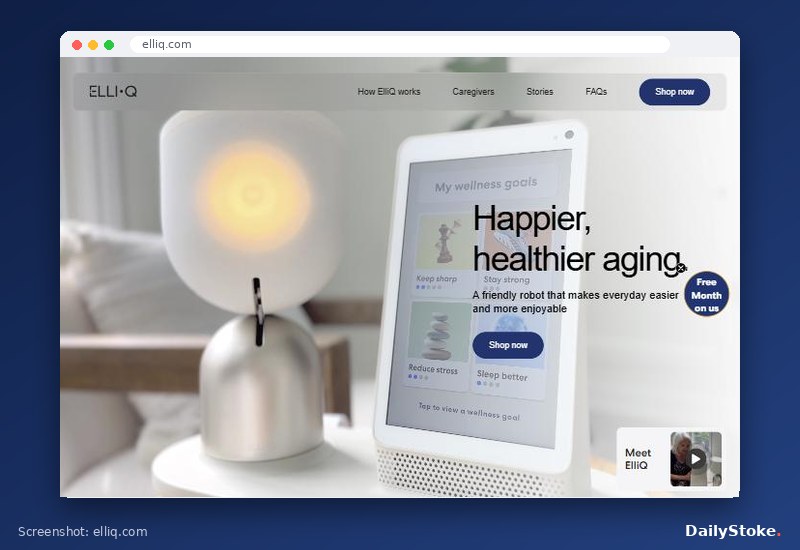
ElliQ, from Intuition Robotics, is the companion robot built most squarely for older people living alone. It is a tabletop device with an expressive light-up “head” and a touchscreen. It starts conversations, suggests activities, remembers what the person tells it, runs exercise and relaxation sessions, and sets medication and hydration reminders. A family app lets relatives schedule reminders, see when the person was last active, send photos and start video calls, and receive alerts if the user reports pain or a change in mood, according to ElliQ’s site.
It is US-only and leased by subscription: ElliQ lists a $249 enrolment fee, then $59 a month, $49 a month on an annual plan or $39 a month over 24 months.
The largest real-world use is in New York. The New York State Office for the Aging (NYSOFA) has supplied around 900 units to older people identified by local offices for the aging. Its July 2023 report cited a 95% reduction in loneliness among users. In October 2026 the state extended the programme; newly reported data put average use at 48 interactions a day, with 94% saying they felt less lonely, Robotics & Automation News reported. These are programme surveys from the state and the vendor, not an independent controlled trial, and there was no comparison group. They show people like it and use it; they do not prove it reduces loneliness more than, say, a weekly volunteer visit.
Note what NYSOFA stresses: all contact with family or case managers is directed by the user. That is the right model.
Other robotic companions for older adults
PARO is a therapeutic robot seal used in care homes and hospitals. It is expensive, around £5,000 according to the University of Plymouth, and is generally bought by care providers rather than families.
Joy for All robot cats and dogs cost around £100 and are among the robot pets UK care homes have tried. Lancashire County Council has placed 20 robotic cats and dogs in care homes to tackle loneliness and isolation, UKAuthority reported.
Casio Moflin, launched in the UK at £369, is a furry, wordless pet robot with a microphone and touch sensors but no camera. It may suit someone who would enjoy something to stroke but would hate being watched. We compare it with other options in our AI companion robots listing.
Humanoid robots such as 1X NEO are sometimes pitched for helping older people at home, but as our humanoid robots for the home guide explains, they are early, expensive and may rely on remote operators for complex tasks.
Companionship is not care: falls, emergencies and what robots cannot promise
This is the distinction families most need to hold on to.
ElliQ’s own site says: “ElliQ is not a medical device, but encourages members to contact their caregiver and trusted contacts.” We found no fall detection or automatic emergency dispatch on its pages. A reminder to take tablets is not the same as checking they were taken, and a cheerful check-in is not the same as someone noticing a stroke.
For safety, the UK already has telecare: pendant or wrist alarms, fall detectors and sensors linked to a 24-hour monitoring centre, often arranged through the local council. About 1.8 million UK households use telecare, Which? reported in 2025. Ask your council’s adult social care team or an alarm provider about it; NHS and social care staff can also advise after a fall.
There is a timely catch. The UK’s old copper phone network is being retired, and the government says most customers should be switched to digital lines by the end of January 2027, according to GOV.UK. Older analogue alarms may not work properly on digital lines, and digital lines do not work in a power cut without a battery backup. Which? notes that two people died in 2023 when telecare devices failed after an earlier switchover. If your parent has an alarm, tell their phone provider they rely on it and check the device works on a digital line.
Consent, dignity and privacy: ask them first
The question in the introduction, “would the person actually want a robot?”, is the one that matters most.
- Ask, and keep asking. The older person should choose the device, agree to every setting, and be able to switch it off or send it back. ElliQ offers a 30-day money-back guarantee.
- Decide who sees what. Caregiver apps can show activity times and mood reports. Agree in advance what relatives can see, and do not enable monitoring the person has not agreed to.
- Watch the tone. Reminders that feel like nagging, or questions about why they haven’t moved, can feel infantilising. Turn off what irritates.
- Mind the camera. A device with a camera in a bedroom or bathroom is a dignity issue as much as a privacy one. Our home robot privacy investigation explains what different robots record and send to the cloud.
- Plan for capacity changes. If dementia progresses, decisions about monitoring should involve whoever holds lasting power of attorney for health and welfare, and the person’s own wishes as far as they can express them.
- Don’t let it replace visits. Use the robot to add contact: shared photos, video calls, a reason to talk about what it said today.
Robot companions for older people in 2027: where things stand
This year the UK’s analogue phone network has largely gone, after the switch to digital lines that the government set for the end of January 2027, so telecare alarms, not companion robots, remain the backbone of emergency help at home, now running over digital lines that need battery backup in a power cut. Ofcom expects providers to offer at least one free option that keeps emergency calls working for at least an hour during an outage for customers who depend on their landline.
In the US, New York State has extended its ElliQ programme after three years of data, making it the longest-running public trial of a companion robot for older adults. ElliQ itself is still not sold in Britain, and the strongest UK evidence on robot companionship still comes from care homes rather than private homes.
Companion robots for elderly relatives: questions answered
Can a companion robot detect a fall?
None of the companion robots we looked at offers dependable fall detection, and ElliQ says it is not a medical device. For falls, use a telecare alarm or fall detector connected to a monitoring centre, which your council can often arrange.
Is ElliQ available in the UK?
No. ElliQ is sold only in the US, as a lease with a $249 enrolment fee and a monthly subscription from $39. In the UK, the realistic options are robot pets such as Joy for All or Casio’s Moflin, alongside telecare.
Do robot pets help people with dementia?
Trials in care homes suggest they can improve mood and reduce agitation for some residents. The 2017 PARO trial found it beat a plush toy only on engagement, and the 2022 Cornwall study of £100 Joy for All pets reported fewer neuropsychiatric symptoms. Results vary from person to person, and some people simply do not like them.
Will a robot make my parent less lonely?
Some studies report small reductions in loneliness, and ElliQ users in New York say they feel less lonely, though those are programme surveys rather than controlled trials. A robot cannot replace human relationships, and it works best as a way to add contact, such as video calls and shared photos.
Should I install a robot without telling them?
No. Monitoring someone without their agreement undermines their dignity and trust, and may raise legal issues. Involve them in the choice, agree what family can see, and make sure they can switch it off.