The best budgeting apps in the US are no longer free, and that is mostly a good thing. When Intuit closed Mint on March 23, 2024 and moved its users to Credit Karma, millions of people discovered that a free app paid for by ads and card offers was never really working for them. The apps that replaced it charge a subscription, and in return they sync your accounts, sort your spending and, in the best cases, change how you think about money.
This guide is for anyone who wants to stop wondering where the paycheck went. We ranked six budgeting apps on how well they help you plan, not just track, plus price, account syncing, sharing with a partner and how much effort they ask of you. Prices are in US dollars and were checked on October 29, 2026.
At a glance: the best budgeting apps compared
| Rank | App | Price | Best for | Standout fact |
|---|---|---|---|---|
| 1 | Monarch | $14.99 a month or $99.99 a year | Couples and households | Partner sharing at no extra cost; 13,000+ connected institutions |
| 2 | YNAB | $14.99 a month or $109 a year | Breaking the paycheck-to-paycheck cycle | Zero-based method: every dollar gets a job |
| 3 | Rocket Money | Free; Premium choose-your-price | Cutting subscriptions and bills | Cancels unwanted subscriptions for you |
| 4 | Copilot | $13 a month or $95 a year | iPhone and Mac users | Polished Apple-first design |
| 5 | EveryDollar | Free; Premium $79.99 a year or $17.99 a month | Dave Ramsey fans | Simple zero-based budget with a free manual plan |
| 6 | Goodbudget | Free; Premium $80 a year or $10 a month | Envelope budgeters | Free plan with no bank linking required |
How we chose the best budgeting apps
We looked at the apps Americans most often move to after Mint, then compared them on the official pricing pages, help centers and US App Store and Google Play listings. We weighed four things: whether the app helps you plan ahead rather than only categorize the past, how reliable and wide its bank syncing is, whether a partner can share it, and what it costs over a year. We did not run every app for months side by side; method and features are described from each company’s documentation, store listings and owner reviews.
A note on Mint: it is gone. Intuit shut it down on March 23, 2024, and while Credit Karma kept spending and net worth tracking, monthly budgets and custom categories did not carry over.
The best budgeting apps, ranked
1. Monarch
Monarch is the closest thing to a grown-up Mint, and the best all-rounder for households. It pulls your checking, credit card, loan and investment accounts into one dashboard, with budgets, cash flow, net worth, recurring charges, goals and custom reports. Monarch says it connects to more than 13,000 institutions through several data providers, which helps when one connection breaks.
What sets it apart is sharing. You can invite a partner at no extra cost, and both of you see the same picture from your own logins. The company, founded in 2018 by Val Agostino, Jon Sutherland and Ozzie Osman, carries no ads and passed one million members in March 2026.
The price is $14.99 a month or $99.99 a year for the Core plan, with the first week free. A Plus tier adds forecasting, business tracking and deeper investment analysis.
Price: $14.99 a month or $99.99 a year (Core)
Pros
- Partner sharing at no extra cost
- Budgets, net worth, investments and recurring charges in one place
- No ads; first week free
Cons
- No free plan
- Plus tier is annual only and desktop only for now
Read our full Monarch Money review.
2. YNAB
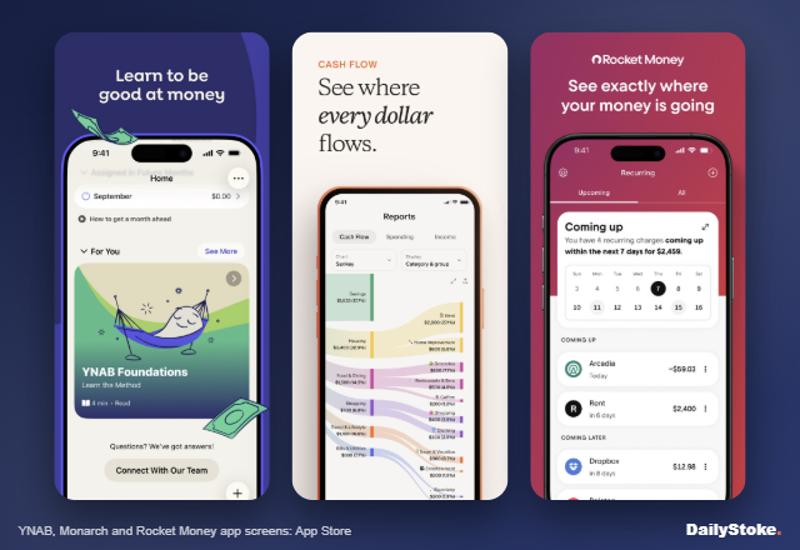
YNAB (You Need A Budget) is less an app than a method with an app attached. It uses zero-based budgeting: before you spend, you assign every dollar you have to a job, whether that is rent, groceries or next year’s car insurance. When you overspend in one category, you move money from another, so the budget always balances with reality.
That takes work, especially in the first month, and YNAB is honest about it. The reward is that people who stick with it tend to stop living paycheck to paycheck. YNAB’s own figures, in its App Store listing, say the average user saves $600 in the first month and $6,000 in the first year; treat that as the company’s claim, not an independent result.
It costs $14.99 a month or $109 a year after a free trial (34 days when you sign up on YNAB’s website), and runs on iPhone, Android and the web.
Price: $14.99 a month or $109 a year
Pros
- Changes behavior, not just tracking
- Excellent for irregular bills and incomes
- Rated 4.8 from 62K ratings on the US App Store
Cons
- Steepest learning curve on this list
- Most expensive annual plan here
Read our full YNAB review.
3. Rocket Money
Rocket Money (formerly Truebill, now owned by Rocket Companies) is the best app for finding money you are wasting. It spots recurring subscriptions, and on Premium it will cancel the ones you no longer want. It also negotiates cable, phone and insurance bills, for a fee of 35% to 60% of the first year’s savings, which you choose within that range.
The free tier is genuinely usable, with spending breakdowns, balance alerts and a credit score. Budgets, net worth tracking and the web version need Premium, which uses pay-what-you-think-is-fair pricing; Rocket Money’s own pricing guide puts typical amounts at $7 to $14 a month. Premium+ costs $15 a month and drops the bill negotiation fee. As a budgeting tool it is lighter than Monarch or YNAB, but for many people cancelling three forgotten subscriptions does more than any spreadsheet.
Price: Free; Premium choose-your-price; Premium+ $15 a month
Pros
- Cancels subscriptions for you on Premium
- Bill negotiation on common household bills
- Free tier worth using
Cons
- Negotiation fee of 35% to 60% of first-year savings on Free and Premium
- Budgets need Premium
Read our full Rocket Money review.
4. Copilot
Copilot is the best-looking budgeting app on this list and the obvious choice if you live on an iPhone and a Mac. It categorizes transactions automatically, learns from your corrections, and makes reviewing your spending feel quick rather than like homework. Investment and net worth tracking are built in.
The trade-off is reach. Copilot has native apps for iPhone, iPad and Mac plus a web app, but no Android app, and it has no free plan. It costs $13 a month or $95 a year after a 30-day free trial. If your household is mixed iPhone and Android, Monarch is the safer pick.
Price: $13 a month or $95 a year
Pros
- Clean, fast design with smart categorization
- Strong net worth and investment views
Cons
- No Android app; Android users are limited to the web version
- No free plan
5. EveryDollar
EveryDollar comes from Ramsey Solutions, the company of radio host Dave Ramsey, and follows his zero-based approach. The free version is a simple budget in which you enter transactions by hand, which some people find useful precisely because it forces attention. Premium adds bank connections that import transactions automatically, payday-based planning, custom reports and access to coaching, with a 14-day free trial for new users. It costs $79.99 a year (about $6.67 a month) or $17.99 billed monthly, so the annual plan is the only sensible way to pay.
It is easier to learn than YNAB but less flexible, and the app leans on Ramsey’s wider program of debt payoff “baby steps.” If that philosophy appeals, it is a friendly start.
Price: Free; Premium $79.99 a year or $17.99 a month
Pros
- Free manual budget
- Simple zero-based setup
Cons
- Bank syncing costs extra
- Tied closely to the Ramsey method
6. Goodbudget
Goodbudget is the digital version of the envelope system: you split your income into virtual envelopes for each spending category and draw them down as you go. It does not need to connect to your bank at all, which suits anyone who prefers not to share logins, and it syncs between partners’ phones.
The free plan gives you 10 regular envelopes, 10 annual or goal envelopes, one account, sharing across two devices and a year of history. Goodbudget Premium, at $10 a month or $80 a year in the US, unlocks unlimited envelopes and accounts, up to five devices and seven years of history. Manual entry is the point, not a flaw, but it does mean more effort than an app that imports transactions.
Price: Free; Premium $10 a month or $80 a year
Pros
- Free plan; no bank connection required
- Easy to share with a partner
Cons
- Every transaction entered by hand
- Basic reporting
How to pick a budgeting app: what matters and what to ignore
Decide between tracking and planning. Tracking apps (Rocket Money, Copilot) tell you where money went. Planning apps (YNAB, EveryDollar, Goodbudget) make you decide where it goes before you spend. Monarch sits in between. If you are already saving each month, tracking may be enough; if you are not, a planning app usually helps more.
Check your banks connect. Every app that syncs relies on data aggregators, and connections sometimes break. Before you pay for a year, link your main accounts during the free trial and check transactions arrive correctly.
Think about your partner. Shared money needs a shared app. Monarch and YNAB both let you share a subscription; check the other person’s phone is supported before committing.
Do the annual sums. At $80 to $109 a year, the paid apps cost about the same as two or three forgotten streaming subscriptions. If the app does not find or save at least that, it is not working for you.
What to ignore: credit score widgets you already get free from your card issuer, lifetime deals you will not use for long, and AI “insights” that only restate your spending.
Budgeting apps: your questions answered
What happened to Mint?
Intuit shut Mint down on March 23, 2024, and invited users to move to Credit Karma, which Intuit also owns. Credit Karma kept spending and net worth tracking, but not Mint’s monthly budgets or custom categories.
What is the best free budgeting app?
Rocket Money’s free tier is the most useful for tracking spending and spotting subscriptions. For an actual budget, Goodbudget and EveryDollar both offer free plans built on manual entry.
Is YNAB better than Monarch?
They suit different people. YNAB is better if you need to change habits and want a strict method; Monarch is better for an all-in-one view of a household’s accounts, investments and net worth, and is cheaper per year at $99.99 against $109.
Are budgeting apps safe to link to my bank?
The major apps use established data aggregators and encryption, and Rocket Money, for example, says your bank login goes directly to Plaid rather than to Rocket Money itself. Use a strong password and two-factor authentication on the app, and unlink accounts you no longer need.
Which budgeting app is best for couples?
Monarch, because a partner can join at no extra cost and see the same budgets from their own login. YNAB also lets you share one subscription, and Goodbudget syncs envelopes between two phones on its free plan.
Do budgeting apps really help you save money?
They help if you look at them. Tracking alone rarely changes behavior; the gains usually come from a weekly check-in, cancelling unused subscriptions and planning for irregular bills before they arrive.