A good flight tracker earns its keep on two kinds of day: when you are collecting someone from Gatwick and want to leave at the right moment, and when your departure board says “on time” while the aircraft meant to take you is still on the tarmac in Lisbon. The right app tells you before the airline does.
We have ranked ten apps and websites for passengers, the people meeting them and the frequent flyers who live by their alerts. We weighed live position, delay and gate-change alerts, “where is my plane” tracking of the inbound aircraft, coverage over Europe, how much is free and what the paid tiers cost in pounds on the UK App Store.
Flight tracking apps at a glance
| Rank | App or site | Price (UK) | Best for | Standout fact |
|---|---|---|---|---|
| 1 | Flightradar24 | Free; Silver from £2.99 a month, Gold £33.99 a year | Most people | About 58,000 receivers plus satellite data |
| 2 | Flighty | Free; Pro £59.99 a year, Lifetime £299 | Frequent flyers on iPhone | Pro is free for your first flight |
| 3 | FlightAware | Free; Ad Remove 99p a month or £8.99 a year | Free alerts and US trips | Free flight status alerts in the app |
| 4 | Plane Finder | Free; Premium £3.49 a month or £19.99 a year | A calmer, British-made map | Playback listed back to 2011 |
| 5 | AirNav Radar | Free; Spotter from £2.99 a month | Spotters on a budget | Feeders get a free Business account |
| 6 | TripIt | Free; Pro £38.99 a year | Organising whole trips | Builds itineraries from forwarded emails |
| 7 | FlightStats | Free; alerts from $2.99 a month | Quick status checks | Airline schedule data from Cirium |
| 8 | Google Search and Google Flights | Free | No download at all | Status card at the top of the results |
| 9 | ADS-B Exchange | Free; ad-free $2.99 a month or $29.95 a year | Unfiltered enthusiast data | “No filtering or blocking” of aircraft |
| 10 | Aviate | Free; Pro $39.99 a year | Android users who want Flighty | Gate predictions from past flights |
How we chose the best flight trackers
We started with every serious flight tracker still available in the UK in October 2026 and dropped those that have closed (App in the Air shut down in 2024) or rate poorly with users. Prices come from the UK App Store and official websites, checked in October 2026; where a service only publishes dollar prices, we give those.
We have used Flightradar24, FlightAware, Flighty and Plane Finder to meet arrivals and follow our own flights. For the others we relied on official feature lists, store listings, owner reviews and independent technology coverage. We favoured apps that answer a passenger’s questions: is my plane late, where is it, has the gate changed?
The 10 best flight tracking apps and sites, ranked
1. Flightradar24
Flightradar24 is the one to install first. The Swedish company draws on roughly 58,000 receivers, many run by enthusiasts at home, and fills the oceans with satellite data. The free app shows the live map, flight details, a 3D cockpit view, seven days of history and an AR mode that identifies the plane over your garden.
The catch is advertising, which long-standing users increasingly complain about. Silver removes it and adds alerts, 90 days of history and weather at more than 3,000 airports. Gold adds a year of history, weather layers and air traffic control boundaries. A 7-day free trial applies to every paid plan.
Price: free with ads; Silver £2.99 a month or £13.99 a year; Gold £5.99 a month or £33.99 a year (UK App Store).
Pros
- Excellent worldwide coverage, including over water
- AR identification and 3D view are free
Cons
- Ads in the free app are intrusive
- Alerts require Silver
Read our full Flightradar24 review.
2. Flighty
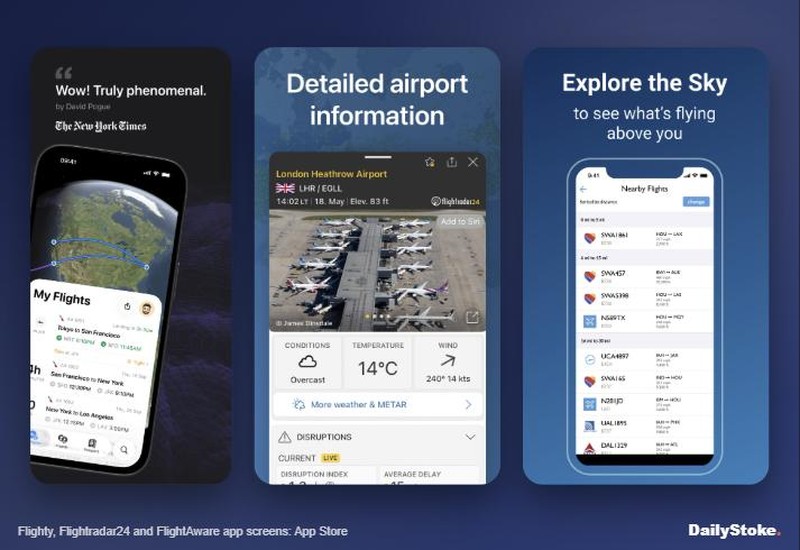
Flighty is less a radar map and more a personal assistant for your own flights. Add a booking and it builds a timeline: departure gate, the inbound aircraft and where it is now (“Where’s My Plane”), predicted delays with a reason, taxi times and the baggage belt. It draws on FAA data, air traffic control advisories and airport feeds such as Eurocontrol, and Pro adds lock-screen Live Activities and push alerts that often beat the airline’s.
There are no ads and the free plan tracks unlimited flights. Your first flight includes Pro; after that, push notifications and delay predictions pause unless you pay. The big limitation: it is Apple-only (iPhone, iPad, Watch, Mac and Vision Pro), with no immediate plans for Android.
Price: free; Pro £59.99 a year, Pay-As-You-Go £4.99, Family £119 a year for up to six people, Lifetime £299 (UK App Store).
Pros
- The clearest view of your own flight and the inbound aircraft
- No ads, even on the free plan
Cons
- Alerts are Pro only after your first flight
- No Android app
Read our full Flighty review.
3. FlightAware
Houston-based FlightAware, part of Collins Aerospace since 2021, is the tracker to pick if you want alerts without paying. The free app sends flight status notifications for departures, arrivals, gate changes, delays, cancellations and diversions, and its “Where is my plane?” view shows whether the inbound aircraft is the reason you are late. It combines air traffic control data from more than 45 countries, ADS-B ground stations in 195 countries and Aireon’s space-based ADS-B.
It is strongest in North America and feels busier than Flightradar24. Ad removal is among the cheapest upgrades here; the Aviator plans are for private pilots, not passengers.
Price: free with ads; Ad Remove 99p a month or £8.99 a year; Aviator from £8.49 a month (UK App Store).
Pros
- Free push alerts for gate changes and delays
- Cheap ad removal
Cons
- Cluttered map compared with the leader
- No AR sky view
Read our full FlightAware review.
4. Plane Finder
Plane Finder is made by Pinkfroot, a small British developer, and it is the tidiest alternative to Flightradar24. You get a live map with altitude, speed and heading, airport arrival and departure boards with weather, custom alerts and filters, a 3D mode and an AR view that uses your camera to name aircraft overhead. Its playback feature is listed as going back to 2011, which is unusual.
The free version carries ads. Premium removes them and unlocks the 3D mode and, in the developer’s words, more than 50 extra features. There is a single paid tier, the annual plan comes with a free trial, and it runs on Apple Watch.
Price: free with ads; Premium £3.49 a month or £19.99 a year (UK App Store).
Pros
- Clean, uncluttered design
- One simple Premium plan
Cons
- Free version is ad-heavy
- Smaller receiver network than the market leader
Read our full Plane Finder review.
5. AirNav Radar
AirNav Radar, which most enthusiasts still know as RadarBox, is a radar-style tracker with flight cards, aircraft details, playback and airport boards. It suits spotters who like to dig into aircraft data.
The plans are confusing. Spotter is the ad-free tier; Pilot adds map layers and weather; Business adds track downloads and aircraft utilisation statistics. Plans bought on the website come with a 7-day free trial, and anyone feeding ADS-B data from a home receiver gets a free Business account.
Price: free with ads; Spotter £2.99 a month or £13.99 a year; Pilot £5.99 a month or £34.99 a year; Business £49.99 a month (UK App Store).
Pros
- Low-cost ad-free tier
- Generous reward for data feeders
Cons
- Confusing range of plans and promotional prices
- Fewer UK ratings than the big names
Read our full AirNav RadarBox review.
6. TripIt
TripIt is not a radar map. It is a travel organiser that turns your forwarded booking emails into a single itinerary, with flights, hotels and trains in one place. It earns a place here because TripIt Pro adds real-time flight status alerts, check-in reminders, terminal and gate reminders and a Seat Tracker that watches for a better seat.
It is owned by SAP Concur and popular with business travellers. If you want flight alerts alongside the hotel address and the train home, it makes more sense than a pure tracker; for a single flight, it is overkill. Flighty can also import trips from TripIt.
Price: free; TripIt Pro £38.99 a year (UK App Store), $49 a year on the website, with a free trial.
Pros
- Whole trips built automatically from emails
- Flight alerts plus seat and check-in reminders
Cons
- No live map of aircraft
- Alerts are Pro only
7. FlightStats
FlightStats is the consumer face of Cirium, one of the big aviation data companies, and it is a solid place to check a flight’s status by number, route or airport. Its strength is schedule data: departure and arrival times, gates, delay indexes for airports and a timeline of what has happened to a flight. The free iPhone app adds a Today widget, Siri Shortcuts and departure and arrival boards.
It is best for a quick look. The iPhone app was last updated in October 2024, according to its UK listing, and email alerts are paid: Standard is $2.99 a month for 25 alert rules, Professional $24.99 for 250.
Price: free status lookup; Flight Alerts Standard $2.99 a month, Professional $24.99 a month (flightstats.com).
Pros
- Reliable schedule and gate information
- Airport delay overview
Cons
- Alerts cost extra
- App feels dated
8. Google Search and Google Flights
Sometimes you do not need an app at all. Type a flight number followed by “status” into Google and a card at the top of the results shows the estimated departure and arrival times, terminal, gate and any delay. It is the quickest check there is for the person waiting at arrivals who has never heard of ADS-B.
Google Flights is a fare search engine rather than a tracker, but its price tracking emails you when fares move on a route you are watching. Neither offers a live map, the inbound aircraft or gate-change alerts, but for a one-off check on a relative’s flight, nothing is simpler.
Price: free.
Pros
- Nothing to install or sign up for
- Fare tracking for future trips
Cons
- No live map or inbound aircraft
- No gate-change notifications
9. ADS-B Exchange
ADS-B Exchange is the enthusiasts’ tracker, built on receivers hosted by aviation fans worldwide and run mainly in the browser; its iPhone companion, Tailvision, launched in August 2026 and covers aircraft near you. Its selling point is principle: its subscription page promises “no filtering or blocking”, which is why it shows military and private aircraft that other trackers hide. It was bought by the aviation data company JETNET in 2023, when its founder said the aim was to keep its “enthusiast roots and unfiltered data”.
For passengers it is less useful: there are no flight alerts, and the map is designed for people who know what a squawk code is. The ad-free subscription adds satellite layers, ownership information and map history back to March 2020; feeders get it free.
Price: free with ads; ad-free $2.99 a month or $29.95 a year (ADS-B Exchange store).
Pros
- Shows aircraft others block
- History back to 2020
Cons
- No passenger alerts
- Interface built for enthusiasts
Read our full ADS-B Exchange review.
10. Aviate
Aviate launched on Google Play in July 2026 as an Android answer to Flighty, and it is the most interesting new option for people who do not own an iPhone. It follows your own flights rather than the whole sky, with gate predictions based on past flights, weather and precipitation radar, indoor airport maps, calendar sync and a profile of the airports, airlines and countries you have visited.
It is young: its Google Play rating stood at 3.3 when we checked. Basic tracking is free, and Pro can be bought for a week or two at a time, which suits occasional travellers.
Price: free; Pro from $1.99 a week, $39.99 a year or $199.99 lifetime at launch (US prices; Google Play shows the local price before you pay).
Pros
- Flighty-style design for Android
- Short Pro passes for single trips
Cons
- New and still maturing
- Mixed early ratings
New flight tracking sites to try in 2027
Two newcomers from Sweden deserve a bookmark if all you need is the status of a passenger flight, with nothing to install. Both are websites only, with no app, and both stick to passenger services rather than cargo or private aviation, which keeps their boards uncluttered. We have not ranked them yet; they are too new for a full verdict.
Flightinformation.com
Flightinformation.com is a new real-time flight status site from Westcoast Digital AB, a small team in Trollhättan, Sweden. Search a flight number and it shows live status, delays and cancellations. It is unusually open about its sources: the about page lists each data feed and how fresh it is, which few rivals bother to do. When we looked in October 2026 its schedule database covered more than 170,000 flight numbers, 665 airlines and around 3,800 airports. For a plain answer to “is my flight on time?”, it is quick and free of clutter.
Airportinformation.com
Airportinformation.com, from the same Swedish company, works from the airport side. It has a page for each of more than 3,000 airports worldwide, with live departures and arrivals boards refreshed every five minutes, a delays page, and the destinations and airlines each airport serves. Schedules run up to a year ahead, handy when planning a trip from a regional airport. The pages carry adverts, and there is no app, but it is a fast way to check the board before you leave for the airport.
Buying guide: choosing a live flight tracker
Free or paid flight tracking: what you actually get
Every app here has a free tier, and for meeting arrivals the free Flightradar24 or FlightAware is enough. You pay for no ads, longer history and alerts. FlightAware gives alerts free, Flighty on your first flight, Flightradar24 on Silver. Pay yearly: Flightradar24 Silver is about £1.17 a month on the annual plan, against £2.99 monthly.
ADS-B coverage and why some flights vanish
Most trackers read ADS-B, the position signal aircraft broadcast, through ground receivers that hear aircraft within about 300km. Coverage is dense over the UK and Europe and patchy over oceans and remote land unless the app buys satellite data, as Flightradar24 and FlightAware do. A plane that disappears has usually flown out of range.
Airline data versus radar data
Radar-style apps show where a plane physically is. FlightStats, TripIt and Google show what the airline has published: gate, times and delays. Flighty combines both, so you can see your flight still says “on time” while the inbound aircraft has not left. The airline’s own app has the final word on gates and rebooking.
Delay and gate-change alerts
Flighty Pro and FlightAware push alerts for gate changes, delays, cancellations and diversions; FlightStats alerts arrive by email and cost extra. Turn on notifications, or none of this works.
Privacy and blocked aircraft
Many private, government and military aircraft are deliberately hidden. In the US, the FAA’s LADD programme lets owners ask for their aircraft to be withheld, and vendors that take the FAA’s data feeds must filter them. Flightradar24 and FlightAware both block such aircraft; ADS-B Exchange does not. On your side of the screen, check each app’s App Store privacy label: Flightradar24 and FlightAware list data used to track you, while Flighty lists none.
What to ignore
Ignore lifetime deals unless you fly constantly: Flighty Lifetime at £299 equals five years of Pro. Ignore pilots’ tiers such as FlightAware Aviator unless you own an aircraft.
Flight tracking in 2027: Wallet alerts and new delay rules
In 2027 some of the tracking has moved into the phone’s own wallet. Apple’s iOS 26 boarding passes put a Live Activity on the lock screen, link to airport maps and follow AirTag-equipped bags through Find My, and you can share the Live Activity with whoever is meeting you, on airlines that support it; United was first. Google’s AI Mode added flight price tracking in more than 180 countries in August 2026.
The rules on delays have moved too. The EU’s revised air passenger rights regulation, adopted in July 2026, keeps compensation of €300 to €600 for delays of more than three hours, gives passengers nine months to claim and gives airlines 30 days to pay or explain, once its one-year run-in ends. Either way, a tracker’s record of when you actually landed is handy evidence.
Flight tracker FAQs
What is the best free flight tracker app?
Flightradar24 is the best free all-rounder, with a live map, AR mode and seven days of history. For free delay and gate alerts, FlightAware is better.
Which flight tracker shows where my inbound plane is?
Flighty’s “Where’s My Plane” and FlightAware’s “Where is my plane?” both show the aircraft due to operate your flight and where it is now. On Flighty this is a Pro feature after your first free flight.
Is Flighty better than Flightradar24?
They do different jobs. Flighty is built around your own bookings, while Flightradar24 shows every aircraft in the sky. Many frequent flyers use both.
Why can’t I see a private jet on a flight tracker?
It may be out of receiver range, not broadcasting ADS-B, or blocked at the owner’s request through schemes such as the FAA’s LADD programme. ADS-B Exchange is the main tracker that does not filter blocked aircraft.
Are flight trackers accurate?
ADS-B positions are close to real time, though some FAA data in the US is delayed by about five minutes. Estimated arrival times shift during the flight, so treat the airport board as the final word.
Do flight tracker apps work offline?
No. Live tracking needs mobile data or Wi-Fi. If you are following a flight from abroad, a travel eSIM keeps you connected without roaming charges.