The short answer: for most people planning a holiday from Britain, a general assistant such as ChatGPT or Google Gemini does the thinking better than the dedicated AI trip planners, while the specialist apps are better at turning that thinking into a map, a shared plan or a booking. None of them is reliable enough to book from without checking, and the published evidence on that point is blunt.
We compared the main options open to UK users in 2026: ChatGPT, Google Gemini with Google’s AI travel features, Mindtrip, Layla, Wonderplan, Trip.com’s TripGenie, and the Booking.com and Expedia assistants. Here is what each draws on, costs and can book, and where it slips.
The AI trip planners at a glance
| Tool | Price (UK) | Where its answers come from | Can it book? | Biggest catch |
|---|---|---|---|---|
| ChatGPT | Free; Go £6.99, Plus £19.99 a month (UK App Store) | Model plus web search; Expedia and Booking.com apps | Searches them in the chat; you book with them | Confident errors on rules and prices |
| Google Gemini and AI Mode | Free; paid plans optional | Google Search, Maps, Flights, Hotels | Hotel booking US only so far | New features reach the US first |
| Mindtrip | Free | Own knowledge base and partners | Via partners; flights since May 2026 | US-leaning knowledge |
| Layla | Free; paid tier was US$49 a year before the takeover | Live flight and hotel prices, human experts | Yes | Future unclear under Expedia |
| Wonderplan | Free | AI suggestions, hotel search | No | Thin on live data |
| Trip.com TripGenie | Free in Trip.com | Trip.com inventory | Yes, on Trip.com | One company’s stock |
| Booking.com and Expedia assistants | Free | Their own listings and reviews | Yes, on their sites | Built to sell their stock |
Prices and features were checked on 29 October 2026 from company announcements, help pages and independent reporting.
How we judged them: one brief, four days in Lisbon
We measured every tool against one realistic brief: four days in Lisbon in March for two, mid-budget, flying from London, with a day trip, no car and a taste for neighbourhood restaurants.
This is not a log of what each app returned on one afternoon. AI planners answer the same prompt differently from day to day, so a single screenshot proves little. Instead we compared what each tool is documented to do with that brief: which live sources it reaches, whether it shows real prices, whether it maps and shares the plan, whether it books, and what testers and researchers say about accuracy.
Lisbon exposes the classic weaknesses: monument closing days, timed tickets for the Sintra palaces, steep walks and March weather. A weak plan gets one wrong and still looks convincing.
ChatGPT: the best conversation, but you supply the checking
ChatGPT is where most people start, and for the thinking part of a trip it is very good. Ask it to rebalance the Lisbon plan because one of you hates early starts, or to swap Sintra for Cascais if the forecast turns, and it does so fluently. With web search on, it can pull in recent pages.
Since October 2025 it has also run third-party apps inside the chat. Expedia says its ChatGPT app shows hotels with room types and prices, flights and maps, for logged-in users outside the EU on every plan, which includes the UK (Expedia newsroom, 2025). Booking.com launched an app on the same footing. You move from ideas to real listings in one conversation, then finish the booking with the travel company.
The free plan is enough for most trips. On the UK App Store, ChatGPT Go costs £6.99 a month and Plus £19.99; OpenAI’s US prices are US$8 and US$20.
The weakness is accuracy on rules and fine print. When Which? put 40 consumer questions to six AI tools in September 2025, ChatGPT scored 64%, behind Perplexity (71%), Google’s AI Overviews (70%), Gemini (69%) and Microsoft Copilot (68%). One of its errors was telling testers that travel insurance is mandatory for visits to the Schengen area, which is not a legal requirement for UK travellers who do not need a visa (Which?, November 2025).
Google Gemini, AI Mode and Maps: the best data, arriving in instalments
Google owns the map. Gemini and AI Mode in Google Search draw on Search, Maps, Flights and Hotels, so a Lisbon plan built here is more likely to name restaurants that still exist and cluster sights sensibly.
The catch is that features arrive in the US first. Canvas, which builds an editable itinerary inside AI Mode, launched in November 2025 in US terms (TechRadar, 2025). In August 2026 Google added flight price tracking in more than 180 countries, plus hotel booking through partners including Booking.com, Expedia, Trip.com, Hilton and Marriott, though booking began in the US, in English, only (TechCrunch, August 2026).
Ask Maps, the Gemini feature in Google Maps that builds itineraries from information on more than 300 million places, launched in the US and India in March 2026 (MacRumors, 2026) and reached more than 150 countries and territories in August (EFTM, 2026). Neither launch report named the UK, so check whether Ask Maps appears in your own Google Maps app before relying on it. Gems, custom Gemini helpers you can set up as a trip planner, have been free since March 2025 (TechCrunch, 2025).
Gemini is free. Google cut its entry AI Plus plan to US$4.99 a month in June 2026, which brought the UK price down to £4.49 (T3, June 2026); Google AI Pro costs £18.99 a month. You do not need a paid plan to plan a trip.
Mindtrip: the specialist that feels most like a travel product
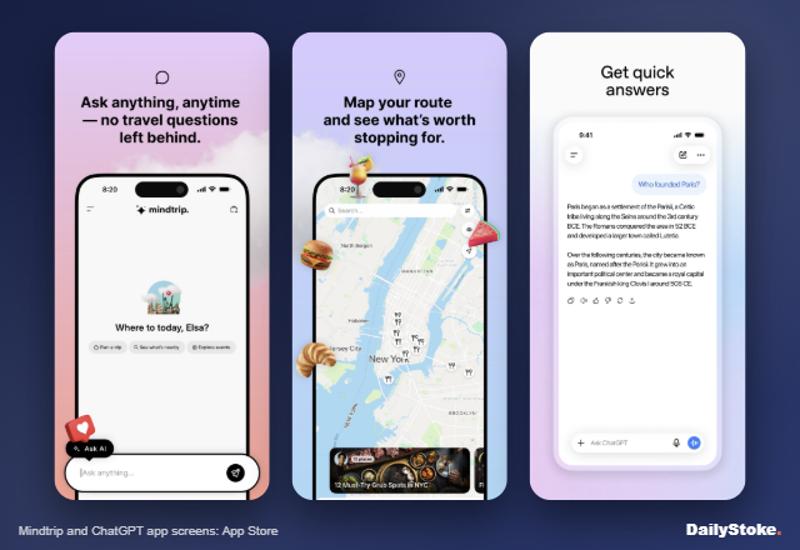
Of the dedicated planners, Mindtrip is the most polished. Founded in Silicon Valley in 2023, it plans trips through conversation and returns recommendations with images, interactive maps and context, drawing on its own knowledge base (Mindtrip, June 2026). Start Anywhere builds a plan from a photo, screenshot or PDF, such as a friend’s list of Lisbon tascas, and shared itineraries come with group chat.
It is free to use and earns its money from booking partnerships rather than subscriptions. In May 2026 it launched Mindtrip Flights, which handles searching, comparing and booking flights in one conversation, with fares from Sabre and checkout through PayPal (TechIntelPro, 2026). The launch announcement did not say which countries it covers, and its launch offer was priced in dollars, so UK travellers should not count on booking flights there yet. Its European push so far has been with tourist boards, starting with Madeira and Norway.
Its map-first layout shows at a glance when a Lisbon day has you criss-crossing the city. Its knowledge is deepest where its tourism partners are, and most are American.
Layla: the planner Expedia just bought
Layla, a Berlin company led by Saad Saeed, was one of the better-known AI trip planners before Expedia Group acquired it on 4 August 2026 (Hospitality Net, 2026). It claims more than 5 million users. Its pitch mixes AI and people: plans show live flight prices and hotel availability, and a human travel expert can step in to apply loyalty points.
Layla’s blog lists a US$49-a-year tier adding live pricing and fare alerts, but that predates the takeover. Expedia has not said whether Layla stays a separate app, so we would not pay for a year until it does.
Wonderplan: free and simple, but you do the legwork
Wonderplan is the no-frills option. It builds a day-by-day itinerary on one page from your dates, budget and interests, lets you edit with travel partners in real time and exports a PDF for offline use. Directory listings show it as free with no paid options (Dataconomy, 2026).
It lacks integrated booking and much live data. For a city break the skeleton is a fair start, but every opening day and price is yours to confirm, and the listings we found do not clearly name the company behind it.
Trip.com TripGenie, Booking.com and Expedia: assistants inside the shop
The big booking sites have their own assistants, and their strength is also their limit: they plan with stock they can sell you.
TripGenie is Trip.com’s assistant, now three years old. It plans, compares hotels, translates menus and conversations, and answers questions about photos. Trip.com says AI-assisted orders rose about 400% in a year and that UK travellers use it weeks ahead, mainly for flights and hotels (Trip.com Group, March 2026). Those are the company’s own figures.
Booking.com has offered its AI Trip Planner in its UK app since 2024, alongside Smart Filter, which turns a description of your ideal stay into search filters, and Property Q&A, which answers questions such as whether a hotel takes pets (Booking Holdings, October 2024).
Expedia added ChatGPT-powered trip planning to its app in 2023, tested an assistant called Romie in 2024 and now owns Layla. Its most useful AI feature for UK readers is arguably the Expedia app inside ChatGPT, which Expedia says is open to logged-in users outside the EU, the UK included.
Any of them will find a mid-priced Lisbon hotel with accurate prices, because the data is their own. For an honest view on which neighbourhood suits you, remember who is answering.
Where AI travel planners go wrong
In the TravelPlanner benchmark, presented at the ICML conference in 2024, language agents had to produce travel plans meeting budgets and other constraints using real tools. Even GPT-4 succeeded only 0.6% of the time in the full setting (Xie et al., 2024). Models have improved greatly since, so read that as a measure of how hard the task is, not of today’s apps.
Consumer testing agrees. In 2023 Which? asked four chatbots to plan a Greek holiday: one topped its list with a hotel rated 2.5 on Tripadvisor, another invented a travel insurer, and ChatGPT wrongly said there were no direct flights from Birmingham to Kefalonia (Which?, 2023). Its 2025 test found errors on flight refunds and delay compensation too.
Then there are places that do not exist. Euronews reported in January 2026 on tourists hunting Tasmanian hot springs invented by an AI-written article, and on two travellers in Peru who paid about €140 to seek a “Sacred Canyon of Humantay” before a local guide stopped them (Euronews, 2026).
The pattern is consistent: good at shape, weak at specifics such as opening days, prices, timetables and entry rules.
How to use an AI trip planner without getting caught out
- Give it the full brief. Dates, budget in pounds, who is travelling and how much walking you can manage.
- Use it for structure, not facts. Let it group sights by area and pace the days, then check each opening day and ticket on the official site.
- Ask for sources. ChatGPT with search and Gemini will show links; if a tool cannot say where a fact came from, treat the fact as a guess.
- Book with a company you know. Check the price and cancellation terms on its own page before paying.
- Check entry rules with the government. For travel from the UK, that means GOV.UK foreign travel advice, not a chatbot.
- Keep a copy offline. Export the plan, or rebuild it in Wanderlog, whose free plan includes five AI assistant messages and Pro (£4.99 a month) unlimited, and download the city in Organic Maps.
Which AI travel planner should you use?
For most trips: shape the plan in ChatGPT or Gemini, then book directly. Gemini has better places data; ChatGPT the smoother conversation.
For a visual, shareable plan: Mindtrip, which is free and the most complete of the specialists.
For a free printable itinerary: Wonderplan, as long as you check every detail.
If you always book on one site: use its assistant for hotel searches, and take neighbourhood advice elsewhere.
AI travel planner FAQs
Is ChatGPT good for planning a trip?
Yes, for ideas and pacing a day-by-day plan, especially with web search on. It is less reliable on opening times, prices and travel rules, so confirm those on official sites.
Can ChatGPT book flights and hotels?
Not by itself. Its Expedia and Booking.com apps let UK users search real listings inside the chat, and you then complete the booking with the travel company.
Is Gemini better than ChatGPT for travel planning?
For places data it usually has the edge, because it draws on Google Maps, Flights and Hotels. Several of Google’s newest travel features, including hotel booking in AI Mode, launched in the US first.
Is Mindtrip free?
Yes. Mindtrip is free to use and makes its money through booking partners, not subscriptions.
Can AI travel planners make things up?
Yes. Which? found errors on travel insurance and flight compensation in 2025, and there are documented cases of tourists looking for attractions that do not exist. Check every specific fact before you rely on it.