There is a certain type of product that sounds ridiculous until you see it working.
A tent that sits on top of a paddle board is one of them.
The idea is simple enough: paddle during the day, pull up somewhere quiet, put the tent over your SUP and use the board itself as your sleeping platform.
That is exactly what the BAJAO Cabin is designed to do.
And unlike some of the stranger surf-camping products that have come and gone over the years, this one is still a real thing you can buy.
What is the BAJAO Cabin?
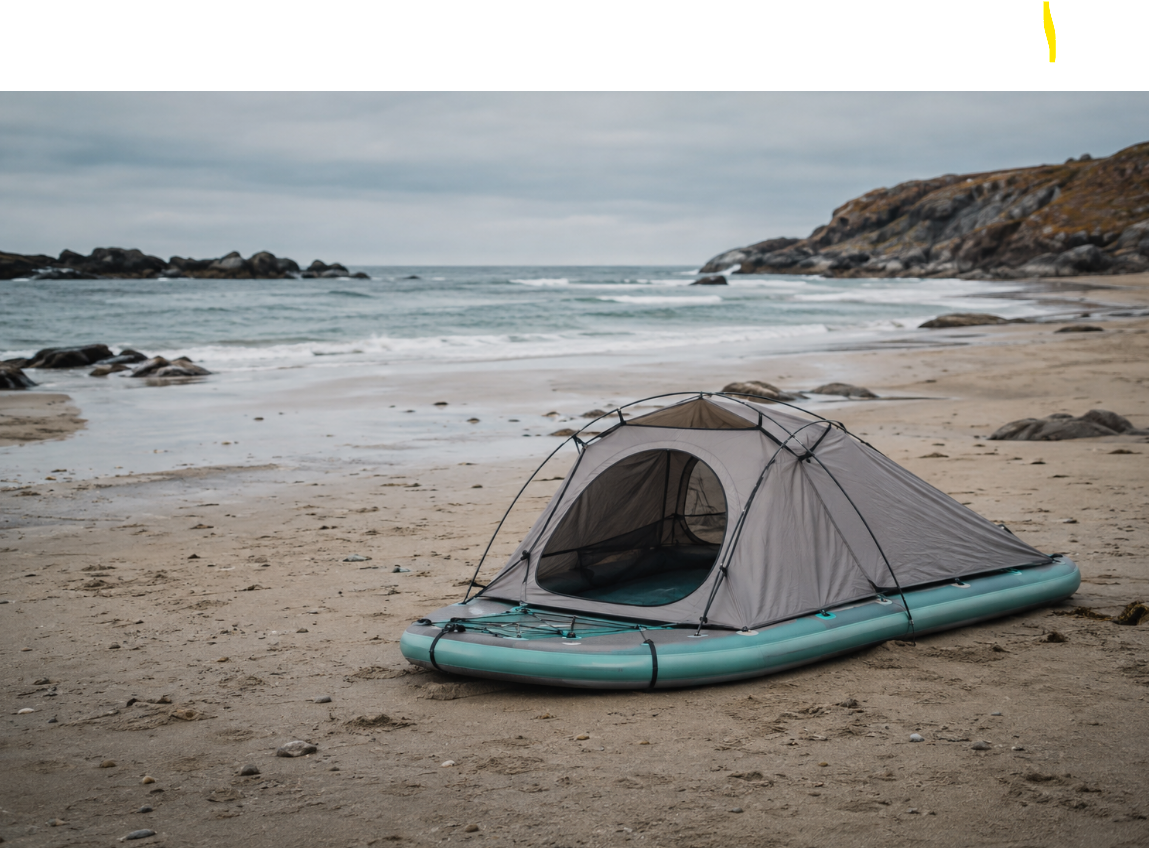
The BAJAO Cabin is an inflatable tent made to fit over larger stand-up paddle boards.
Instead of using normal tent poles, it has inflatable supports that can be pumped up with a SUP pump and adapter.
The board sits underneath and becomes the floor.
It is a clever use of something you already have with you. A touring SUP is basically a long, firm inflatable platform, so turning it into the base of a shelter is not as strange as it first sounds.
The tent has a waterproof outer layer, a mesh inner section and enough space for one person to sleep on the board.
It can also be pitched on land without the SUP.
Can you really sleep on the water?
Technically, yes — in the right conditions.
The tent can be used with the SUP on calm, sheltered water, although this is not something to treat casually.
Wind matters. So do currents, local rules and how securely the board is positioned.
A paddle board can move quickly once the wind gets hold of it, especially with a tent adding extra surface area.
For most people, the more sensible setup will probably be pulling the board onto a beach, riverbank or campsite and sleeping on it there.
You still get the raised, cushioned sleeping platform without worrying about waking up halfway across a lake.
What size paddle board do you need?
BAJAO says the Cabin is intended for larger inflatable SUPs, starting at around 11’2″.
Maximum board width is listed at roughly 86cm.
That means it is much better suited to touring boards than short recreational SUPs.
That fits the idea anyway.
If you are carrying camping gear for a multi-day trip, you probably want a longer board with decent deck space and carrying capacity.
If you already own a SUP, check the dimensions before assuming the tent will fit.
Can you buy one in 2026?
Yes, although availability varies.
BAJAO still lists the Cabin as a current product, while Lite Venture also sells a complete package that combines one of its touring SUPs with the BAJAO tent.
When we checked, the Lite Venture bundle included the board, tent, pump, waterproof backpack, fin, leash and repair kit.
That makes this more than an old prototype or forgotten crowdfunding project.
You can actually build a full SUP-camping setup around it.
How much does it cost?
The standalone BAJAO Cabin has been listed at several hundred euros depending on retailer and availability.
Complete board-and-tent packages cost considerably more, but at that point you are buying a touring SUP as well as the shelter.
It is not a cheap way to go camping.
Then again, this is a fairly niche product aimed at people who already want to combine paddle touring and overnight trips.
If you only want somewhere to sleep beside the beach, a normal lightweight tent is going to be cheaper and easier.
Why put a tent on a paddle board?
For a normal campsite, there is not much reason.
For SUP touring, it starts to make more sense.
Everything you take has to travel on the board, so space matters.
A regular camping setup usually means carrying a tent, sleeping mat, dry bags, clothes, food and whatever else you need for the trip.
With this system, the SUP itself becomes part of the sleeping setup.
You are not carrying a separate mattress-sized platform because you already have one under your feet all day.
It also keeps you off wet or uneven ground.
If the shoreline is rocky, muddy or covered in roots, sleeping on the board suddenly looks quite attractive.
The part that looks better in photos than real life
There are a few things worth thinking about before getting carried away with the floating-cabin fantasy.
First, space is limited.
You are sleeping on a paddle board, not in a camper van.
Second, everything needs to stay dry.
A wet sleeping bag at the end of a long paddle is going to ruin the romance very quickly.
And then there is the weather.
A calm evening can turn windy overnight. A tent catches more wind than a bare SUP, so sleeping on open water is not something we would treat as the default way to use it.
On shore, though, many of those problems disappear.
Is it better than a normal tent?
Not for everyone.
A normal tent gives you more choice, more room and usually costs less.
It also works perfectly well if your paddle board is still wet, covered in sand or loaded with gear.
But if you are specifically doing multi-day SUP trips, the BAJAO idea has some logic behind it.
The board is already coming with you.
The pump is already coming with you.
The sleeping platform is already there.
The tent simply makes use of all three.
This idea feels strangely familiar
A few years ago, surf brands tried something similar with board bags.
Products such as BoardSwag and WaveCave combined a surfboard travel bag with a tent, letting surfers carry their boards during the day and turn the bag into a shelter at night.
Those products became difficult to find.
The BAJAO Cabin takes a slightly different approach.
Instead of making the bag do two jobs, it uses the board itself.
For a SUP, that might actually be the smarter solution.
An inflatable paddle board is already big, flat and comfortable enough to sleep on. You do not need to reinvent the luggage.
Would we use one?
For a normal beach weekend, probably not.
We would take a decent tent and leave the SUP outside.
For a two- or three-day paddle trip through lakes or along a quiet river, though, it becomes much more interesting.
There is something appealing about finishing a day’s paddle, pulling onto shore, putting the tent over the board and waking up next to the water the following morning.
It is niche.
It is slightly ridiculous.
And that is probably exactly why we like it.