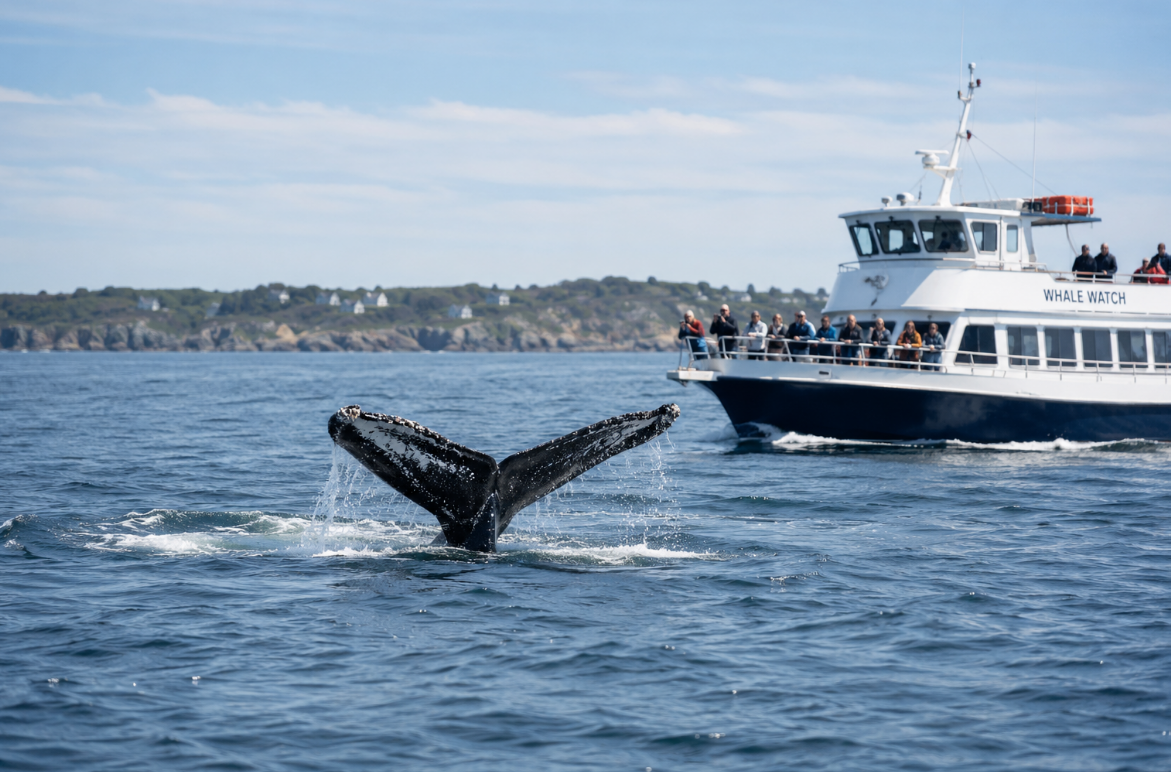
Captain Ahab had a particularly bad experience looking for whales off New England. Thankfully, whale watching here has improved considerably since Moby-Dick.
There are no harpoons involved, for one thing. Today, boats leave Boston, Gloucester, Provincetown, and other New England harbors looking for humpbacks, fin whales, minkes, dolphins, and the occasional rarer visitor.
And unlike Ahab, you do not need to spend years at sea looking for one.
Some of the best whale-watching waters on the U.S. East Coast are surprisingly easy to reach from Massachusetts. The big reason is Stellwagen Bank National Marine Sanctuary, a rich feeding area between Cape Ann and Cape Cod where humpback, fin, and minke whales are regularly seen.
The harder question is where to get on the boat.
Boston is by far the easiest option if you are already visiting the city. Gloucester gets you closer to open water without going all the way to Cape Cod. Provincetown sits close to Stellwagen Bank and has been taking visitors whale watching for more than 50 years.
So which one should you choose?
Editorial disclosure: This is an independent, research-based travel article, not paid promotion. DailyStoke does not endorse any tour company mentioned, and no company paid for inclusion. We have not personally tested the tours discussed here.
The quick answer
If whale watching is one part of a Boston trip, leave from Boston. You avoid adding another journey just to board a boat that may eventually head toward many of the same feeding areas.
If you are already staying on Cape Cod, Provincetown is the obvious choice. It is close to Stellwagen Bank and has one of the longest whale-watching traditions on the East Coast.
Gloucester may be the best option if whale watching is the main purpose of the day. You get relatively direct access to productive offshore waters without making the longer trip to the end of Cape Cod.
Just remember that the whales move. No departure point can guarantee that the animals will be sitting conveniently outside the harbor when you leave.
| Departure | Best for | Main advantage | Main drawback |
|---|---|---|---|
| Boston | First-time visitors | Very easy if you are already in the city | More travel time on the water |
| Gloucester | A dedicated whale-watching day | Good access to offshore feeding areas | Requires a separate trip from Boston |
| Provincetown | Cape Cod visitors | Close to Stellwagen Bank | Getting to Provincetown can take time |
| Plymouth | South Shore and Cape travelers | Convenient if already nearby | Less reason to travel there specifically |

Why Stellwagen Bank is such a good place for whales
Stellwagen Bank is not an island. It is a large underwater plateau at the mouth of Massachusetts Bay.
The relatively shallow bank meets deeper surrounding water, creating a productive marine environment with plenty of fish. That food attracts whales.
Humpbacks are the main attraction, but fin whales and minke whales are also regularly seen. Dolphins, porpoises, seals, and seabirds can make an appearance too.
For most visitors, you do not need to understand much more marine biology than that: there is a lot of food here, so whales keep coming back.
Boston: the easiest choice
Boston has one major advantage over every other option: convenience.
You can spend the morning sightseeing, walk down to the harbor, head offshore for a whale watch, and be back in the city later the same day.
The New England Aquarium runs whale watches from Central Wharf, with naturalists on board and trips heading toward Stellwagen Bank and other feeding areas.
If you only have a few days in Boston, I would not rent a car and drive toward Cape Cod simply because someone online claims the whales are better somewhere else.
They may be. They may not be.
The main disadvantage is that Boston sits farther from the offshore feeding grounds, so more of the trip can be spent traveling there and back.
Even so, for most visitors staying in the city, Boston is the sensible choice.
Gloucester: possibly the sweet spot
Gloucester gets less attention from first-time New England visitors, but it may be the most interesting option if whale watching is the main reason for the day.
The old fishing port sits on Cape Ann, northeast of Boston, with relatively direct access to the Gulf of Maine and Stellwagen Bank area.
You also get something from the journey itself. Gloucester is a historic New England fishing town, so the day can feel like more than simply driving to a marina and getting on a boat.
The downside is obvious: you have to leave Boston to get there.
But if you are willing to turn whale watching into a proper day trip, Gloucester may offer the best balance between convenience and location.
Provincetown: great if you are already on Cape Cod
Provincetown has perhaps the strongest whale-watching identity of the three.
Commercial whale watching on the East Coast began here in the 1970s, and boats have been taking visitors offshore ever since.
Its position at the tip of Cape Cod also puts it close to Stellwagen Bank. Standard whale watches generally last around three to four hours.
If you are already staying on the Outer Cape, I would choose Provincetown without much hesitation.
From Boston, the calculation is different.
Cape Cod looks close on a map, but Provincetown sits at the very end of the peninsula. In summer, traffic can make the drive much longer than expected.
A more enjoyable option can be the seasonal fast ferry from Boston. That allows you to combine whale watching with some time in Provincetown rather than spending much of the day in a car.
I would travel to Provincetown because I wanted to visit Provincetown and see whales — not because I thought it guaranteed a better sighting.
When is the best time to go?
The broad New England whale-watching season runs from spring into fall, with most visitors choosing May through October.
For a normal vacation, I would focus on three periods.
May and June
Late spring and early summer can be excellent if you want fewer crowds.
Whales are feeding in the area, tour schedules are running, and Cape Cod has not yet reached peak summer traffic.
The main drawback is temperature. It can feel much colder offshore than it does back in Boston.
Bring layers.
July and August
These are the easiest months to fit into a summer vacation.
You get long days, frequent departures, and the full Cape Cod summer atmosphere.
You also get the crowds.
Hotels are more expensive, roads are busier, and Provincetown can take longer to reach by car.
And do not assume summer automatically means calm water. You are heading into the Atlantic, not taking a harbor cruise.
September and early October
This is the period I find most appealing.
Whale watches are still operating, while the biggest summer crowds start to thin out. September can also work nicely as part of a wider New England road trip before the main fall foliage rush.
The weather becomes a little less predictable, but if your dates are flexible, September is a very good time to consider.
What whales might you see?
Humpback whales
Humpbacks are the stars of most New England whale watches.
They can breach, slap their tails, feed near the surface, and lift their flukes before diving.
Individual humpbacks can often be recognized by the markings underneath their tails, allowing researchers to follow the same animals over many years.
Fin whales
Fin whales are enormous — second only to blue whales in size.
They tend to be less theatrical than humpbacks, but seeing one of these huge animals move quietly past the boat can be just as impressive.
Minke whales
Minkes are smaller and often a little more difficult to watch.
They may surface briefly and disappear again without the dramatic tail display you get from a humpback.
Dolphins and other wildlife
Atlantic white-sided dolphins, harbor porpoises, seals, and seabirds are also found in the region.
On a slower whale day, they can make the trip much more interesting.
What about North Atlantic right whales?
You may see North Atlantic right whales mentioned when researching Massachusetts.
They are critically endangered, and boats must stay well away from them.
That means a responsible tour operator should not chase a right whale simply to provide passengers with a closer photograph.
If you happen to see one at the required distance, consider it a rare bonus rather than something to book a trip around.
How long should you allow?
Plan on roughly four hours, and avoid scheduling something important immediately afterward.
A whale watch is not a fixed sightseeing loop. The crew is looking for wild animals, and the route can change depending on recent sightings and conditions.
Sometimes the whales are relatively close.
Sometimes the boat has to travel farther.
Leave some room in your day.
Seasickness is worth thinking about
The boats used for whale watching are substantial, but Stellwagen Bank is open water.
If the sea is moving, so will the boat.
A few simple things can make the trip easier:
- Check the marine forecast rather than only the Boston weather forecast.
- Eat a light meal before boarding.
- Spend time outside where you can see the horizon.
- Avoid staring at your phone while the boat is moving.
- Bring warmer clothing than you think you need.
- If you know you are prone to motion sickness, ask a pharmacist or healthcare professional about suitable options beforehand.
And if the forecast looks awful and the operator allows you to move the booking, consider doing it.
Seeing a whale is less exciting when you are counting the minutes until you can get back on land.
Morning or afternoon?
I would not overthink this.
Whales do not follow a visitor timetable.
Morning trips sometimes benefit from calmer conditions, but wind, weather, and where the animals are feeding matter more than the clock.
Choose whichever departure fits your plans, then check the weather closer to the day.
Be careful with “sighting guarantees”
Many whale-watch operators advertise some type of sighting guarantee.
Read the details.
A guarantee usually means you can join another trip if no whales are found. It does not necessarily mean you get your money back.
That is useful if you are staying in the area for several days.
It is less useful if your whale watch is booked for the afternoon before you fly home.
I would pay more attention to the operator’s reputation, naturalists, recent sightings, cancellation policy, and responsible whale-watching practices.
From Moby-Dick to whale watching
New England’s relationship with whales has changed dramatically.
For centuries, the region made money by hunting them. By the time Herman Melville published Moby-Dick in 1851, New England whaling ships were traveling around the world.
Today, people still leave Massachusetts harbors looking for whales.
The difference is that now we want them to swim away.
Commercial whale watching began around Provincetown in the 1970s, and Stellwagen Bank became one of its natural destinations. The area’s whales later helped build support for protecting the waters as a National Marine Sanctuary.
It is a much better ending than Captain Ahab managed.
So where would I go?
Already staying in Boston?
Leave from Boston. The convenience matters more than trying to shave some time off the offshore journey.
Spending time on Cape Cod?
Choose Provincetown. It has the history, location, and easy access if you are already on the Outer Cape.
Whale watching is one of the main reasons for the trip?
I would seriously consider Gloucester. You get a historic fishing town and good access to offshore waters without traveling all the way to Provincetown.
Doing a longer New England road trip?
Choose whichever port already makes sense for your route. I would not cross Massachusetts simply to chase a supposedly superior departure point.
The DailyStoke verdict
Captain Ahab probably would not appreciate the advice, but do not become obsessed with finding one perfect place to look for whales.
Stellwagen Bank and the surrounding waters are the real attraction.
Boston is easiest. Provincetown is the most atmospheric and makes particular sense for Cape Cod visitors. Gloucester may be the sweet spot if whale watching itself is the main event.
If I could choose the timing freely, I would look particularly at June or September. Both can give you a strong whale-watching season without quite as much of the July and August tourism rush.
Most importantly, remember that these are wild animals.
There is no scheduled 10:30 humpback breach.
That uncertainty is part of what makes finally seeing one so good.


