
A smart scale is the most honest gadget in the house when it comes to weight, and the least honest when it comes to body fat. Every model in this guide will tell you what you weigh to within a few tens of grams. The fat, muscle and water percentages that follow are estimates built on an electrical current and an algorithm, and they deserve to be read as trends, never as verdicts.
This guide is for people who want a scale that syncs readings to their phone, tracks a long-term trend and adds some useful extras without a sales pitch. We ranked five models from £89.95 to £449.95, weighing measurement method, software, running costs and what each one is honestly good at. Prices were checked on 29 October 2026.
Smart scales at a glance
| Rank | Scale | Price | Best for | Standout fact |
|---|---|---|---|---|
| 1 | Withings Body Comp | £189.95 | Most people | Multi-frequency bioimpedance plus vascular and nerve health checks, no handle needed |
| 2 | Withings BodyScan 2 | £449.95 | Health data enthusiasts | 12 electrodes, 6-lead ECG and hypertension notifications |
| 3 | RENPHO MorphoScan Nova | £179.99 | Segmental data on a budget | Dual-frequency, eight electrodes and a handle with no subscription |
| 4 | Garmin Index S2 | £129.99 | Garmin watch owners | Wi-Fi sync to Garmin Connect for up to 16 users |
| 5 | Withings Body Smart | £89.95 | Value | Visceral fat index and standing heart rate under £90 |
How we chose these body composition scales
Martin Eriksen worked in the Danish pharmaceutical industry, where the gap between a measurement and a claim matters a great deal. That shaped how we ranked these scales: accuracy of weight first, consistency of body composition readings second, software and running costs third, extra health features last.
We were open about sources. Rankings draw on manufacturers’ specifications, retailer listings, independent lab and editorial tests (Live Science, TechRadar and Tom’s Guide all compared scales against reference machines or rival devices) and published research on bioimpedance. Where a test used a reference method, we say which one. We did not run our own DXA comparisons, and most consumer reviews do not either.
What a smart scale really measures
Weight is measured directly by load cells. Everything else comes from bioelectrical impedance analysis (BIA): the scale passes a small current through your body, measures the resistance, and plugs that figure into an equation alongside your height, age and sex. Water conducts well and fat does not, so the scale infers fat from how hard the current has to work.
That method has well-documented limits:
- Hydration moves the number. A 2023 study in Nutrients by Nescolarde and colleagues found that single-frequency BIA underestimated fat mass compared with DXA in 188 adults, and linked the error to fluid shifts (Nutrients, 2023). Weigh after a long run, a big night or a salty meal and your body fat reading will change overnight.
- Foot-to-foot scales mostly see your legs. The current takes the shortest path, up one leg and down the other. A German study in Obesity Facts (Bosy-Westphal et al., 2008) tested consumer BIA devices against MRI and DXA and found that foot-to-foot models showed systematic bias for body fat, while a hand-and-foot (tetrapolar) device did not (Obesity Facts, 2008). The authors recommended four-point electrode designs for individual use.
- Even good scales miss. A French hospital study in JMIR mHealth and uHealth (Frija-Masson et al., 2021) compared three smart scales, including a Withings Body Cardio, with DXA. All three were accurate for weight, with median errors of 0.3 kg or less, but all underestimated fat mass, by a median of 2.2 to 4.4 kg (JMIR mHealth, 2021). The authors concluded smart scales should not replace DXA in patient care.
The practical lesson: weigh at the same time each day, ideally on waking after the loo and before food or drink, and judge body composition by the direction of travel over weeks, not by a single number.
The best smart scales, ranked
1. Withings Body Comp
The Body Comp is the scale we would buy for most households. It uses multi-frequency bioimpedance through the feet, which is a step up from the single-frequency sensors in cheaper scales, and adds visceral fat and lean mass estimates, a standing heart rate, a vascular assessment and a nerve health check through the soles of the feet. It recognises up to eight users automatically, syncs over Wi-Fi or Bluetooth to the Withings app and runs for up to 15 months on AAA batteries, so there is no charging ritual.
It is still a foot-only design, so the limits above apply: treat the fat percentage as a trend line. The baseline metrics and trends are free in the app; Withings+ is an optional subscription at £8.95 a month or £89.50 a year, though on Withings accounts created on or after 13 October 2026 it is now required for automatic syncing to Apple Health and other third-party apps.
Price: £189.95 (Boots)
Pros
- Multi-frequency BIA and useful extras without a handle
- Up to 15 months on AAA batteries
Cons
- No segmental (arm and leg) breakdown
- Withings pushes its subscription inside the app
2. Withings BodyScan 2
The BodyScan 2 is less a bathroom scale than a home health station. Eight electrodes in the glass and four in a retractable handle with a colour screen allow multi-frequency bioimpedance up to 800 kHz, six-zone segmental analysis, a 6-lead ECG with atrial fibrillation detection, pulse wave velocity for a vascular age estimate, SpO2 and a nerve response score. It can also send hypertension notifications to eligible adults, though it does not measure blood pressure. A full assessment takes about 90 seconds.
It is impressive and expensive, and some headline metrics, including Heart Age and Glucose Resilience, need Withings+. Read our full Withings BodyScan 2 review.
Price: £449.95 (Withings)
Pros
- The most complete hand-and-foot measurement on sale for the home
- Rechargeable battery rated up to a year per charge
Cons
- Costs more than twice our top pick
- Several estimates are novel and vary between sessions
3. RENPHO MorphoScan Nova
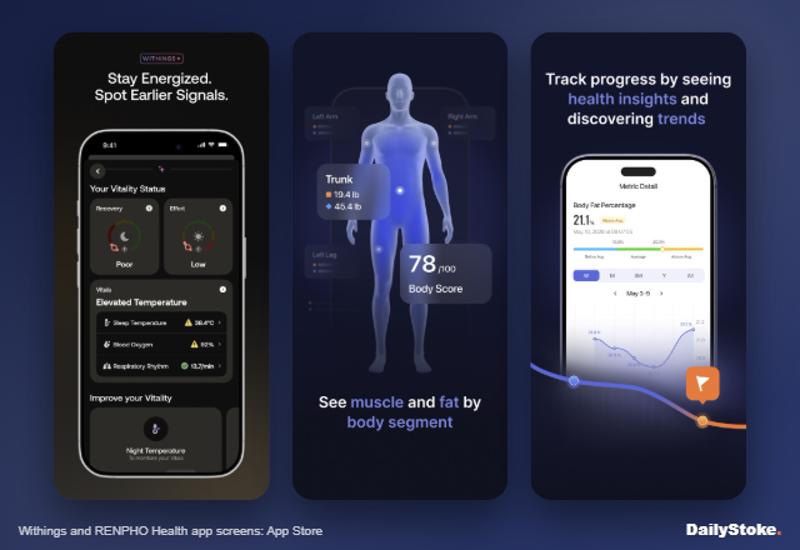
The MorphoScan Nova (model MSC04) is the cheapest route to a proper hand-and-foot scale. Four electrodes in the platform and four in a retractable handle, measuring at 20 kHz and 100 kHz, produce segmental fat and muscle readings for each limb and the trunk, shown on a 4.3-inch colour display in the handle. There is no subscription, and data syncs to Apple Health, Google Fit and Fitbit.
Live Science compared it with a gym-grade FitQuest analyser over a month: weight was within 0.1 kg and body fat about 5 per cent high. The same reviewer reported setup trouble and random Bluetooth disconnects. See our RENPHO MorphoScan review.
Price: £179.99 (Sports Direct)
Pros
- Segmental data and a four-point design for under £200
- No paywall
Cons
- Bluetooth only, with reported app connection problems
- Only Standard and Athlete modes
4. Garmin Index S2
If you already train with a Garmin watch, the Index S2 makes sense: it sends weight, BMI, body fat, skeletal muscle, bone mass and body water over Wi-Fi straight into Garmin Connect, next to your training load and sleep. It recognises up to 16 users, shows a 30-day weight trend on its colour screen and runs for up to nine months on four AAA batteries.
It is a foot-to-foot design launched in 2020, with no heart, vascular or segmental features, and no pregnancy mode. Outside Garmin’s ecosystem it is hard to justify. Our Garmin Index S2 review has more.
Price: £129.99 (Currys)
Pros
- Seamless with Garmin watches and Garmin Connect
- Wi-Fi sync, so no phone needed at weigh-in
Cons
- Basic body composition for the money
- Limited third-party app support
5. Withings Body Smart
The Body Smart gives you most of what matters for £89.95: weight to 50 g, eight body composition metrics including a visceral fat index and basal metabolic rate, a standing heart rate, automatic recognition of up to eight users and modes for pregnancy, babies and athletes. It has a 2.8-inch colour screen, syncs over Wi-Fi or Bluetooth to the Withings app, which can pass readings to Apple Health and Google Fit (a Withings+ feature for accounts created from 13 October 2026), and runs up to 15 months on AAA batteries.
It is a foot-to-foot scale, so the body fat caveats apply in full. For weight and trend tracking, though, it does the job as well as scales costing twice as much.
Price: £89.95 (John Lewis)
Pros
- Pregnancy and baby modes
- Clear, well-designed Withings app
Cons
- No nerve or vascular checks
- Foot-only measurement
How to choose a smart scale: what matters and what to ignore
What matters
- Electrode layout. Hand-and-foot scales with a handle (BodyScan 2, MorphoScan Nova) send current through your whole body. Foot-only scales are fine for weight and trends but guess more about your upper body.
- Consistency over accuracy. A scale that is 2 per cent out but consistent is more useful than one that jumps around. Weigh under the same conditions every day.
- The app and its costs. Check what needs a subscription before you buy. Withings gates some features behind Withings+, and since 13 October 2026 new Withings accounts also need it to sync automatically with Apple Health; Garmin and RENPHO currently do not charge for scale data.
- Syncing. Wi-Fi means readings upload without your phone. Bluetooth-only scales need the app open nearby.
- Who is in the house. Multi-user recognition, pregnancy modes and weigh-only modes matter for families.
What to ignore
- Metric counts. “50+ metrics” mostly means more equations run on the same impedance reading.
- Metabolic age and body scores. These are marketing constructs without an agreed clinical definition.
- Bone mass. Scales estimate it from the same impedance data. They cannot assess bone density; that needs a DXA scan.
Safety note. Bioimpedance scales are generally not suitable for people with pacemakers or other implanted electronic devices; check the manual and use weigh-only mode where offered. Pregnant users should also follow the manufacturer’s guidance. If you are losing weight without trying, or your weight is changing quickly for no clear reason, speak to your GP rather than your scale.
Smart scale FAQs
Are smart scales accurate for body fat?
They are accurate for weight and reasonably consistent for trends, but not precise for body fat. Studies comparing consumer scales with DXA found median fat mass errors of several kilograms, mostly underestimates. Use the reading to see whether you are heading in the right direction.
Is a scale with a handle better?
Generally, yes. Hand-and-foot (tetrapolar) designs measure the whole body rather than mainly the legs, and research has found less systematic bias with this layout. They are also bulkier and cost more.
Which smart scale is best for Garmin users?
The Garmin Index S2 feeds Garmin Connect directly, so your weight sits alongside your training data without extra setup. Withings and RENPHO scales can share data through other apps, but the Garmin route is the tidiest.
Do I need a subscription for a smart scale?
Not for the basics. Withings offers Withings+ at £8.95 a month for extra insights such as Heart Age on the BodyScan 2, and Withings accounts created on or after 13 October 2026 need it for automatic syncing to Apple Health. Garmin and RENPHO do not charge for scale data at present.
How often should I weigh myself?
Daily weighing at a consistent time smooths out the noise once you look at a weekly average. If daily numbers make you anxious, weekly weigh-ins under the same conditions work too.
Can a smart scale replace a DEXA scan?
No. DXA directly images fat, lean tissue and bone. A smart scale estimates them from electrical resistance. For bone health concerns or a clinical body composition assessment, speak to your GP.