High blood pressure rarely causes symptoms, which is why a reliable home monitor is one of the few health gadgets doctors actively encourage. The word that matters is reliable. Plenty of monitors on sale have never passed an independent accuracy test, and a smart app cannot fix a cuff that reads 10 mmHg out.
So this guide has one rule: every monitor we recommend appears on the British and Irish Hypertension Society (BIHS) list of monitors for home use. In the US the equivalent is the American Medical Association’s Validated Device Listing at validatebp.org. Three of our five have passed their own validation study; the two Omron Intelli IT models sit in the list’s equivalence section, which we explain below. All five are upper-arm models, and four of them sync to an app. Prices were checked on 29 October 2026.
Smart blood pressure monitors at a glance
| Rank | Monitor | Price | Best for | Standout fact |
|---|---|---|---|---|
| 1 | Omron Evolv (HEM-7600T-E) | From £74.99 | Tubeless design and pregnancy | Validated in pregnancy, including pre-eclampsia |
| 2 | Withings BPM Connect (WPM05) | £119.95 | Wi-Fi and families | Wi-Fi sync for up to eight users, rechargeable |
| 3 | A&D UA-651 | From £20.78 | Lowest cost | Five-star BIHS rating, no app, pen-and-paper simple |
| 4 | Omron M7 Intelli IT (HEM-7361T-EBK) | From £90 | AFib alerts in a cuff monitor | BIHS-listed (equivalence section), Bluetooth, AFib mode |
| 5 | Omron M4 Intelli IT (HEM-7155T-EBK) | From £63.49 | Value with an app | BIHS-listed (equivalence section) Bluetooth model under £70 |
How we chose these monitors
Validation came first, and it was non-negotiable. We checked each model against the BIHS list of monitors validated for home use and, for US equivalents, against validatebp.org. Then we compared cuff fit, connectivity, app quality and price from retailer listings and PriceSpy.
The BIHS list we used is the version dated 28 June 2026, published through the validation database Medaval. It has two kinds of entry. Monitors that passed a validation study get a star rating. A separate section covers monitors with a possible equivalence to a validated device under EU medical device rules: the manufacturer declares the model is technically the same as one that was tested. Both count as BIHS-listed, but a monitor with its own validation study is the stronger evidence.
What validation means: an independent study measured the device against trained observers using a recognised protocol, such as the European Society of Hypertension International Protocol or the ISO 81060-2 standard. The US listing also requires FDA clearance and cuffs that fit the general population. FDA clearance on its own does not prove clinical accuracy, which is precisely why the US list exists.
We did not run our own clinical trials. Martin Eriksen, who worked in the Danish pharmaceutical industry, reviewed the validation data and published studies; feature and price details come from manufacturers, retailers and validation registries.
One practical tip: model numbers matter. A monitor with a similar name but a different suffix may not be the version that was tested. Search the BIHS or validatebp.org list for the exact model on the box.
The best smart blood pressure monitors, ranked
1. Omron Evolv
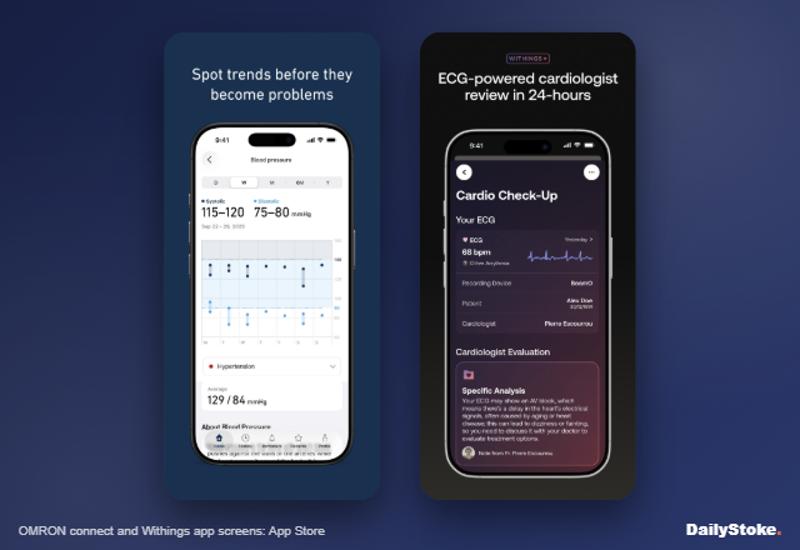
The Evolv is a one-piece monitor: the cuff and the electronics are a single unit, with no tube. It fits arms from 22 to 42 cm and connects by Bluetooth to OMRON connect. It is on the BIHS list with a three-star rating, on validatebp.org as the BP7000, and was validated in a 2018 study in pregnant women, including those with pre-eclampsia, which few monitors can claim.
It lacks AFib screening and stores 100 readings for a single user. Read our full Omron Evolv review.
Price: from £74.99 (PriceSpy); £103.20 at Chemist Direct
Pros
- Validated in pregnancy
- Neat, tubeless and easy to put on one-handed
Cons
- No AFib screening
- Runs on four AAA batteries
2. Withings BPM Connect
The BPM Connect (WPM05) is on the BIHS list with a three-star rating and is the most polished app experience here. It syncs over Wi-Fi or Bluetooth to the Withings app, supports up to eight profiles, can pass readings to Apple Health and Google Health Connect (on Withings accounts created from 13 October 2026, that automatic sync needs Withings+), and charges by micro-USB, lasting up to six months per charge. Readings show on an LED matrix with colour-coded indicators. The cuff fits arms from 22 to 42 cm.
Baseline readings and trends are free; Withings+ (£8.95 a month after a one-month trial) adds extra insights you do not need for home monitoring.
Price: £119.95 (Withings)
Pros
- Wi-Fi sync and multi-user profiles
- No batteries to replace
Cons
- Stores only eight readings on the device between syncs
- New Withings accounts need Withings+ for Apple Health sync
3. A&D UA-651
Not every useful monitor needs an app. The A&D UA-651 sits on the BIHS list with its top five-star rating and costs from about £21. You read the screen and write the numbers down, which is exactly what many GP surgeries ask for anyway. If you want an app, A&D’s Bluetooth UA-656BLE also appears on the list, in the equivalence section.
Price: from £20.78 (PriceSpy)
Pros
- Validated for a fraction of the price
- Simple for anyone uncomfortable with apps
Cons
- No app or automatic averaging
- Check that the cuff suits your arm size
4. Omron M7 Intelli IT
The M7 Intelli IT is the monitor we would hand to a family member. The HEM-7361T-EBK version appears on the BIHS list in its equivalence section, and Medaval records that the HEM-7361T passed a validation study to the ISO 81060-2 standard. It uses Omron’s Intelli Wrap cuff for a wide range of arm sizes and sends readings by Bluetooth to the free OMRON connect app, where you can share them with your GP surgery. UK retailers sell it as the M7 Intelli IT AFib: its AFib mode flags irregular pulses that suggest atrial fibrillation, though only an ECG can confirm it. It runs on four AA batteries, with an optional mains adapter.
Beware the near-twin: PriceSpy also lists an M7 Intelli IT AFib with the model number HEM-7380T1-EBK at a lower price. Check that version against the current BIHS list before buying, or stick with the HEM-7361T-EBK.
Price: from £90 (PriceSpy, October 2026)
Pros
- BIHS-listed, from a validated model family, with a cuff that suits most arms
- AFib screening and easy sharing with clinicians
Cons
- Two similar model numbers on sale
- Bluetooth only, so readings sync when your phone is nearby
5. Omron M4 Intelli IT
The M4 Intelli IT (HEM-7155T-EBK) is the cheapest BIHS-listed monitor here that still talks to an app, though it sits in the list’s equivalence section rather than among the star-rated devices. Medaval’s own entry for the HEM-7155T notes that Omron declares it equivalent to validated models but that published evidence of that comparison has not yet been found. It syncs by Bluetooth to OMRON connect, so you get the app essentials of the M7 for less. If independent validation matters most to you, the Omron Evolv or the A&D UA-651 is the safer buy. Omron also sells newer “Connect AFib” models at similar prices; buy the one you can find on the BIHS list.
Price: from £63.49 (PriceSpy)
Pros
- BIHS-listed and app-connected for under £70
- Same Omron app as pricier models
Cons
- Listed on equivalence, without its own published validation study
- Confusing range of similarly named Omron models
Monitors we left out, and why
Garmin Index BPM (from £159.99) and Withings BPM Vision (from £159) do not appear on the BIHS list dated 28 June 2026. That does not mean they are inaccurate, only that we could not confirm independent validation on the UK list.
Wrist monitors are harder to use accurately because your wrist must be at heart height. The BIHS recommends upper-arm devices for home use, and the AMA list excludes wrist and finger devices.
Smartwatches and smart scales with blood pressure “insights”, such as the Withings BodyScan 2, may flag a possible problem but do not replace a cuff reading. Our Withings BodyScan 2 review explains the difference.
How to measure blood pressure at home properly
The BIHS and NICE describe a consistent routine. Small mistakes, such as talking or crossing your legs, can add several mmHg.
- Prepare. Avoid caffeine, smoking and exercise for 30 minutes beforehand, and empty your bladder.
- Sit correctly. Sit with your back supported, feet flat and legs uncrossed. Rest for five minutes.
- Position your arm. Rest it on a table so the cuff is level with your heart. Put the cuff on bare skin, about 2 to 3 cm above the elbow crease.
- Stay still and quiet while the cuff inflates.
- Take two readings, a minute apart, in the morning and again in the evening.
- Repeat for at least four days, ideally seven. Ignore the first day and average the rest. This is the figure your GP will use.
Use the right cuff size. A cuff that is too small reads high; too large reads low. Measure around the middle of your upper arm and check the range printed on the cuff.
When to see a GP or get urgent help
NICE guidance (NG136) uses a home average of 135/85 mmHg or higher to confirm stage 1 hypertension in adults in England. If your average is at or above that, book an appointment with your GP or ask your pharmacist for a check. Many pharmacies in England offer free blood pressure checks for adults over 40.
Contact your GP the same day, or call NHS 111, if readings are repeatedly 180/120 mmHg or higher. Call 999 if a high reading comes with chest pain, breathlessness, a severe headache, confusion, blurred vision or weakness on one side of the body.
Low readings matter too: if you feel dizzy or faint and your blood pressure is low, speak to your GP.
In the US, the American Heart Association and American College of Cardiology define stage 1 hypertension as 130 to 139 systolic or 80 to 89 diastolic. Readings above 180/120 need prompt medical attention.
Never change or stop medication based on a home reading without talking to your doctor or pharmacist.
Buying guide: what matters and what to ignore
What matters
- Validation for the exact model. Check the BIHS list in the UK or validatebp.org in the US.
- Cuff size. Most standard cuffs fit about 22 to 42 cm. Larger arms may need a dedicated large cuff.
- Upper arm, not wrist.
- Easy sharing. An app that exports a PDF or CSV makes GP appointments simpler.
What to ignore
- “Clinically proven” on the box without a listing to back it up.
- Colour-coded risk bands that do not match NICE thresholds.
- Subscriptions. You need nothing beyond the free app to monitor blood pressure properly. The one exception to note: new Withings accounts now need Withings+ to sync readings automatically to Apple Health.
Blood pressure monitor FAQs
How do I know if my blood pressure monitor is validated?
Search for the exact model number on the BIHS home-use list (UK) or validatebp.org (US). If it is not there, it may simply not have been submitted, but you cannot be sure it has passed an independent test.
Are wrist blood pressure monitors accurate?
They can be, but they are harder to use correctly because the wrist must be at heart level. The BIHS recommends upper-arm monitors for home use.
What is a normal home blood pressure?
NICE uses a home average below 135/85 mmHg as the threshold below which hypertension is not diagnosed. Your GP may set a different target for you based on age and other conditions.
Why are my home readings lower than at the surgery?
Many people read higher in clinic because of nerves, often called white coat hypertension. That is one reason NICE recommends home or ambulatory readings to confirm a diagnosis.
Can I use a smart blood pressure monitor in pregnancy?
Use a monitor validated for pregnancy, such as the Omron Evolv, and follow your midwife’s advice. High blood pressure in pregnancy needs prompt clinical attention.
Should I buy a monitor with AFib detection?
It can be useful for people over 65 or with risk factors, as atrial fibrillation often has no symptoms. A positive result is a prompt to see your GP, not a diagnosis.