
Our verdict: The RENPHO MorphoScan Nova is the cheapest credible way to get a hand-and-foot body composition scale, with dual-frequency measurement, segmental readings and no subscription. Independent testing puts its readings close to a gym-grade analyser. The catch is the Bluetooth app, which several reviewers found unreliable.
First, which MorphoScan? RENPHO has sold more than one. The original MorphoScan (model R-MSC01) arrived in 2024 at £169. The current flagship, reviewed here, is the MorphoScan Nova Body Composition Scale, model MSC04, launched in October 2025. RENPHO’s European store now uses its old MorphoScan web address for the Nova, and retailers still list both, so check the model number on the box or listing before you buy.
RENPHO MorphoScan Nova at a glance
- Model: MorphoScan Nova, MSC04
- Price: £179.99 (Sports Direct, UK); €229.99 RRP, €189.99 on sale (renpho.eu); $199.99 to $233.99 (US)
- Subscription: none
- Electrodes: 8 (4 in the platform, 4 in a retractable handle)
- Method: dual-frequency bioimpedance at 20 kHz and 100 kHz, with segmental arm, leg and trunk readings
- Metrics: RENPHO lists more than 50 in its app
- Display: 4.3-inch colour screen in the handle
- Capacity: up to 180 kg
- Users: 8 on the scale, unlimited profiles in the app
- Battery: rechargeable via USB-C, rated up to 5 months
- Connectivity: Bluetooth; syncs with Apple Health, Google Fit and Fitbit
- Modes: Standard and Athlete
What the MorphoScan Nova does
Most smart scales measure through your feet, which means the current mostly travels up one leg and down the other. The MorphoScan Nova adds a handle. Hold it with your thumbs and fingers on the electrodes, and the current passes through arms, trunk and legs. This four-point (tetrapolar) layout is what research favours: a 2008 study in Obesity Facts by Bosy-Westphal and colleagues found that foot-to-foot consumer devices showed systematic bias for body fat, while a hand-and-foot device did not.
The Nova also measures at two frequencies, 20 kHz and 100 kHz. Lower frequencies travel mostly through fluid outside the cells; higher ones pass through cells too. Using both gives the algorithm a better sense of where the water in your body sits, which is the main thing that throws bioimpedance readings off.
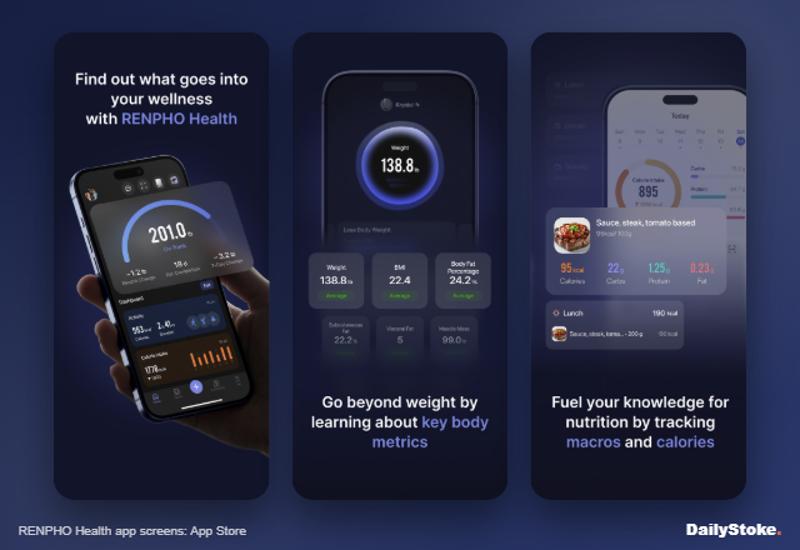
The result is a segmental breakdown of fat and muscle for each arm, each leg and the trunk, plus visceral fat, protein, skeletal muscle index and the usual weight, BMI and water figures. The headline numbers appear on the 4.3-inch handle display, so you do not need the app for a quick check.
RENPHO MorphoScan price
Sports Direct sells the MorphoScan Nova for £179.99. RENPHO’s European store lists it at €229.99, often discounted to €189.99. In the US, Live Science reported a usual list price of $233.99, with RENPHO and Target at $199.99 and an Amazon low of $189.98 in March 2026.
There is no subscription. RENPHO’s product page describes zero subscription fees and no paywalled app features, which is a real advantage over Withings, whose newest accounts now need Withings+ even to sync with Apple Health.
How accurate is it?
Live Science tested the Nova for more than a month against a FitQuest bioimpedance analyser at a gym, a larger and more precise machine. Weight was within 0.1 kg. Body fat came out about 5 per cent high and muscle mass about 2 per cent high, which the reviewer rated on a par with the RunStar 8E SmartScan Pro and better than stand-on scales.
That is a good result for a home scale, with a caveat: the FitQuest is itself a bioimpedance device, not DXA. We found no published DXA validation for this model, so treat the segmental numbers as a consistent trend tool. An Australian reviewer at Digital Reviews found readings 1 to 2 kg different from an older single-frequency RENPHO scale, which is exactly the kind of gap you should expect between methods.
What we liked
A handle for under £200. Hand-and-foot measurement used to cost far more. The Nova brings it below £180.
Segmental data. Seeing muscle in each limb is useful during rehab after injury, or to check whether strength training is building muscle where you intend.
No subscription. Everything the app offers is included.
Good display. The handle screen is bright and readable, and the cable is long enough for tall users, according to Live Science.
Broad syncing. Apple Health, Google Fit and Fitbit are supported, and Live Science also lists Samsung Health.
What we did not like
Bluetooth app wobbles. Live Science reported setup difficulties and random disconnects, and noted mixed user reviews about advanced readings failing to sync. Digital Reviews found the handle cable did not always retract smoothly.
Only two modes. There is no pregnancy mode. The manual for the original MorphoScan tells pregnant users and people with pacemakers, artificial joints or other metal implants to use the scale for weighing only, wearing shoes. Follow the same guidance on the Nova.
Algorithmic extras. Visceral fat and protein are estimates from the same impedance data, not direct measurements.
Questionable advice in the app. Tom’s Guide’s review of the original MorphoScan criticised the app’s health guidance and its sources. We would ignore the coaching and focus on the trend graphs.
How the MorphoScan compares
| RENPHO MorphoScan Nova | Withings BodyScan 2 | Withings Body Comp | |
|---|---|---|---|
| Price | £179.99 | £449.95 | £189.95 |
| Electrodes | 8, hand and foot | 12, hand and foot | Foot only |
| Frequencies | 2 (20 and 100 kHz) | Multi-frequency, up to 800 kHz | Multi-frequency |
| Heart features | No | 6-lead ECG, vascular age | Vascular assessment, heart rate |
| Subscription | None | Withings+ for some features | Optional |
| Sync | Bluetooth | Wi-Fi | Wi-Fi or Bluetooth |
Withings BodyScan 2 adds an ECG, vascular age, nerve health and Wi-Fi, for two and a half times the price. Read our Withings BodyScan 2 review.
Withings Body Comp costs about the same and has a better app and Wi-Fi, but measures through the feet only.
Garmin Index S2 is cheaper at £129.99 and suits Garmin users, but is foot-to-foot with fewer metrics. See our Garmin Index S2 review.
MorphoScan Nova or the original MorphoScan?
The original MorphoScan (R-MSC01) also has eight electrodes, a handle, a colour display and Bluetooth, and supports up to 180 kg and eight users. Tom’s Guide’s 2024 review praised its range of metrics and low price but found inconsistent analysis, with a body fat reading of 23.5 per cent against 17 per cent on a Withings scale. If you see it heavily discounted it is still a usable hand-and-foot scale, but the Nova’s dual-frequency measurement is the reason to pay a little more.
Who should buy the RENPHO MorphoScan Nova
Buy it if you want segmental body composition trends, you lift weights or are rebuilding after injury, and you refuse to pay a subscription.
Skip it if you want Wi-Fi syncing that just works, need a pregnancy mode, or have an implanted electronic device. For heart rhythm or blood pressure, use dedicated, validated devices instead.
RENPHO MorphoScan FAQs
What is the difference between the MorphoScan and MorphoScan Nova?
The Nova (MSC04) measures at two frequencies, 20 kHz and 100 kHz, and has a 4.3-inch handle display. The original MorphoScan (R-MSC01) is an earlier eight-electrode handle scale launched in 2024. Check the model number when buying.
Does the RENPHO MorphoScan need a subscription?
No. RENPHO states there are no subscription fees and no paywalled features in the app.
Is the RENPHO MorphoScan Nova accurate?
In Live Science’s month-long test it weighed within 0.1 kg of a gym-grade analyser, with body fat about 5 per cent high. Like all bioimpedance scales, it is best for trends rather than one-off readings.
Does the MorphoScan work with Apple Health?
Yes. RENPHO lists Apple Health, Google Fit and Fitbit syncing, and Live Science also reports Samsung Health support.
Can I use it if I am pregnant or have a pacemaker?
RENPHO’s MorphoScan manual advises weighing only, wearing shoes, for pregnant users and anyone with a pacemaker or metal implants. Ask your midwife, GP or cardiology team if in doubt.