I do not use Wise as my main bank.
That is actually part of why I like it.
Revolut has gradually become my primary everyday account, especially when I travel. Wise is the account I keep alongside it because it is simple, free to maintain and useful whenever I want to hold another currency, compare exchange costs or make an international transfer.
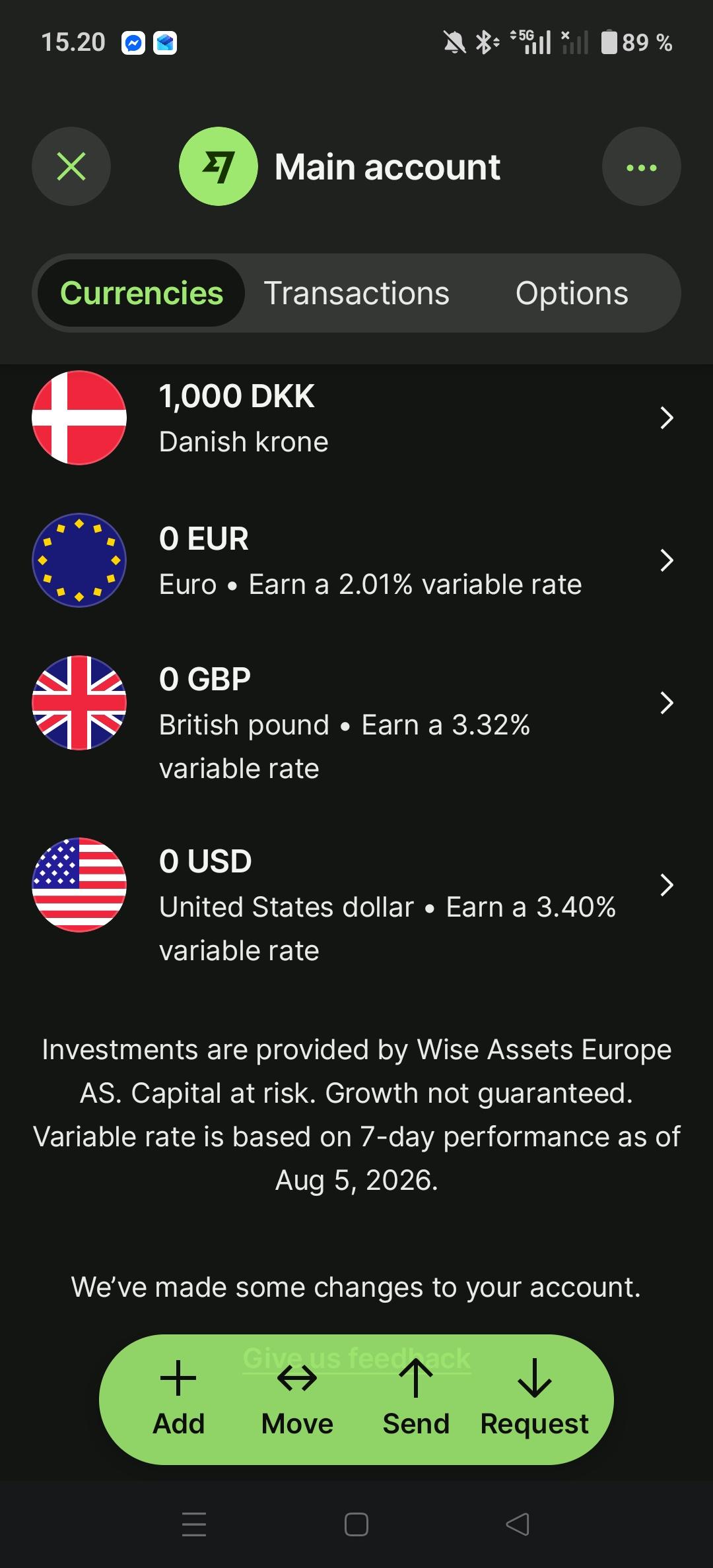
I currently keep a few currencies there.
Wise does not try to sell me airport lounges, insurance, subscriptions or a premium membership tier. It mostly does a smaller number of things: hold currencies, exchange money, receive payments, make transfers and give you a card to spend from those balances.
For me, that makes Wise less useful as a complete primary bank than Revolut, but very good as an additional account.
| Wise | Details |
|---|---|
| Best For | A second account for currencies, international transfers and travel |
| Monthly Account Fee | Free |
| Currencies | Hold and convert 40+ currencies |
| Exchange Rate | Mid-market rate plus a disclosed conversion fee |
| Local Account Details | Available for several major currencies |
| Card | Physical and digital debit card |
| Subscription Plans | None required |
| Travel Extras | Very limited |
| Account Protection in Europe | Customer money is safeguarded, not covered by a normal bank deposit guarantee |
| Best Feature | Keeping international banking simple and FX costs transparent |
Wise Pros and Cons
Wise is best judged as a practical international-money account, not as a full-service lifestyle bank.
| Pros | Cons |
|---|---|
| No monthly personal account fee | Few additional benefits |
| Hold 40+ currencies | Not a conventional bank in Europe |
| Mid-market exchange rate plus transparent fee | Currency conversion is not free |
| Useful local account details | Modest ATM allowances |
| Very useful as a second account | No lounge or major insurance package |
| Simple app | Less useful as an all-in-one financial platform |
| Good for international transfers | Product availability varies by country |
| Useful backup card while traveling | Normal EEA balances do not have a standard €100,000 bank guarantee |
Why I Keep Wise as a Second Account
I do not use Wise every day and there is no reason I need to. The personal account has no monthly subscription, so it can simply sit there until I need it. Revolut plans on the other hand need to justify themselves, otherwise it gets to expensive to keep a subscrition.
That is useful when I want to keep money in a particular currency, compare the cost of a transfer with Revolut or have another card available while traveling.
Having a second financial provider also gives me some practical redundancy. If one card is blocked, lost or temporarily unavailable, I am not relying on several cards connected to the same account.
For someone moving between countries regularly, that is more useful than it might sound.
Wise Is Mostly About Keeping Exchange Costs Down
This is where Wise earns its place for me.
The pricing is relatively easy to understand.
Wise uses the mid-market exchange rate and then shows its conversion fee separately.
That does not mean currency exchange is free.
It means you can see:
the rate, the fee and what you will actually receive.
There is very little to decode.
That is preferable to a provider advertising “0% commission” while making money through a worse exchange rate.
Is Wise Always Cheaper?
No.
I would not assume Wise automatically beats Revolut or every other provider on every exchange.
Revolut can be particularly competitive if you are already paying for a higher plan with generous currency allowances.
For larger transfers, I normally think the sensible comparison is simple:
How much arrives at the other end?
That tells you more than comparing marketing claims about exchange rates.
Wise’s advantage is that the cost is usually easy to see before you confirm anything.
Holding Several Currencies
I keep several currencies in Wise rather than immediately converting everything back into euros.
If I know I will need Danish kroner again, there is little point converting the balance twice.
The same applies to pounds, dollars or other currencies I may need later.
Wise supports holding and converting more than 40 currencies in the same account.
That makes it useful if your work, travel or personal life regularly crosses borders.
The feature itself is not complicated, which is part of the appeal.
Getting Paid in Different Currencies
Wise is also useful for receiving money.
Eligible customers can get local account details for several currencies, including major currencies such as EUR, GBP and USD.
That means someone may be able to pay you using what looks like a domestic transfer on their side, while the money arrives in your Wise account.
For freelancers, remote workers or anyone receiving income internationally, that can be more useful than the card itself.
I do not need this every day, but it is one of the reasons I would keep Wise open even if I were not using it regularly for spending.
The Wise Card
The Wise card is straightforward.
If I already hold the currency I am spending, Wise uses that balance.
If I do not, it can convert automatically from another balance and apply the relevant conversion fee.
That makes it useful as a travel card without requiring much preparation.
I mainly see it as a backup card attached to a good multi-currency account, rather than the main reason to open Wise.
ATM Withdrawals
Wise works for occasional cash withdrawals, but I would not choose it specifically for ATMs.
There is a monthly fee-free allowance, which varies according to where the card was issued, and additional Wise fees can apply above it.
The ATM owner can also add its own surcharge.
For the occasional withdrawal while traveling, that is fine.
For someone who uses a lot of cash, there are stronger options.
Pay in the Local Currency
The same travel rule applies with Wise as with Revolut:
Choose the local currency when an ATM or card terminal offers to convert the payment for you.
Otherwise, the ATM or merchant may perform the conversion using its own exchange rate.
That can wipe out much of the benefit of using a low-cost international card.
Wise vs Revolut
I use both, but for different reasons.
| Feature | Wise | Revolut |
|---|---|---|
| How I Use It | Secondary account | Primary everyday account |
| Monthly Fee | Free personal account | Free tier plus paid plans |
| Multi-Currency Account | Excellent | Excellent |
| FX Pricing | Mid-market rate + disclosed fee | Plan-dependent pricing and allowances |
| International Transfers | Core strength | Strong |
| Local Account Details | Major strength | Available |
| Airport Lounges | No major bundled benefit | Unlimited with Ultra |
| Travel Insurance | No comparable bundle | Included on higher plans |
| Subscriptions | Essentially none | Significant bundle on higher tiers |
| Travel Extras | Limited | Much broader |
| App Style | Simple and focused | Broader financial ecosystem |
| Best Use | Additional account and FX/transfers | Primary banking and travel |
Which Is Better: Wise or Revolut?
For me, Revolut is the better primary account.
I use its broader travel features, airport lounges, insurance and subscriptions. The app also handles more of my everyday financial life.
Wise is better when I want something simpler.
If I need another currency, want to compare a transfer or simply want a backup card abroad, Wise is useful.
And because there is no monthly subscription, I do not need to think about whether I am “getting value” from it every month.
That is probably the best way to think about Wise:
not necessarily your only account, but a very useful second one.
The Wise App
The Wise app reflects the product.
It is relatively simple.
The main things you see are:
- Balances
- Send money
- Receive money
- Currency conversion
- Cards
- Transactions
There are far fewer secondary services than on Revolut.
I actually like that.
If I open Wise, I generally know why I am there.
I want to check a balance, exchange money, receive something or send a transfer.
The app does not need to be much more complicated than that.
Is Wise a Bank?
In Europe, Wise is not a conventional bank.
Wise Europe SA is an authorized payment institution rather than a bank.
Customer balances are safeguarded separately from Wise’s own operating money, but normal EEA Wise balances are not covered by the standard €100,000-style bank deposit guarantee you would expect from an EU bank.
That is one reason I personally treat Wise as a secondary account rather than somewhere I want to keep most of my long-term cash.
I am comfortable using it for spending, transfers and foreign currency balances.
For substantial cash savings, I prefer a conventional bank structure.
Where Wise Is Weaker
There Are Almost No Extras
This is both a strength and a weakness.
There is no Wise equivalent of Revolut Ultra with lounge access, insurance, subscriptions or eSIM data.
If you value those things, Wise feels basic.
If you do not, you are also not paying for them.
It Is Not a Complete Primary Bank
Wise can hold money, receive payments and provide a card.
That does not mean it replaces every normal banking service.
Depending on where you live, you may still want a bank for things such as credit products, savings protection and other domestic services.
Currency Conversion Still Costs Money
Wise is transparent, but it is not free.
The value proposition is low-cost and clearly priced FX, not zero-cost FX.
That is a distinction I actually prefer because it is easier to understand what I am paying.
Wise FAQs
Is Wise free?
A personal Wise account has no monthly subscription fee. Currency conversions, some transfers, physical cards and ATM use above the allowance can still carry fees.
Is Wise a bank?
No, not in the conventional European sense. Wise Europe SA is an authorized payment institution. Customer funds are safeguarded, but normal balances are not protected by a standard EU bank deposit guarantee.
Is Wise good for traveling?
Yes. It is useful for holding different currencies, converting money and having an additional travel card.
Does Wise use the real exchange rate?
Wise uses the mid-market exchange rate and charges its conversion fee separately.
Can I keep several currencies in Wise?
Yes. Wise supports holding and converting more than 40 currencies.
Can I receive salary or freelance payments into Wise?
Eligible users can receive payments using local account details for supported currencies. Whether it works for a particular salary payment depends on the employer, country and currency.
Is Wise better than Revolut?
For me, no as a primary account — but that is not really how I use it.
Revolut is my main account. Wise is a simple secondary account for currencies, international transfers and an additional card.
For someone who does not need Revolut’s broader travel and lifestyle features, Wise may be all they need.
Is Wise Worth Using?
Yes — particularly as an additional account.
That is where I think Wise makes the most sense.
It costs nothing monthly to keep the personal account open, supports a large number of currencies and makes international transfers and conversions easy to understand.
There are not many extra features.
But that is partly the attraction.
I already have a broader financial app in Revolut. I do not need Wise to duplicate it.
Wise gives me another card, another place to hold currencies and another way to move money internationally while keeping exchange costs visible.
If you live in one country, use one currency and rarely make international transfers, you may not need it.
If you travel frequently, work internationally or simply want a second account that handles foreign currencies well, Wise is very easy to justify.
It is not the account I use for everything.
It is the account I am glad to have when I need it.