Here is the answer up front. All three measure the same raw signals overnight: heart rate, heart rate variability (HRV), breathing rate, skin temperature and movement. Oura has the strongest published evidence for overnight HRV and sleep. WHOOP builds the most training-focused coaching around recovery and strain, but costs the most over time. Garmin gives you recovery data for free on a watch you may already own, alongside GPS training tools the other two cannot match.
None of their recovery scores is a medical measurement, and none has been validated against health outcomes. They are useful mirrors of how your body is coping, provided you treat them as prompts rather than instructions.
WHOOP, Oura and Garmin side by side
| WHOOP | Oura | Garmin | |
|---|---|---|---|
| Form | Screenless strap (wrist, bicep or garments) | Smart ring | Watch (or Index Sleep Monitor armband) |
| Daily score | Recovery (0 to 100 per cent) and Strain | Readiness and Sleep scores | Training Readiness, Body Battery, HRV Status |
| Key overnight inputs | HRV, resting heart rate, respiratory rate, sleep, skin temperature | HRV, resting heart rate, body temperature, sleep, respiratory rate | HRV, resting heart rate, sleep, stress, training load |
| GPS and live workout display | No (uses phone) | No | Yes |
| Hardware cost | Included in membership | Ring bought outright | Watch bought outright |
| Subscription | Required | Required for most features | Not required; optional Connect+ |
| Price | One, Peak and Life memberships at £169, £229 and £349 a year at UK launch ($199, $239 and $359 in the US) | Ring 4 from $349 in the US, plus membership at £5.99 a month or £69.99 a year | Watch prices vary; see our best Garmin watches for the money. Connect+ is optional at £6.99 a month |
How each brand measures recovery
WHOOP Recovery
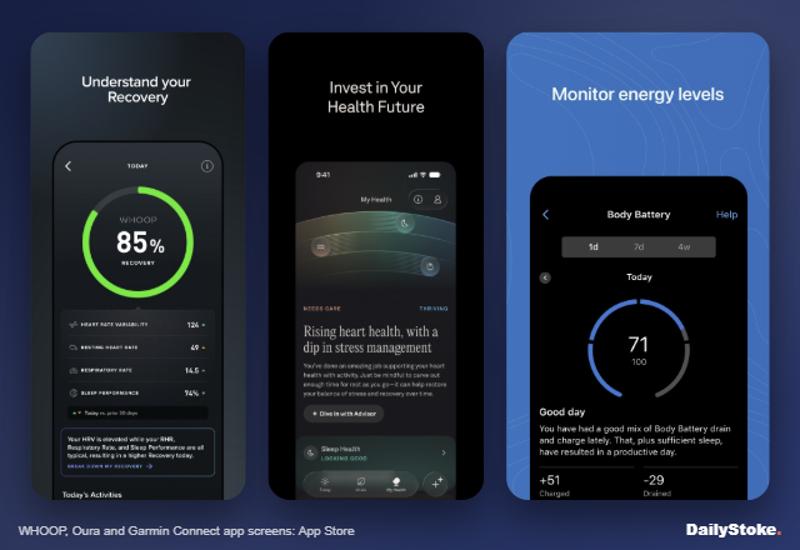
WHOOP is built around one idea: balance strain against recovery. Each morning it gives a Recovery percentage, calculated from overnight HRV, resting heart rate, respiratory rate, sleep, skin temperature and blood oxygen. During the day it tracks Strain on a 0 to 21 scale from heart rate. The coaching then suggests how hard to train.
The strap has no screen, which is either the point (fewer distractions) or a drawback (no time, no live pace). Most runners and cyclists who use WHOOP pair it with a sports watch.
Oura Readiness
Oura’s Readiness score combines HRV balance, resting heart rate, body temperature deviation, sleep and recent activity. A finger is a good place to measure: the arteries are close to the surface and there is less movement overnight than at the wrist. Temperature trends are a particular strength, useful for spotting the start of an illness and for cycle tracking.
Oura is weaker as a workout tracker. It records activity and heart rate during exercise, but has no screen and no GPS.
Garmin Training Readiness, Body Battery and HRV Status
Garmin splits recovery across several features. HRV Status needs about three weeks of overnight data to set your baseline, then shows whether your seven-day HRV average is balanced, unbalanced or low. Body Battery estimates energy reserves from 5 to 100 through the day. Training Readiness, on Garmin’s running and multisport watches, combines sleep, recovery time, training load, HRV and stress into one morning score.
The advantage is context. Garmin knows your actual training, down to the interval, because the same watch recorded it.
What the research says about accuracy
Recovery scores are proprietary formulas, so no study can validate “Readiness” or “Recovery” directly. What researchers can test are the inputs, chiefly sleep detection and overnight HRV.
Sleep. In a study published in Sleep in 2021, Chinoy and colleagues compared seven consumer sleep trackers, including two Garmin devices (a Fenix 5S and a Vivosmart 3), with laboratory polysomnography in 34 healthy young adults. Most matched or beat research-grade actigraphy at distinguishing sleep from wake, though the two Garmin devices did worse, and results for sleep stages were inconsistent across devices (Sleep, 2021). Neither Oura nor WHOOP was in that test. Oura’s own researchers, Altini and Kinnunen, reported in Sensors (2021) that combining motion, heart rate, HRV and temperature improved sleep stage classification against polysomnography (Sensors, 2021); as a company-authored study, it needs independent replication.
Overnight HRV and resting heart rate. A 2025 study in Physiological Reports (Dial and colleagues) followed 13 healthy adults over 536 nights and compared five wearables with ECG (Physiological Reports, 2025). For overnight HRV, the Oura Ring 4 agreed most closely (a concordance score of 0.99 out of 1), followed by the Oura Gen 3 (0.97), WHOOP 4.0 (0.94), Garmin Fenix 6 (0.87) and Polar Grit X Pro (0.82). For resting heart rate, both Oura rings again came out ahead of WHOOP; the Garmin was left out of that comparison for methodological reasons. It is a small study and it predates WHOOP 5.0, but it is the clearest head-to-head test so far.
What this means in practice. For tracking your own HRV trend, all three are good enough. For the closest overnight HRV reading, the evidence currently favours a ring.
Subscriptions and total cost
This is where the three diverge most.
WHOOP sells memberships, and the hardware comes included. Since the launch of WHOOP 5.0 and WHOOP MG in 2025 it has offered three annual tiers. One ($199 in the US, £169 at UK launch) covers sleep, recovery, strain, the AI coach and VO2 max. Peak ($239, £229) adds Healthspan, with WHOOP Age and Pace of Aging, plus Health Monitor and Stress Monitor. Life ($359, £349) swaps in the MG strap and adds blood pressure insights and an ECG feature where it is cleared. Stop paying and the strap stops being useful.
Oura charges for the ring, from $349 in the US, and then a membership for most insights: £5.99 a month or £69.99 a year in the UK, with the first month free. Without membership you see only the three daily scores (Readiness, Sleep and Activity) and little else.
Garmin includes HRV Status, Body Battery and sleep tracking at no extra cost on supported watches. Garmin Connect+, an optional paid tier launched in March 2025 at £6.99 a month or £69.99 a year, layers on AI-generated insights and extra coaching, but recovery data does not depend on it, and Garmin has said the free app is not going away.
Over three years, a Garmin you already own costs nothing extra, while WHOOP and Oura each add their membership fees on top.
Which recovery tracker suits you?
Choose WHOOP if you train hard, already own a sports watch for GPS, and want coaching that tells you how much strain to take on each day. You must be comfortable with an ongoing membership.
Choose Oura if you care most about sleep, temperature trends and the closest overnight HRV reading, and dislike wearing a watch to bed. It also suits people who want health tracking with no exercise focus.
Choose Garmin if you run, cycle, swim or hike and want navigation, workout metrics and recovery data in one device with no subscription. It is the best value for anyone who trains outdoors.
Some athletes wear two: a Garmin for training and an Oura for sleep. That doubles the data, and the two will often disagree on the same night. Pick one recovery score to follow.
Using recovery scores sensibly
A low score after a hard session or a late night tells you what you already suspect. Its real value is spotting the unexpected: a dip in HRV and rise in resting heart rate with no obvious reason can come a day before you feel a cold coming on.
Do not let the score override your body. If you feel well and the score is low, a gentle session is fine. If you feel unwell and the score is high, rest anyway.
These devices are not medical tools. See your GP if you have a persistently raised resting heart rate, palpitations, unexplained breathlessness or chest pain during exercise, whatever your recovery score says. Call 999 for chest pain that does not settle.
For more on what HRV is and why it varies so much between people, read our explainer: what is heart rate variability, and why does it matter?
WHOOP vs Oura vs Garmin FAQs
Which is more accurate, WHOOP or Oura?
For overnight HRV and resting heart rate, a 2025 study in Physiological Reports found Oura rings agreed slightly more closely with ECG than WHOOP 4.0. Both are accurate enough to follow your own trend.
Does Garmin have a subscription for recovery tracking?
No. HRV Status, Body Battery, sleep tracking and, on supported watches, Training Readiness are included. Garmin Connect+ is optional.
Can I use WHOOP without a subscription?
No. WHOOP’s hardware is supplied as part of a membership, and the strap needs an active membership to provide insights.
Is a ring better than a wrist tracker for sleep?
Rings tend to move less overnight and measure from arteries close to the skin, which can help HRV readings. For sleep stages, no consumer device matches a sleep laboratory.
Why do my WHOOP and Garmin scores disagree?
They use different measurement windows, baselines and formulas. Garmin’s HRV Status, for example, compares your seven-day average with a baseline built over about three weeks, while WHOOP resets its Recovery score each morning. Follow one score consistently.
Should I train hard on a low recovery day?
Usually not, if the low score reflects poor sleep, illness or heavy training. If you feel fine and can explain the dip, a moderate session is reasonable.