There is a mildly irritating ritual that comes with owning a sleep tracker. You wake up feeling tired, open the app, and wait for the technology to confirm that you did, indeed, have a bad night.
Perhaps you scored 62. Maybe your deep sleep was “below optimal.” Either way, you are still tired, and the app has not done much beyond giving the problem a number.
That is why the more interesting sleep technology in 2026 is not necessarily the technology that measures the most. It is the technology that changes something: cooling a bed that gets too warm, softening the sound of a snoring partner, helping reset a late body clock, or guiding someone through an established insomnia treatment.
The right choice depends less on which product has the smartest dashboard and more on what is actually waking you up. If heat is the problem, a cooling system may genuinely help. If you have chronic insomnia, another ring is unlikely to tell you anything you do not already know.
The slightly surprising winner here is digital cognitive behavioral therapy for insomnia, or CBT-I. It is less exciting than a temperature-controlled bed, but the evidence behind it is much stronger than the evidence supporting most sleep gadgets.
Research-based buying guide: DailyStoke has not tested these products directly. This guide is based on current specifications, independent testing, clinical research, documented owner experience, and comparison with relevant alternatives. Prices and availability were checked August 7, 2026, and can change.
The useful sleep technology, at a glance
| Tool | Most useful when | Price checked | The catch |
|---|---|---|---|
| SleepioRx or another credible digital CBT-I program | You have persistent insomnia | Cost and coverage vary | SleepioRx requires a provider order in the U.S. |
| BedJet 3 | Heat, sweat, or hot flashes wake you | $699 list; $498 sale; Cloud Sheet $139 | It moves room-temperature air rather than chilling the mattress |
| Eight Sleep Pod 5 | You want precise temperature control on both sides of the bed | About $2,848 to $3,248 before extras | High upfront price plus a $17 to $33 monthly plan, billed annually |
| Ozlo Sleepbuds 2 | A partner, neighbors, or traffic keep disturbing you | $279 | The second generation is too new for a long-term reliability verdict |
| Luminette 3 or a proper 10,000-lux light box | Your body clock runs late or winter mornings are difficult | Luminette 3: $199 | Using bright light at the wrong time can move sleep in the wrong direction |
| Hatch Restore 3 | You want a repeatable routine without your phone | $169.99; Hatch+ optional | It supports a routine but does not treat insomnia |
Prices are U.S. prices unless noted. Current sale prices may not last.
For chronic insomnia, start with treatment rather than tracking
If you regularly lie awake for a long time, wake for extended periods, or begin worrying about sleep before you have even gone to bed, more tracking can become part of the frustration.
A wearable may confirm that the night was rough. It usually cannot change the thoughts and behaviors that keep insomnia going.
CBT-I is designed to do exactly that. The treatment combines techniques such as a structured sleep schedule, stimulus control, cognitive exercises, and relaxation work. It is more involved than listening to a meditation at bedtime, and some parts can feel counterintuitive at first. You have to participate rather than simply wear something.
The payoff is that digital CBT-I has far better evidence than most consumer sleep products. A 2025 systematic review covered 29 randomized trials and 9,475 participants. It found that fully automated digital CBT-I can provide an effective alternative when face-to-face treatment is difficult to access.
A large Sleepio trial involving 1,711 people also reported improvements in insomnia symptoms, daily functioning, well-being, and sleep-related quality of life.
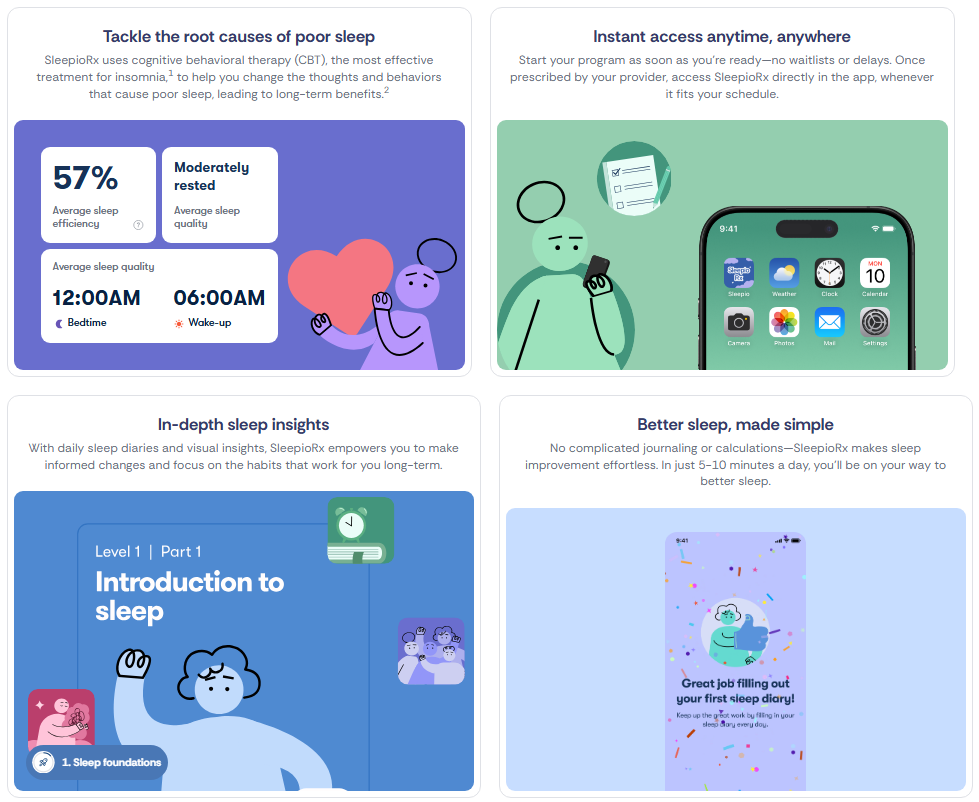
SleepioRx is one of the more credible options available in the U.S. The FDA cleared it in 2024 as a computerized behavioral therapy device for adults with chronic insomnia or insomnia disorder. It is used alongside usual care and must be ordered by a licensed healthcare provider.
That last point is important. SleepioRx is not something you casually download from an app store. Access and cost depend on your provider and insurance plan.
There is also a nonprescription Sleepio program, which some people can access through an employer or health plan. Before signing up, check which version you are being offered, what it costs, and whether anyone will review your progress.
For persistent insomnia, CBT-I is a sensible place to start. It has a stronger evidence base than most sleep gadgets and focuses on changing the habits and thought patterns that can keep insomnia going. It will not be the right option for everyone, so ongoing sleep problems are still worth discussing with a healthcare professional.
If heat wakes you, changing the bed can make sense
Temperature is one of the few things a sleep product can change throughout the night without asking you to do much.
Research into cooling bedding is still developing, and it does not prove that every hot sleeper needs an expensive bed system. Still, the basic idea is credible. Your body naturally loses heat around sleep, and a bed that traps too much of it can become uncomfortable enough to cause awakenings.
The first step should be simple: lower the room temperature if possible, use lighter bedding, and check whether your mattress protector or foam mattress is trapping heat.
If those changes are not enough, active bed cooling becomes more interesting.
BedJet 3 is the sensible place to start

BedJet 3 blows air into your bedding. It can cool, warm, dry sweat, or follow a temperature schedule through the night.
It does not refrigerate the mattress. The system uses air from the room, so it cannot make the bed colder than the surrounding space. What it does well is keep air moving and reduce the warm, damp feeling that can build up under a comforter.
That makes it especially relevant for people dealing with night sweats or hot flashes. You can also make a quick adjustment with the included remote without opening an app at 3 a.m.
The normal price is $699, although BedJet was showing a $498 sale price when checked. Its optional Cloud Sheet costs $139 and spreads the airflow more evenly. You can use the system with ordinary bedding, but the sheet is close to being part of the real purchase if you want the intended experience.
There is no required subscription. That alone makes BedJet easier to recommend than many connected sleep products.
It will not replace air conditioning in a very hot bedroom, and some people may dislike the airflow. Even so, for most hot sleepers, this is the bed system to try before spending several thousand dollars.
Eight Sleep Pod 5 offers more control for much more money

Eight Sleep takes a different approach. Its Pod 5 circulates heated or cooled water through a one-inch cover placed over your existing mattress. Each side can be controlled separately.
This is the most useful part. One person can sleep warm while the other keeps their side cool, without renegotiating the thermostat every night.
The Pod 5 Core costs roughly $2,848 for a full size and up to $3,248 for a California king before optional extras. Eight Sleep lists a temperature range of approximately 55 to 110 degrees Fahrenheit.
The Autopilot plan costs $17 to $33 per month, billed annually, and is required for the first year. It controls automatic temperature changes and includes sleep reports and other connected features. More expensive plans extend warranty coverage and add health-monitoring functions.
Independent reviews are generally positive about the temperature control. That does not make the rest of the ownership experience trivial.
You need space for the hub beside the bed, along with Wi-Fi, an app, periodic maintenance, and some tolerance for owning a water-based system with pumps and tubing. Earlier generations have also attracted owner complaints about leaks, failing pumps, and expensive replacements outside warranty.
The Pod 5 includes design changes intended to reduce maintenance, but it has not been around long enough to settle questions about five-year reliability.
Eight Sleep makes the most sense for couples with very different temperature preferences or people whose sleep is repeatedly disrupted by heat and who have already tried cheaper fixes. The tracking alone is not a good reason to spend this much.
Sleep earbuds are useful when the bedroom is the problem

Noise masking will not cure insomnia, but it can make a difficult bedroom easier to live with.
A steady sound makes sudden noises less noticeable. It can soften a partner’s snoring, passing traffic, a neighbor’s television, or the clatter of an early garbage collection.
The wider evidence for white and pink noise is mixed. A systematic review of 34 studies found positive results in some trials but concluded that the research was not strong enough to support auditory stimulation as a general sleep treatment.
Noise masking may help when noise is clearly causing the problem. It is much less convincing as a broad way to “optimize” otherwise normal sleep.
Ozlo Sleepbuds 2 are the most interesting purpose-built option at the moment. They were released on July 28, 2026, for $279.
Each earbud weighs 1.6 grams and sits almost flush inside the ear, making the design more suitable for side sleeping than normal wireless earbuds. Battery life is rated at up to 14 hours. They use sound masking rather than active noise cancellation and can stream a podcast or audiobook before switching to a sleep sound.
The original Ozlo Sleepbuds established that this tiny shape could be comfortable, but owner reports repeatedly mentioned connection problems, charging failures, and inconsistent battery performance.
Ozlo says the second generation improves those areas. It may well have done so, but a week of launch coverage cannot tell us how the product will behave after six months.
Try the cheaper options first. Foam earplugs or a bedside sound machine may solve the same problem with no charging case or app involved.
Sleepbuds become easier to justify when you share a bed, cannot play sound into the room, need a private alarm, or find normal earbuds uncomfortable. If you are not in a hurry, waiting for longer-term owner reports would be sensible.
Bright light can help when your body clock runs late

Bright light is not something that knocks you out at bedtime. It is a signal that helps set your body clock.
Used after waking, bright light can help move a delayed sleep schedule earlier. Used in the evening, it can shift sleep later. Timing matters more than whether the light comes from a fashionable wearable or a large box on your desk.
A meta-analysis of light therapy for insomnia found improvements in time spent awake after initially falling asleep, although it did not find consistent gains across every sleep measure. The case is clearer when the problem involves circadian timing, including delayed sleep-wake phase, dark winter mornings, jet lag, or certain shift-work schedules.
Luminette 3 is a wearable option costing $199. It projects blue-enriched white light from a frame worn above the eyes and weighs 65 grams. Sessions last from 20 to 60 minutes, depending on the setting.
The advantage is freedom to move. You can make breakfast or work at a computer instead of sitting close to a large lamp. The U.S. product page showed conflicting in-stock and restocking messages when checked, so availability is worth confirming before ordering.
A standard 10,000-lux light box is usually less expensive. The important detail is whether it produces that intensity at a realistic distance. Some small lamps reach their advertised output only when placed uncomfortably close to your face.
Carex’s Day-Light Classic Plus, for example, produces 10,000 lux at 12 inches using a large 16-by-13-inch screen. It takes up considerably more space than light-therapy glasses, but the larger surface makes positioning less fussy.
People with bipolar disorder, eye disease, or medications that increase sensitivity to light should discuss light therapy with a healthcare professional. Clinical guidance is also worthwhile if you are trying to shift a stubborn sleep schedule rather than simply make a dark morning feel more manageable.
For the right person, this is one of the less expensive forms of sleep technology that can influence something real. Just remember that more light is not automatically better. The timing is the treatment.
Hatch Restore 3 helps most when it replaces your phone

Hatch Restore 3 is a bedside light, sound machine, sunset cue, sunrise alarm, and routine timer in one device. It costs $169.99.
Its real value is not any single feature. It is the ability to press one button and begin the same wind-down sequence every evening without picking up your phone.
That might mean dim amber light followed by rain sounds, then a dark room and a gradual sunrise at the same time each morning. The idea is simple, but simple routines are often easier to follow when they do not depend on willpower and six different apps.
Hatch+ costs $4.99 per month or $49.99 per year and adds a larger collection of meditations, stories, music, and sleep sounds. The subscription is optional, and the basic light, alarm, sound, and routine functions remain available without it.
The Restore 3 does require Wi-Fi and the Hatch app for setup and customization. It also cannot be used as an ordinary Bluetooth speaker for your own audio.
There is no strong evidence that this particular device treats insomnia. Hatch’s customer survey is not the same as an independent clinical trial. Its usefulness is more ordinary: it can make bedtime feel consistent and keep a bright, distracting phone out of reach.
That may be worth $170 if you will use the complete routine. If all you want is a sunrise alarm or white-noise machine, cheaper devices can handle those jobs perfectly well.
Possible sleep apnea needs a different kind of technology
Loud habitual snoring, witnessed pauses in breathing, gasping, morning headaches, high blood pressure, and excessive daytime sleepiness should not be treated as another opportunity to buy a wearable.
A ring or watch may show an unusual oxygen pattern. It cannot diagnose sleep apnea by itself.
The American Academy of Sleep Medicine says a technically adequate home sleep apnea test can be used for uncomplicated adults who have signs suggesting moderate to severe obstructive sleep apnea. The test should follow a medical evaluation, and the underlying data should be interpreted by a qualified clinician.
A negative or inconclusive home test does not always close the question. Some people still need an overnight study in a sleep laboratory.
Once sleep apnea has been diagnosed, the technology can do far more than track. CPAP and APAP machines use air pressure to keep the airway open while you sleep. A custom oral appliance may be suitable for some people, depending on the type and severity of the problem.
This is one area where waiting for a smarter consumer wearable is the wrong move. If the symptoms fit, start with a clinician or accredited sleep service.
Sleep technology we would wait on
Closed-loop sound systems, EEG earbuds, neurostimulation headbands, and vibration wearables are becoming more sophisticated.
The idea is appealing: detect what the brain or body is doing and deliver a precisely timed intervention without waking the person. Some of these products may eventually prove useful.
For now, most still have limited independent research, small studies, short follow-up periods, or benefits that are difficult to notice outside the company’s own sleep score.
Be particularly cautious with products claiming to increase deep sleep by a precise percentage. Consumer sleep stages are estimates. A higher proprietary score does not automatically mean better health, better daytime function, or even a noticeably better night.
What we would try first
- If you wake hot: Lower the room temperature and change the bedding first. Move to BedJet if airflow and sweat control address the problem. Consider Eight Sleep only when precise dual-zone cooling is worth the much higher cost.
- If noise wakes you: Start with earplugs or a bedside sound machine. Ozlo Sleepbuds 2 make sense when you need private audio or something comfortable enough for side sleeping, but waiting for long-term reliability reports would be sensible.
- If your body clock runs late: Keep a regular wake time and get outdoor light early in the day. Add a properly specified light box or wearable light when natural morning light is not practical.
- If your phone keeps taking over bedtime: Hatch Restore 3 can make a wind-down routine easier to repeat. A basic sunrise alarm is enough if you do not need the sounds and routine programming.
- If you have persistent insomnia: Ask about CBT-I, including credible digital options. Another tracker is unlikely to change the problem.
- If you snore loudly or feel dangerously sleepy during the day: Seek a sleep evaluation. The useful technology here is proper testing and treatment.
The DailyStoke verdict
The best sleep technology in 2026 is targeted, practical, and often less exciting than the marketing suggests.
Digital CBT-I has the strongest evidence for chronic insomnia. Bed cooling is the most convincing consumer hardware category when heat causes awakenings. Timed bright light can help a body clock that runs late, while noise masking can make a difficult bedroom more tolerable.
For most hot sleepers, BedJet is the sensible place to begin. Eight Sleep offers better control and a more polished system, but the price and subscription make it a specialist purchase rather than a general recommendation.
Ozlo Sleepbuds 2 look promising, especially for side sleepers, but they are too new for a confident long-term verdict. Hatch Restore 3 is useful when it replaces phone use with a routine you will actually follow.
Best for
People who can identify a specific, repeated reason they are sleeping badly and want a tool that acts on it.
Skip it if
You mainly want more sleep data or have symptoms that need proper medical evaluation.
What works
Evidence-based behavioral treatment, active temperature control, correctly timed bright light, practical noise masking, and diagnosed sleep-apnea treatment.
What does not
Buying premium hardware before identifying the problem or treating consumer sleep data as a diagnosis.
Buy now or wait?
Buy proven tools that address a clear problem. Wait on newly launched intervention wearables and products whose main evidence is an improvement in their own proprietary score.
Medical disclaimer: This article is for general information and is not medical advice. Persistent insomnia, dangerous daytime sleepiness, breathing pauses, chest symptoms, severe mood changes, or other concerning symptoms should be discussed with a qualified healthcare professional. Do not use a consumer device to diagnose or replace treatment for a sleep disorder.


