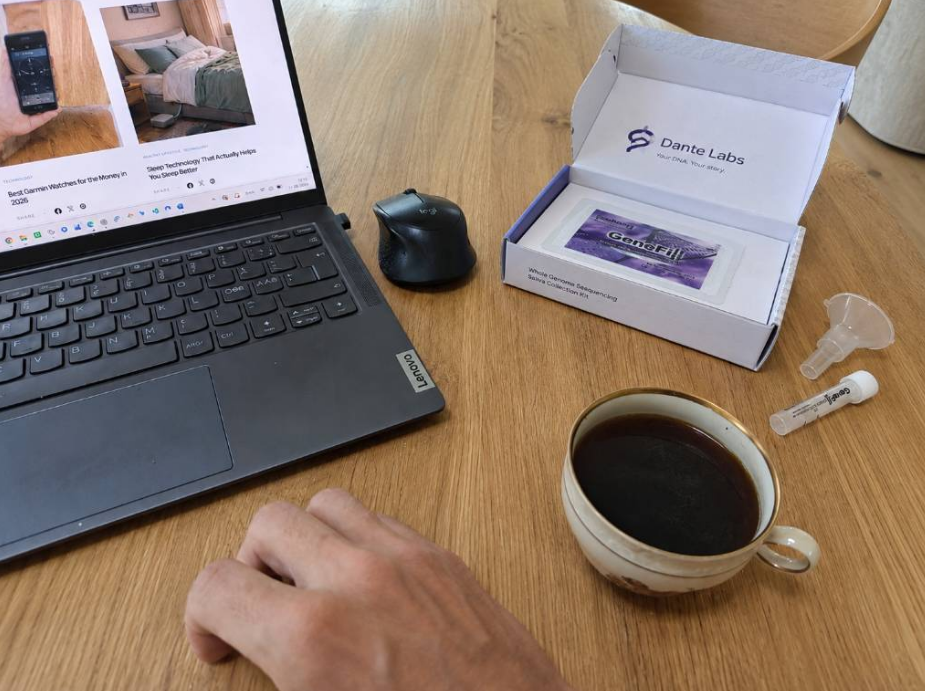
I had my whole genome sequenced mostly out of curiosity.
I have a background in pharmaceutical sciences from the University of Copenhagen, and I’ve always been interested in health, prevention, longevity, and the idea of using better data to make better decisions.
So whole-genome sequencing sounded interesting.
If you can sequence almost all of your DNA, surely there must be something useful hidden in there. I wondered whether it could tell me more specifically how I should eat, train, sleep, or what I should pay more attention to as I get older.
I probably expected something closer to a personalized recipe book for living better and, hopefully, longer.
That wasn’t really what I got.
There is a huge amount of information. Some of it is genuinely interesting, and some of it seems to confirm things I already knew about myself. But I didn’t find anything particularly worrying, and I didn’t make any major lifestyle or health decisions because of the results.
That was probably the biggest lesson from having my genome sequenced.
The data is personalized. What you can actually do with it is much less straightforward.
What You Actually Get From Whole-Genome Sequencing
Once my results were available, the first thing that surprised me was simply how much there was to look through.
My Dante Labs dashboard contains more than 175 clinical reports, while the platform describes the whole-genome sequence as supporting more than 200 reports overall.
The clinical section covers a wide range of areas, from cardiovascular and neurological conditions to metabolism, sleep, nutrition, and more.
There is also family-planning information covering inherited conditions.
Then there are the more lifestyle-oriented reports:
- Nutrigenetics
- Sports & Performance
- Sleep & Chronotype
- Clinical Ancestry
- Family Planning
- Raw genetic data
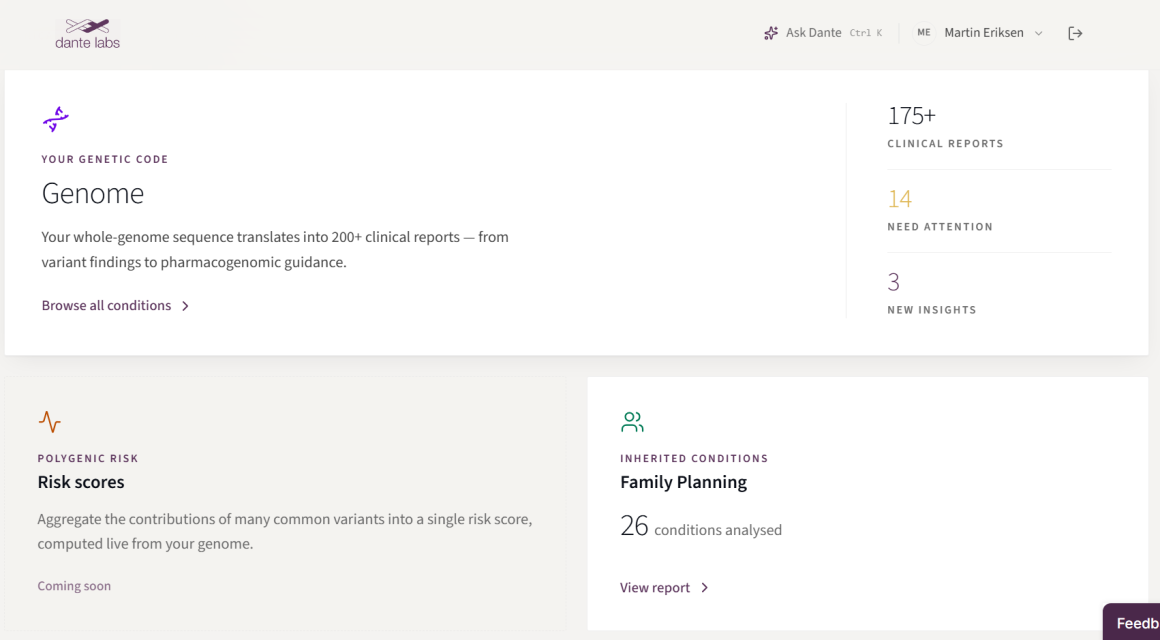
So you do not just receive a giant genetic file and get left to work it out yourself. Dante tries to translate the data into understandable reports.
That is an important part of the product.
The Dashboard Looked More Alarming Than the Details
My dashboard also showed a number of results under “Need attention.”
That sounds slightly alarming at first. But when I opened the individual reports, I did not find anything that made me think I had uncovered a serious medical problem or needed urgent follow-up.
A genetic finding is not the same thing as a diagnosis. Dante also notes that its reports cover specific variants and statistical associations, and that lifestyle, environment, and overall health can outweigh the effect of an individual variant.
I expected the lifestyle advice to be more personalized
This was probably the biggest difference between what I imagined before doing the test and what I actually received.
The genetic analysis can be extremely specific.
A report can tell me exactly which gene is being examined, the SNP involved, which genotype I have, and what published research has associated that genotype with.
Then you reach the section explaining what you can actually do about it.
That is where things often become much more familiar.
My caffeine report, for example, says I am an intermediate caffeine metabolizer.
The practical recommendation is to experiment with caffeine timing and pay attention to how it affects sleep.
I do think I may be somewhat sensitive to caffeine, particularly if I drink too much later in the day. But I already had a reasonable idea that drinking a lot of coffee in the afternoon probably wasn’t helping my sleep.
My FTO result is another example.
The report says I do not carry the tested risk alleles at that locus, but the recommendations still come back to things such as protein, fiber, exercise, sleep, and meal timing.
Those are sensible recommendations.
I just didn’t need my entire genome sequenced to discover them.
My DNA says endurance suits me
One of the more interesting reports for me was Sports & Performance.
Dante looked at my ACTN3 result and classified me as having an “endurance-type profile.”
The report explains that the genotype is overrepresented among endurance athletes and is associated with a metabolic phenotype that favors aerobic capacity.
It then recommends building a strong aerobic base and leaning into endurance work rather than focusing only on explosive power.

This one actually feels quite believable.
I have never thought of myself as much of a sprinter. I am more the type who can keep going for a long time.
So this result did not reveal something completely unexpected. It more or less put a genetic explanation around something I already recognized in myself.
Would I rebuild my training program around it?
Probably not.
I would still care more about how I actually perform, how I recover, what I enjoy doing, my cardiovascular fitness, and whether my training is producing results.
The genetic result adds another piece of information. I wouldn’t treat it as an instruction.
Lactose was another case of DNA confirming the obvious
The Nutrigenetics report also says that I have lactase persistence, meaning I should generally tolerate dairy into adulthood.
That certainly fits.
I am very lactose tolerant and, as far as I know, I don’t have any particular problems with food.
Again, it was interesting to see something I already knew about myself reflected in my genetics.
The Most Useful Results Suggested What to Measure Next
Some findings were more useful because they gave me something specific to check.
My vitamin D report suggested lower receptor activity, but the practical next step was simply to measure my actual vitamin D level with a blood test.
The MTHFR result was similar. It suggested reduced enzyme activity and the possibility of elevated homocysteine, but again, a blood test would tell me whether this was actually affecting me.
That became an important distinction: the genetic result can raise a question, but it does not always answer it.
Some results were simply reassuring
There were also plenty of results where the conclusion was essentially that nothing unusual was found at the particular variant being tested.
For example, one report found no disease-associated C282Y variant at the HFE locus involved in hereditary hemochromatosis.
Another HFE result showed standard iron regulation at the H63D locus.
I wouldn’t describe this as having a “healthy genome.” Genetics is far too complicated for that.
But I also didn’t come away from the results feeling like I had uncovered something I needed to worry about.
I Expected Something More Personalized
I don’t think “generic” is quite the right word. The reports are personalized because Dante is using my genotype and linking it to specific findings.
But personalized information does not always lead to a personalized intervention.
My genome can tell me something about caffeine metabolism, endurance, vitamin D, folate, lactose tolerance, or omega-3 processing. The harder question is what I should actually do with that information.
Often, the answer still comes back to fairly normal things: exercise, sleep well, eat reasonably, avoid obvious excesses, and measure something directly if there is a reason to think it may be abnormal.
Maybe that is not really a limitation of Dante Labs. Maybe there simply is not enough evidence yet to turn most genetic differences into highly specific lifestyle advice.
I had probably expected something closer to a longevity recipe book: how I should train, what I should eat, what I should monitor, and where my biggest health risks might be.
That is not what I got.
What I got was more like a large collection of clues. Some were interesting, some confirmed things I already knew, and a few suggested something I could measure or investigate further.
There was no big revelation.
Maybe the more useful data is what changes over time
Your inherited genome is largely fixed.
Your health is not.
If I want to know how healthy I am today, I may get more immediately useful information from measurements such as blood pressure, blood lipids, ApoB, HbA1c, vitamin levels, VO2 max, sleep, body composition, or other biomarkers that can change over time.
Those measurements tell me something about what my body is actually doing now.
Genetics often tells me more about what I may be predisposed to.
That does not make genetics useless. It just means it answers a different question.
It is also why I have become more interested in epigenetics and other forms of biological monitoring.
Epigenetic markers can change over time, unlike the underlying DNA sequence.
Whether today’s commercial biological-age tests are useful enough to guide real health decisions is another question. I would rather test that than assume the answer is yes.
But it feels like a logical next experiment.
The genome itself may become more useful over time
There is another reason I still think having my whole genome sequenced was worthwhile.
The sequencing is already done.
Dante lets me download my genome variants as a VCF file. Mine is about 402 MB — a good reminder that there is a lot more sitting behind the dashboard than a few summary reports.

And the interpretation can continue to change.
Dante already lists polygenic risk scores as a forthcoming feature. These are intended to combine the effects of many common genetic variants rather than looking at individual variants in isolation.
That does not mean every future report will be useful or included for free.
But it does mean that I don’t necessarily need to sequence my genome again for every new way of interpreting it.
The underlying data is already there, and its value may increase as the science and interpretation improve.
Would I do it again?
Yes, I think I would.
Not because the results transformed how I live. They didn’t.
I didn’t overhaul my diet, change my training because of a particular gene, or suddenly start taking a list of supplements.
A lot of the results simply put genetic explanations around things I already knew. I apparently lean toward endurance rather than sprinting. That sounds about right. I tolerate lactose extremely well. I knew that. And I probably shouldn’t drink too much coffee late in the day.
I expected something closer to a personalized manual for living better and longer.
What I actually got was a much larger dataset about myself — one that may become more useful as the science and interpretation improve.
For now, that feels like the more realistic value of whole-genome sequencing.
Martin Eriksen has a background in pharmaceutical sciences from the University of Copenhagen and writes about health technology, longevity, and practical health optimization for Dailystoke.


