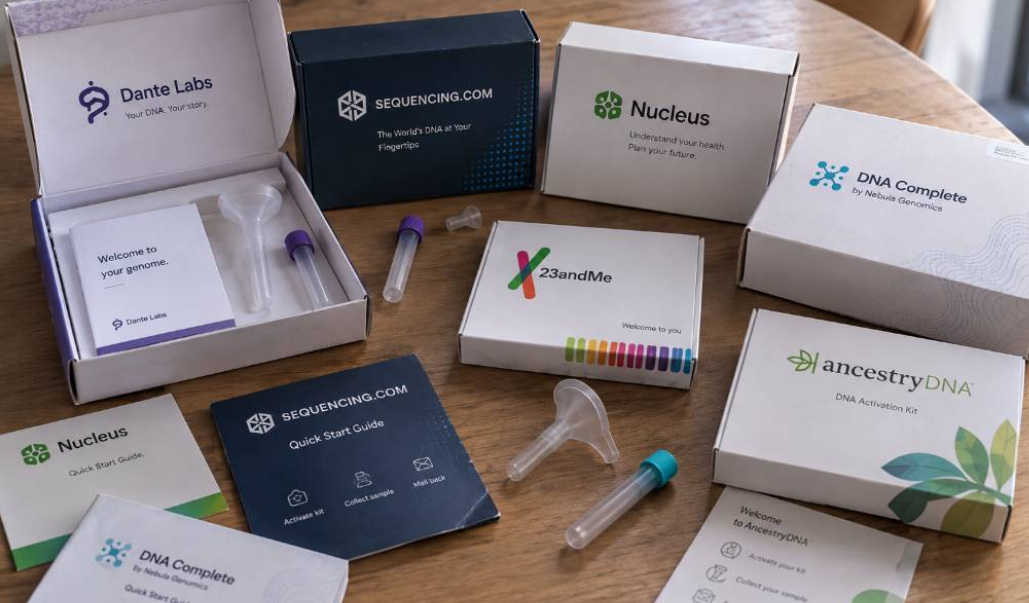
I recently had my whole genome sequenced with Dante Labs. What surprised me most was not how much data I received, but how difficult it was to turn all that data into something I would actually do differently.
That made me look more closely at the wider consumer genomics market.
Whole-genome sequencing is no longer something reserved for research labs or unusual clinical cases. Consumers can now get 30x whole-genome sequencing for a few hundred dollars, with health reports and downloadable genomic data included to varying degrees.
But once several companies can sequence essentially the same genome, the more interesting question becomes:
What happens after the sequencing?
That is where these services increasingly differ.
Whole-genome sequencing is not the same as a normal DNA test
Services such as 23andMe and AncestryDNA primarily use genotyping, which examines selected positions in your DNA rather than sequencing nearly the whole genome.
That can still provide ancestry estimates, relative matching, traits, and selected health information.
Whole-genome sequencing, or WGS, reads far more of your DNA and produces a much larger underlying dataset. Some providers also use that data for ancestry analysis. In my Dante Labs account, for example, a Clinical Ancestry report estimates population background and uses it to support variant interpretation, drug-response analysis, and future polygenic-risk calibration.
So if your main goal is genealogy or a simple ancestry estimate, WGS may be more than you need.
But if you want a high-depth copy of your genome that can support health interpretation and be reanalyzed later, WGS becomes more interesting.
This keeps the ancestry point without repeating the same “more data / future reinterpretation” idea too many times.
What does 30x whole-genome sequencing mean?
You will see 30x repeatedly when comparing WGS providers.
In simple terms, it means each position in the genome is read around 30 times on average. Multiple reads help improve confidence in the final variant calls.
For health-focused consumer sequencing, 30x is generally the level I would compare rather than very low-coverage options such as 1x sequencing.
But once I had my own results, I realized that sequencing depth was not really what I cared about as a consumer.
I was thinking:
What does any of this actually tell me to do?
That is why interpretation matters at least as much as sequencing specifications once you are comparing similar 30x products.
The main whole-genome sequencing options
Prices and packages change frequently, but these are some of the main consumer options. I have used Dante Labs and 23andMe myself; the other providers are compared based on their current published products, pricing, data access and positioning.
| Provider | Main test | Approx. price | Raw genomic data | Main angle |
|---|---|---|---|---|
| Dante Labs | 30x WGS | ~$460 | FASTQ, BAM, VCF | Clinical + lifestyle reports |
| Sequencing.com | 30x WGS | ~$399 | FASTQ, BAM, VCF | Broad health-analysis ecosystem |
| Nucleus | WGS | From ~$499 | Product dependent | Health risks + family planning |
| DNA Complete Pro | 30x WGS | ~$595 | CRAM, VCF | Health + ancestry + genome exploration |
| DNA Complete Essential | 1x WGS | ~$245 | Yes | Lower-cost WGS entry |
| 23andMe | Genotyping | Varies | Genotype download | Health + ancestry |
| AncestryDNA | Genotyping | Varies | Genotype data | Ancestry + relatives |
Dante Labs

Dante Labs is the service I used.
Its main appeal to me is now less the sequencing specification and more the interpretation layer built on top of it.
My account contains a large set of clinical reports alongside nutrigenetics, sports and performance, sleep, family planning, and other analyses.
I found many of the results interesting, but relatively few changed what I actually did.
The longer-term value may be more important. The genome has already been sequenced, so new reports and interpretation methods can potentially be added later without requiring another sample.
Sequencing.com
Sequencing.com is one of the more aggressive competitors on price and breadth of analysis.
Its 30x packages include access to raw genomic files and a large ecosystem of health reports and genome-analysis tools.
It also offers much faster processing tiers for people willing to pay substantially more.
For someone ordering out of curiosity rather than because of an urgent medical question, I would personally struggle to justify paying a large premium just to receive the results several weeks earlier.
Nucleus
Nucleus is positioned more heavily around health risks and family planning.
That may make it attractive to people who want a polished health-focused interface rather than those primarily interested in raw genomic files or running their own analysis.
Its family-oriented products are also more central to the offering than they are with some competitors.
DNA Complete
DNA Complete offers several sequencing depths, including cheaper low-pass sequencing and higher-depth 30x products.
Its 30x product combines health reports, ancestry tools, and downloadable genomic data.
One thing to watch is the membership model. The initial sequencing price is only part of the cost if ongoing interpretation and new reports require an annual subscription.
That is something I would compare carefully across all providers.
More reports do not mean more actionable health advice
This is probably the biggest lesson I took from having my own genome sequenced.
Dante gave me well over 175 clinical reports, plus separate reports covering nutrition, fitness, sleep, ancestry, and family planning.
That sounds enormous. It is enormous.
But it does not mean I received 175 meaningful health decisions.
Some results were reassuring. Others were interesting.
My genetics apparently lean more toward endurance than sprinting, which fits how I see myself.
The test also says I am lactase persistent. That fits too: I tolerate dairy extremely well.
My caffeine result broadly matches my sense that too much coffee later in the day probably is not ideal for my sleep.
The problem is that I already knew most of this.
That has made me skeptical of using report count as the main way to compare genome services.
A provider offering 1,000 reports is not necessarily ten times more useful than one offering 100.
The better question is:
How many results are strong enough to change something you actually do?
Read more about my experience here.
Interpretation is becoming the real product
This is where I think the market is heading.
Once several providers can offer 30x whole-genome sequencing, the laboratory part becomes less distinctive. The harder questions are about interpretation: how variants are classified, how uncertainty is explained, whether pharmacogenomics or polygenic risk scores are included, whether reports update over time, and whether you can take your raw genome elsewhere.
From my own experience, this is where both the value and the frustration sit.
My genome can contain a very specific genetic finding, but the practical recommendation may still be something fairly ordinary: exercise, sleep properly, eat reasonably well, or measure a blood marker to see whether the genetic predisposition actually matters.
That is not necessarily a failure of the company.
There may simply not be enough evidence yet to turn most genetic differences into highly specific lifestyle prescriptions.
Raw data matters more than I expected
I would now put raw-data access fairly high on my buying checklist.
My Dante VCF alone is around 402 MB.
I am not going to manually inspect hundreds of megabytes of variants, but having that file changes the proposition.
A VCF contains identified genetic variants. BAM or CRAM files contain aligned sequencing reads. FASTQ files are closer to the original sequencing output.
Why does that matter?
Because the company that sequences your genome today may not have the best interpretation tools five years from now.
If you retain the underlying data, you may be able to analyze it elsewhere without giving another sample and paying to sequence yourself again.
That is one of the strongest long-term arguments for WGS.
Your genome is not the same as your current health
Having my genome sequenced also changed how I think about health optimization.
Genetics can tell me something about predisposition.
But if I want to know whether my vitamin D is low, whether my ApoB is elevated, whether my blood pressure is improving, or how good my cardiovascular fitness actually is, I still need measurements of what is happening now.
That is why I think the future of consumer health probably involves several different layers:
Genome: What did I inherit?
Blood biomarkers: What is happening physiologically now?
Fitness data: What can my body actually do?
Sleep and lifestyle data: How am I actually sleeping, eating, exercising, and living?
Epigenetic or other dynamic measurements: Are measurable biological patterns changing over time?
Whole-genome sequencing gives you a very rich layer of information.
It is still only one layer.
That is also why I am interested in trying epigenetic or biological-age testing next. I do not assume those tests will be more actionable. I would rather find out.
Privacy matters more with genomic data
Genomic data deserves more caution than most consumer health information.
A compromised password can be changed.
Your inherited genome cannot.
It can also reveal information about biological relatives.
Before choosing a provider, I would check whether you can download and delete your data, whether the physical sample can be destroyed, how research participation works, whether data is shared with third parties, and what happens if you stop paying for a membership.
Those details matter more to me now than another ten lifestyle reports.
Which kind of DNA test should you choose?
If ancestry and relatives are the priority, I would still look first at an ancestry-focused product such as AncestryDNA.
If you want relatively simple health and ancestry reports, genotyping may be enough.
If you specifically want a long-term genomic dataset, I would compare 30x WGS providers based on raw-data access, interpretation quality, privacy, ongoing costs, and how useful the reports are for your goals.
And if you have symptoms, a strong family history, or a specific medical concern, I would not treat a consumer genome dashboard as a substitute for clinical genetics or professional medical evaluation.
Is whole-genome sequencing worth it?
I think it is becoming easier to justify for people who are genuinely curious about their biology and want access to a high-depth genomic dataset.
But I would go into it with different expectations than I did.
I would not expect a personalized longevity manual.
I would expect a large dataset about my inherited biology, a collection of interpretations of varying usefulness, and potentially something that becomes more valuable as the science improves.
If I were comparing providers today, I would focus less on who advertises the largest number of reports and more on four things:
sequencing quality, raw-data access, interpretation quality, and what happens to my data over time.
The sequencing itself is increasingly becoming the easy part.
Making the genome genuinely useful is where this market still has plenty of room to improve.
Medical disclaimer: This article is based on personal experience and is for informational purposes only. Genetic test results are not a diagnosis and should not be used on their own to make medical decisions. If a result raises a health concern, discuss it with a qualified healthcare professional and consider appropriate confirmatory testing.
Martin Eriksen has a background in pharmaceutical sciences from the University of Copenhagen and writes about health technology, longevity, and practical health optimization for Dailystoke.


