
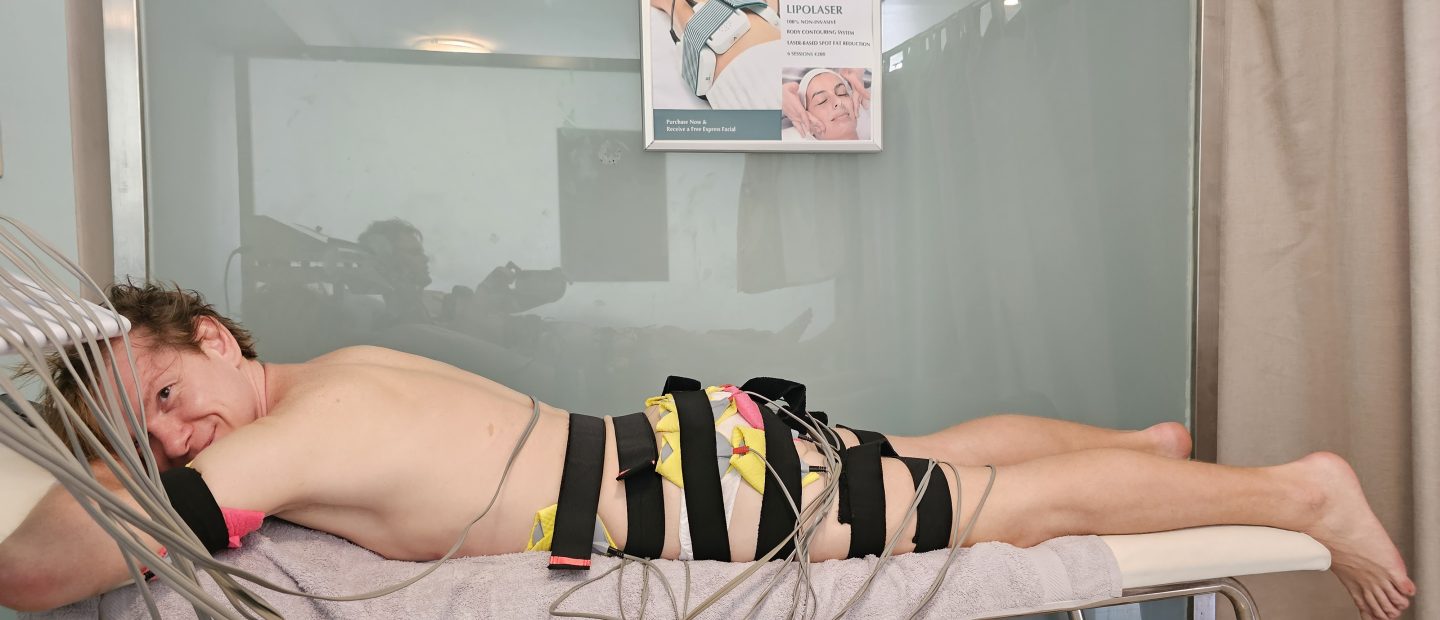
I spent approximately €750 on three months of electrical muscle stimulation in Malta, curious whether the technology could improve muscle definition without conventional exercise. Here’s what the experience was like, what the research suggests, and why I eventually returned to the gym.
After one of my electrical muscle stimulation (EMS) sessions, I went out for fries and Prosecco. I’d just spent around 40 minutes having my abdominal muscles and other major muscle groups stimulated by electrical impulses, without having to perform any actual exercises. It seemed like a rather convenient way to approach fitness, even if following it up with fries and alcohol wasn’t exactly in keeping with the idea of achieving a more defined body.
I remember the therapist joking that a session could be equivalent to something like a thousand sit-ups. The comment came with a wink, and I don’t recall the exact number, but it captured the appeal of the treatment. Imagine getting some of the benefits of an intensive workout while doing little more than lying around.
What initially interested me, though, was the science. I was curious about how electrical impulses could stimulate muscles and whether repeated stimulation could actually produce results comparable to conventional exercise. EMS has long been used in physiotherapy and rehabilitation, but it has also become a commercial wellness treatment marketed for muscle toning and body shaping.
When I discovered that Marion Mizzi offered EMS treatments at the AX Palace Hotel in Sliema, Malta, it seemed like a good opportunity to try the technology myself. We decided to give it a proper trial rather than book a single session, purchasing packages of ten treatments and continuing for approximately three months.
By the end, I had completed around 30 sessions, spent roughly 20 hours connected to the machine, and paid an estimated €750. I thought I might have noticed some improvement in muscle definition, although the results were far from dramatic. More importantly, the experience left me questioning whether EMS offered enough additional benefits to justify the cost and time involved.
What does electrical muscle stimulation feel like?
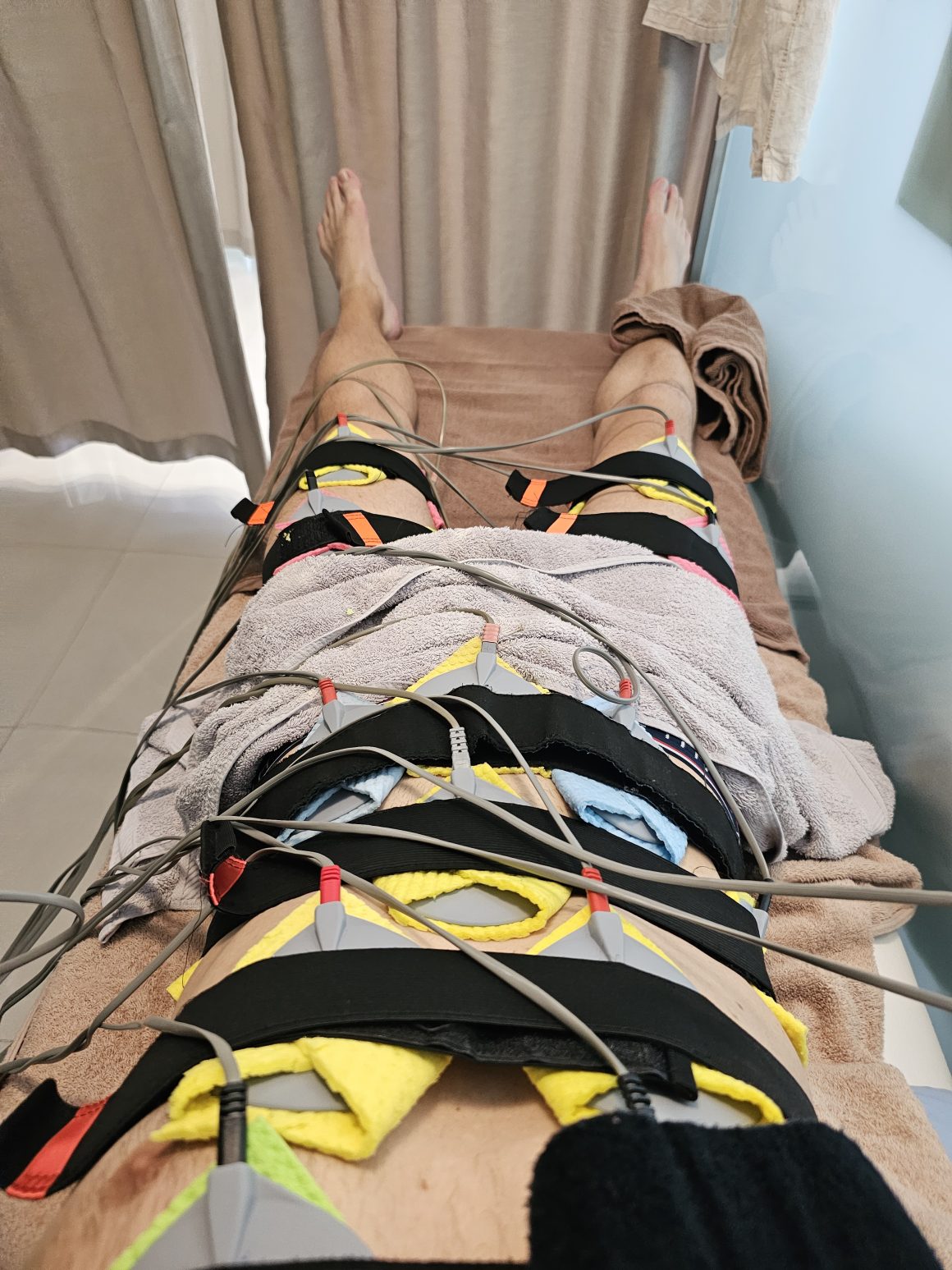
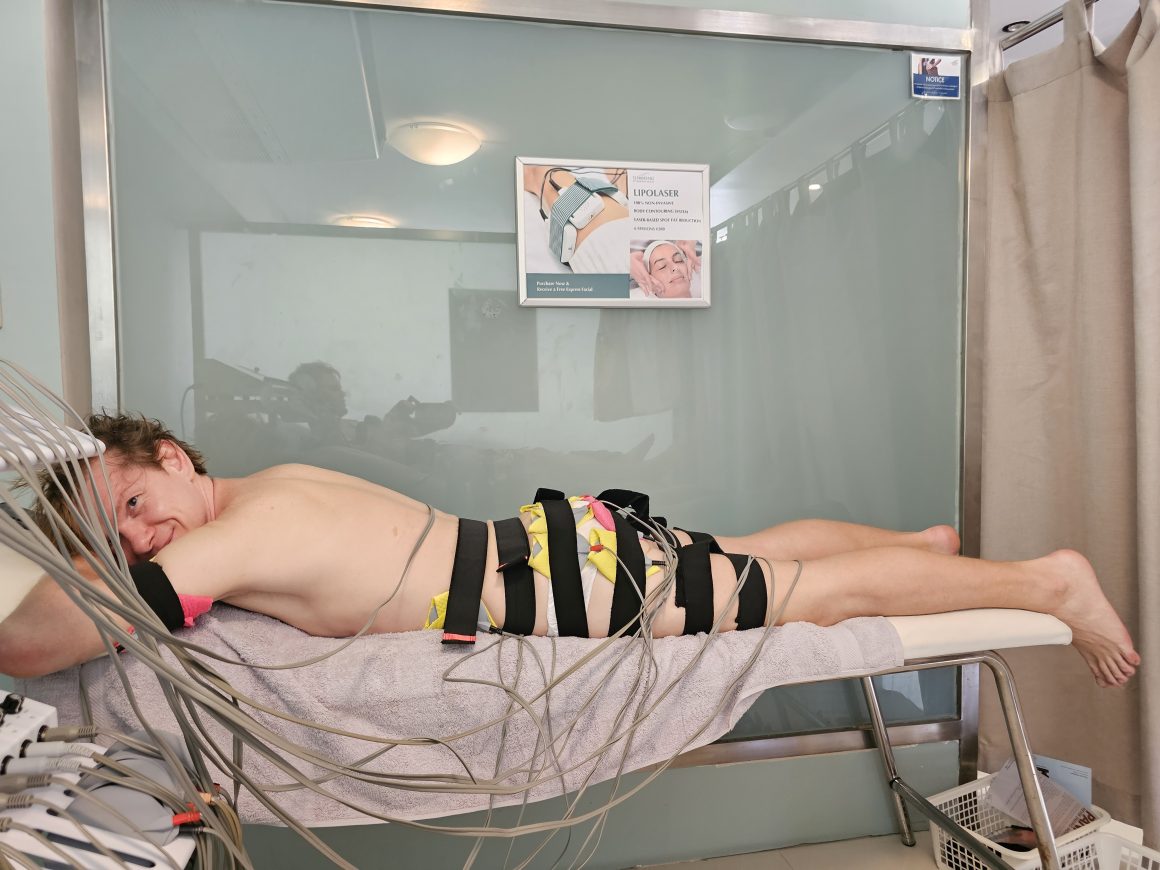
My first session was quite strange, particularly because I had never tried anything remotely similar. I had to strip down to my underwear while the therapist prepared the electrodes and straps that would be attached to different parts of my body.
I remember a faint vinegar-like smell, which I assumed came from the cleaning or preparation process. A layer of fabric separated the electrodes from my skin, while Velcro straps kept everything in place. Eventually, I had electrodes attached across most of the major muscle groups, including my abdomen, chest, and legs.
Once everything was secured, the therapist started the machine, and I experienced the rather unusual sensation of my muscles contracting without me consciously activating them. The electrical impulses created a mild tingling feeling, followed by contractions that tightened the muscles involuntarily.
The stimulation followed different intervals and patterns. Certain muscles would contract for a period, relax, and then contract again as the machine continued through its program. The sensation was initially unfamiliar, although I soon became accustomed to it. There was something fascinating about feeling muscles tighten repeatedly without having to perform the movements that would normally produce those contractions.
Otherwise, there wasn’t much to do during the treatment. You could look at your phone, listen to a podcast, or simply let the machine continue. Unlike a conventional workout, there were no exercises to concentrate on or movements to coordinate. After the initial novelty wore off, I found the sessions rather uneventful and, eventually, somewhat boring.
That was an unexpected downside. One of the attractions of EMS is that you don’t have to do very much, but I discovered that sitting around while a machine stimulates my muscles wasn’t necessarily how I wanted to spend 40 minutes.
Three months of EMS: Did I notice any results?
We purchased packages of ten sessions at a time, which worked out to approximately two or three treatments per week. Each session lasted around 40 minutes, and if I remember correctly, the packages cost about €250 each. That put the price at roughly €25 per visit and €750 over the three months.
I wanted to give the treatment enough time to produce noticeable results. A single session would have told me how EMS felt, but very little about whether regular stimulation could actually improve muscle definition.
During the same period, I was also doing conventional cardio, so EMS wasn’t my only form of physical activity. That makes it difficult to judge how much of any improvement came from the electrical stimulation itself.
Looking back, I think my muscles may have become slightly more defined, although I wouldn’t describe the difference as particularly significant. I didn’t measure muscle thickness, body-fat percentage, or strength before and after the treatments, which would have made the comparison more meaningful.
The difficulty is that even if I looked somewhat different after three months, I couldn’t confidently attribute that change to EMS. My regular exercise, diet, and normal fluctuations in body composition could all have contributed.
I also didn’t experience the kind of obvious transformation that might have persuaded me to continue regardless of the expense. The treatment was interesting, and perhaps it helped a little, but I was still uncertain whether the results justified the investment.
The question became whether there was convincing scientific evidence that repeated electrical stimulation could strengthen muscles and improve body composition, even when performed without conventional exercise.
Does EMS actually work? What the research says
Electrical muscle stimulation is based on a well-established physiological mechanism. Under normal circumstances, our nervous system sends electrical signals to muscles, triggering contractions. EMS delivers electrical impulses externally, activating motor nerves and causing muscles to contract without requiring the person to initiate the movement voluntarily.
The technology has established medical applications, particularly in rehabilitation. Physiotherapists may use electrical stimulation to help patients activate weakened muscles, reduce muscle atrophy, or recover muscular function after certain injuries and medical conditions.
Its use for cosmetic muscle toning and general fitness is more complicated. Muscle contractions can stimulate physiological adaptations, but the effectiveness depends on several factors, including the intensity and frequency of the impulses, the muscles involved, recovery time, and whether the stimulation is combined with voluntary exercise.
Can electrical stimulation build muscle?
A 2023 systematic review and meta-analysis published in Medicine examined 26 studies involving 1,183 participants. The researchers found that whole-body EMS was associated with improvements in muscle mass, strength, and muscular power. They also reported favorable changes in body-fat measurements.
The results are encouraging, although the researchers rated the overall quality of evidence as low, meaning that future studies could change our understanding of the benefits.
Another limitation is particularly relevant to my experience. Almost all the studies involved participants performing voluntary movements or exercises alongside the electrical stimulation. This differs from the largely passive treatment I received, where I was simply connected to electrodes and allowed the machine to stimulate my muscles.
A 2025 study published in the Journal of Exercise Science & Fitness offers another useful comparison. Researchers followed 46 physically active adults for 20 weeks, comparing twice-weekly, 25-minute EMS sessions with conventional resistance-training sessions lasting 90 minutes.
Both groups improved their strength, although conventional resistance training produced greater improvements in several strength measurements and body-fat percentage. The EMS participants achieved some improvements while spending considerably less time training, suggesting that electrical stimulation can provide a meaningful muscular stimulus.
However, the researchers used a structured program involving supervised stimulation, controlled intensities, and progressively adjusted treatment settings. The EMS participants also performed a warm-up and maintained a standing position during stimulation. Those conditions aren’t directly comparable to every commercial body-toning treatment.
The research gives me reason to believe that the contractions I experienced could have provided some training stimulus. It doesn’t establish how much additional muscle development I should have expected from the particular treatment I received.
Is EMS really equivalent to thousands of sit-ups?
This is where the marketing becomes less convincing.
A muscle contraction isn’t necessarily equivalent to a repetition during resistance training. When performing a sit-up, the abdominal muscles generate force while moving the body against gravity. With EMS, electrical impulses trigger contractions, but the body may remain largely stationary.
The amount of mechanical work involved can therefore be very different. Counting electrical contractions doesn’t tell us how much strength has been developed, how many calories have been burned, or whether the effects are comparable to conventional exercise.
Interestingly, Marion Mizzi’s website currently describes its 45-minute EMS treatment as providing muscle engagement equivalent to up to 30 hours of intensive training. That’s a substantial claim, and I haven’t found convincing clinical evidence supporting that comparison for the treatment.
The US Food and Drug Administration takes a more cautious position on electrical muscle stimulators. It acknowledges that repeated stimulation may strengthen or tone muscles to some extent, but states that these devices haven’t been cleared for weight loss, reducing body measurements, or achieving dramatically defined abdominal muscles.
There is also a difference between building abdominal muscles and reducing the fat covering them. Stronger abdominal muscles won’t necessarily become more visible unless body fat decreases as well. Although some whole-body EMS studies have reported improvements in body composition, that doesn’t establish that passive stimulation can selectively remove belly fat.
I never expected the machine to perform miracles, and I understood that diet and regular physical activity would still matter. Nevertheless, the idea of achieving meaningful muscle development while barely moving was appealing enough to make me curious.
EMS versus the gym: Is it really a time-saving alternative?
One of the main selling points of EMS is efficiency. Some commercial providers emphasize how much muscle stimulation can supposedly be achieved in a relatively short session, suggesting that it offers an alternative for people who don’t have time for conventional exercise.
I can understand why that appeals to people, particularly those with demanding schedules. If a technology could produce comparable muscular benefits in substantially less time, it might be worth considering.
My experience, however, made me question how much time I was actually saving.
The stimulation itself lasted approximately 40 minutes, but that wasn’t the entire appointment. I still had to travel to the hotel, prepare for the treatment, have the electrodes attached, and get dressed afterward. Once everything was included, EMS took a fairly substantial amount of time out of my day.
I could have spent much of that time doing strength exercises at home or visiting the gym. The comparison would have been different if I had a treatment device at home, but that wasn’t the situation.
There’s also the question of what you actually gain from those 40 minutes.
A conventional resistance-training session can progressively challenge muscles using weights or body weight, while simultaneously involving coordination and movement. Cardio exercise places sustained demands on the cardiovascular system, something passive EMS does not reproduce in the same way.
EMS may offer a useful stimulus for certain muscles, but the evidence doesn’t provide a simple conversion between 40 minutes of electrical stimulation and 40 minutes of conventional exercise.
For someone with reduced mobility or undergoing rehabilitation, these differences might make EMS particularly useful. The ability to stimulate muscles without requiring conventional movements can have genuine medical value.
For someone like me, who could exercise normally and already had access to a gym, I found the practical advantages less convincing.
What about the mental benefits of exercise?
Another consideration became increasingly important during those three months.
I generally feel good after going to the gym. Even when I’m not particularly motivated beforehand, completing a workout, raising my heart rate, or spending time being physically active feels satisfying.
The feeling afterward is part of why I continue exercising. I might go to the gym partly to maintain my fitness and appearance, but I also enjoy how regular exercise affects my mood.
I didn’t get quite the same satisfaction from EMS. It was interesting to experience the involuntary contractions, especially during the first few treatments, but once I got used to the sensation, the sessions offered little beyond the stimulation itself.
I could listen to a podcast or use my phone, but ultimately I was mostly waiting for the machine to finish.
Scientific evidence supports the mental benefits of conventional exercise. A 2024 meta-analysis published in Psychosomatic Medicine examined 103 studies involving 4,671 participants and found that a single bout of exercise was associated with improvements in mood and reductions in anxiety and depressive symptoms. Effect sizes varied considerably between studies, but the overall findings support something many people recognize from experience: physical activity can make us feel better.
That doesn’t mean EMS cannot have psychological benefits, and someone might genuinely enjoy receiving treatment while relaxing.
For me, though, it was a reminder that exercise’s benefits extend beyond muscle development. I enjoy moving, concentrating on a workout, and feeling physically active. Even if a machine could provide some of the same muscular benefits in less time, I wouldn’t necessarily want it to replace those experiences.
In that respect, EMS was an interesting experiment. I was initially attracted to the idea of achieving results with less effort, only to discover that effort was part of what made conventional exercise enjoyable.
Why I eventually stopped going
After approximately three months, we decided not to purchase another package.
I hadn’t experienced anything particularly negative during the treatments, and I wasn’t convinced that they had been ineffective. There may well have been some improvement in muscle definition, although it was difficult to separate that from my other physical activity.
The decision was mainly about whether the treatment offered enough value to justify continuing.
At around €250 per month, EMS represented a fairly substantial recurring expense. The price of an individual session wasn’t outrageous, but it added up when attending two or three times per week.
It was also inconvenient to travel somewhere specifically to have electrodes attached to my body. The treatments weren’t unpleasant, but they weren’t particularly enjoyable either, and the routine gradually became something I had to fit into my schedule rather than something I looked forward to.
Most importantly, I didn’t have a medical reason to choose electrical muscle stimulation over conventional exercise.
I could build strength at home or in the gym, where I had access to equipment and could gradually increase my workouts’ difficulty. I also enjoyed exercising normally, which made paying for a passive alternative feel increasingly unnecessary.
If I had seen a dramatic improvement in muscle definition or strength, I might have reconsidered. But after three months, I was left with only a possible modest improvement, and that wasn’t enough to persuade me to continue spending the money.
There are circumstances where EMS might make more sense. In rehabilitation, for example, electrical stimulation can help patients whose muscles cannot be activated effectively through ordinary movement. Structured whole-body EMS training may also appeal to people looking for an alternative way to supplement their exercise routines.
It isn’t entirely risk-free, however. The FDA has received reports of skin irritation, burns, pain, and interference with implanted electronic devices associated with electrical muscle stimulators. International whole-body EMS guidelines also emphasize appropriate supervision, gradual increases in intensity, and sufficient recovery between sessions.
Those considerations reinforce the importance of understanding what a treatment involves rather than assuming that a non-invasive wellness procedure is automatically suitable for everyone.
Was three months of EMS worth €750?
I don’t regret trying electrical muscle stimulation. The technology interested me, and the experience let me see firsthand how external electrical impulses can produce muscle contractions.
It was certainly unusual at first, and I can see why some people might enjoy receiving muscle stimulation without performing conventional exercises. I also wouldn’t dismiss the possibility that the treatments contributed to some improvement in muscle definition.
The scientific research provides reasonable grounds for taking EMS seriously as a muscle-training technology, although the evidence for passive cosmetic treatments is less established than the evidence for structured EMS training and medical rehabilitation.
My own experience wasn’t convincing enough to continue.
After approximately 30 sessions, the cost, inconvenience, and uncertain additional benefits outweighed the novelty. I already had access to conventional exercise, and I couldn’t see a compelling reason to keep paying for something that might offer only modest improvements over what I could achieve at home or in the gym.
Perhaps the most unexpected part of the experiment was realizing how much I value the experience of exercising itself. I had become interested in EMS partly because of the possibility of achieving results without the usual effort. Three months later, I was more appreciative of the effort involved in a conventional workout.
A machine can make my muscles contract, and under the right conditions, that stimulation can help strengthen them. But I’m not convinced that replacing exercise with electrical impulses is particularly worthwhile when you’re healthy, physically active, and already enjoy working out.
I’ll stick with the gym for now. And if I decide to have fries and Prosecco afterward, at least I’ll know I’ve done the workout myself.