On July 21st, 2025, tech entrepreneur and longevity advocate Bryan Johnson unveiled a significant expansion of his health protocol, Blueprint, via BuisnessInsider. Far more than a health app or supplement plan, Blueprint is presented as a complete system for reversing aging, optimizing every biological process, and ultimately making death optional. His vision includes global longevity clinics, food purity certifications, algorithm-driven health monitoring, and a rigorously standardized daily routine. As bold as it is controversial, Blueprint is both a personal experiment and a commercial venture—and it demands scrutiny.
This article dives into what Blueprint is, how Johnson describes it, and what we can learn from both his mission and the critiques it has sparked—including those from experts like Nicklas Brendborg, author of the bestselling science book Jellyfish Age Backwards.
Bryan Johnson’s Blueprint: A Controlled Rebellion Against Aging
Frustrated by the lack of consistency and transparency in conventional wellness culture, Johnson created Blueprint as a personal rebellion against entropy. Initially cobbling together practices from various sources, he found the quality poor, the results inconsistent, and the management exhausting.
So, he launched Blueprint—a methodically structured regimen designed around one principle: use the best science and the best tools to achieve the best biomarkers on Earth. That meant measuring, tracking, and optimizing everything from diet and supplements to sleep and cognitive performance. The process was designed to be scalable and reproducible, with data shared publicly.
What Does Blueprint Include?
Blueprint is a multi-layered platform that combines:
- Nutrition & Skincare: Blueprint Nourish delivers precise daily meals and micronutrients, alongside dental, hair, and skin health routines.
- AI-Driven Biomarkers: Users track their body’s internal markers through AI tools that reward progress and maintain leaderboard rankings.
- Therapies & Clinics: The system plans global rollout of longevity clinics offering regenerative treatments and diagnostics.
- Food Certification: Blueprint Quantified aims to standardize purity and quality in food—beginning with pet food and expanding to humans.
Johnson claims that after years of trial and error, the system now delivers the best health outcomes achievable—and he puts himself forward as living proof.
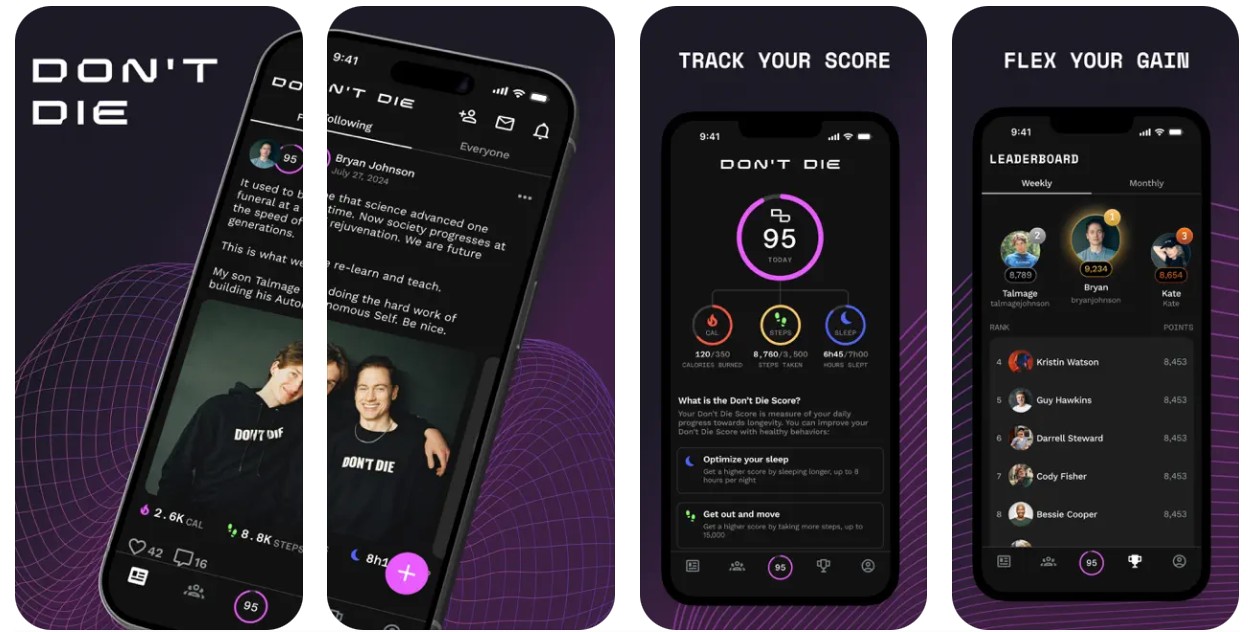
As a companion to Blueprint, Johnson has also released the Don’t Die App—a simple habit-tracking tool that encourages daily behaviors linked to long-term health, though its usefulness beyond motivation remains limited.

The Philosophy: “Don’t Die”
More than health optimization, Blueprint is driven by a philosophy Johnson calls “Don’t Die.” It is literal: Johnson believes that with enough science, AI, and discipline, humans could overcome death.
“Death is our only foe,” he states. “We are the first generation who won’t die.” His protocol is a living enactment of that belief, and he invites the public to join this effort through radical data transparency and open access.
Radical Transparency—or Just the Best Highlights?
Johnson has earned praise for making his health data and daily protocols public. However, the level of transparency is debatable. He claims to be the most “tested” person alive, and publishes results from frequent blood draws and physiological monitoring.
But a closer look reveals that the biomarker values shared publicly are selective: they often reflect only the best results obtained over the past two years, not a real-time reflection of current health. This kind of cherry-picking raises concerns about the integrity of the dataset. Furthermore, the results are displayed in spreadsheets without attached lab documentation, leaving no way to verify their accuracy.
If Blueprint is a scientific experiment, it demands scientific rigor. That means publishing not just the flattering results, but the complete dataset—including the failures.
Nicklas Brendborg’s Critique: Good Intentions, Flawed Method
Biologist and author Nicklas Brendborg, whose acclaimed book Jellyfish Age Backwards explores the mechanisms of longevity in nature, offers a pointed critique of Johnson’s approach.