Spain overtook Malta at the top of Europe’s main LGBTIQ rights ranking this year, Iceland now sits alone at the top of the Spartacus Gay Travel Index, and Cape Town has already set its dates for a month of Pride in February 2027. For a city break where you can hold hands on the street and know the law is on your side, the shortlist has rarely looked so international.
This guide is for LGBTQ+ travellers who want more than a rainbow flag in a hotel lobby. We ranked ten gay friendly cities on the latest independent indexes and on what each offers a visitor: a real neighbourhood, a Pride worth travelling for in 2027, and laws that protect you while you are there.
LGBTQ+ City Breaks at a Glance
| Rank | City | Spartacus Index 2026 (country) | ILGA-Europe Rainbow Map 2026 | Big date in 2027 | Best for |
|---|---|---|---|---|---|
| 1 | Madrid, Spain | Joint 2nd | 1st, 89% | Pride (MADO), provisionally 30 June to 4 July | One of Europe’s biggest Prides |
| 2 | Amsterdam, Netherlands | Outside top 10 | 13th, 64% | Canal Parade, 7 August | History and canal-side Pride |
| 3 | Berlin, Germany | Joint 4th | 7th, 70% | CSD parade, 24 July | Nightlife and queer culture |
| 4 | Reykjavík, Iceland | 1st | 3rd, 86% | Reykjavík Pride, August | A small, safe first trip |
| 5 | Valletta and St Julian’s, Malta | Joint 2nd | 2nd, 88% | Malta Pride, September | Sun, sea and strong laws |
| 6 | Lisbon, Portugal | Joint 4th | 12th, 67% | Lisbon Pride, June | Relaxed bars and good value |
| 7 | Sydney, Australia | Outside top 10 | Not covered | Mardi Gras Parade, 6 March | The world’s best-known parade |
| 8 | Montréal, Canada | Joint 4th | Not covered | Fierté Montréal, summer | A pedestrianised gay village |
| 9 | Cape Town, South Africa | Outside top 10 | Not covered | Pride Parade, 27 February | Beaches and a month of Pride |
| 10 | Bangkok, Thailand | Outside top 10 | Not covered | Bangkok Pride, June | Asia’s marriage equality pioneer |
How We Ranked the World’s Most Welcoming Cities
We started with two independent rankings. The SPARTACUS Gay Travel Index 2026 scores 217 countries and regions on 18 categories, from marriage equality and anti-discrimination law to the death penalty, conversion therapy bans and hostility from the public. The ILGA-Europe Rainbow Map 2026, published in May, scores 49 European countries on law and policy alone. We cross-checked laws on Equaldex, the crowd-sourced database of LGBTQ+ rights by country.
Both indexes rate countries, not cities, so we then looked at what a visitor finds on the ground: an established gay neighbourhood or nightlife district, a Pride or festival with confirmed or published dates for 2027, and a city that is easy to reach from the UK. Pride dates come from organisers and official tourism boards, and provisional dates are marked as such. No city in a country that criminalises same-sex relationships made the list.
The Best Gay Friendly Cities for 2027, Ranked
1. Madrid, Spain
Spain is now the top-scoring country on the Rainbow Map, at 89%, after putting its 2023 LGBTI and trans laws into practice. It shares second place on the Spartacus index with Malta. Same-sex marriage has been legal since 2005, and Madrid has hosted WorldPride before, in 2017.
The heart of gay Madrid is Chueca, a grid of narrow streets north of Gran Vía where the main square is named after Pedro Zerolo, the city councillor who campaigned for marriage equality.
Madrid Pride, known as MADO, is the reason many people book. The city’s official tourism site lists stages in Plaza de Pedro Zerolo, Puerta del Sol, Plaza del Rey and Plaza de España from 30 June to 4 July 2027, with the opening speech on 30 June, all dates still to be confirmed. Hotels around Chueca sell out months ahead.
Pros
- Highest legal protections in Europe
- Chueca is central, walkable and lively all week
Cons
- Pride week is hot, loud and expensive
- Accommodation near Chueca books up early
2. Amsterdam, Netherlands
The Netherlands opened civil marriage to same-sex couples on 1 April 2001, the first country in the world to do so, and Amsterdam still carries that history openly. The Homomonument at Westermarkt, remembers people persecuted for their sexuality. On Zeedijk, Café ‘t Mandje has been pouring drinks since 1927, when Bet van Beeren opened it as one of the first openly gay bars in Europe.
The Rainbow Map is cooler on the Netherlands than you might expect: 13th place and 64%, with ILGA-Europe pointing to a self-determination gender recognition bill stalled since 2021.
After hosting WorldPride in 2026, the city returns to its usual Pride Amsterdam. I amsterdam lists the Pride March for Saturday 24 July 2027 and the Canal Parade, with its decorated boats on the Prinsengracht, for 7 August 2027.
Pros
- Deep queer history within a short walk
- The Canal Parade is unlike any other Pride event
Cons
- Rainbow Map score has slipped behind its reputation
- Summer hotel prices are among Europe’s highest
3. Berlin, Germany
Germany sits seventh on the Rainbow Map at 70% and shares fourth place on the Spartacus index. Marriage equality arrived in 2017, and the Self-Determination Act, which lets people change their legal gender by declaration, took effect in November 2024. ILGA-Europe does note that much of the government’s equality action plan was declared complete before it was actually implemented.
Berlin’s queer scene is spread across the city rather than packed into one quarter. Schöneberg, around Nollendorfplatz and Motzstraße, is the historic gay district and home to the Schwules Museum; Kreuzberg and Neukölln are where younger, queerer and later-night crowds go.
Christopher Street Day, Berlin’s Pride, takes place on 24 July 2027. visitBerlin says the parade leaves Leipziger Straße at Spittelmarkt at noon, passes Nollendorfplatz and ends at the Victory Column.
Pros
- The widest choice of bars, clubs and queer culture in Europe
- Good public transport to every part of the scene
Cons
- No single gay neighbourhood for first-timers to base themselves in
- Club entry can feel arbitrary
4. Reykjavík, Iceland
Iceland is the outright leader of the Spartacus Gay Travel Index in 2026, having shared first place the year before, and is third on the Rainbow Map with 86%. Same-sex marriage has been legal since 2010, and since 2015 the Church of Iceland has married couples of any gender. In 2009 the country chose Jóhanna Sigurðardóttir as the world’s first openly lesbian head of government.
Reykjavík is small, so the scene is too, but it is unusually mixed and relaxed. Kiki Queer Bar, in a rainbow-painted house at Laugavegur 22, is the best-known venue, with drag, karaoke and DJs from Thursday to Saturday. Skólavörðustígur, the street that runs up to Hallgrímskirkja, was painted in rainbow colours for Pride and has stayed that way.
Reykjavík Pride has been held every summer since 1999 and normally falls in early August.
Pros
- Top-ranked country for LGBTQ+ travellers in 2026
- Compact, safe and easy for a first solo trip
Cons
- Very expensive for food and drink
- Only a handful of dedicated venues
Visit Reykjavík’s LGBTQIA+ guide
5. Valletta and St Julian’s, Malta
Malta led the Rainbow Map for ten years running until 2026, and it still sits second at 88%, sharing second place with Spain on the Spartacus index. In 2016 it became the first European country to ban conversion therapy, and marriage equality followed in 2017. ILGA-Europe’s main criticism is that a broader Equality Bill, tabled in 2019, has stalled.
The islands are small enough that Valletta and St Julian’s work as one destination. Valletta, the honey-coloured capital, is where you stay for architecture and quiet evenings. St Julian’s and Paceville, twenty minutes away along the coast, are where Malta goes out, and the bars and clubs there are mixed and welcoming rather than strictly gay. Malta hosted EuroPride in Valletta in 2023.
Malta Pride takes place in Valletta every September, with a week of events ending in a march through the capital’s streets.
Pros
- Some of the strongest LGBTQ+ laws in the world
- Warm-weather Pride, with beaches a short bus ride away
Cons
- Few dedicated gay venues; the scene is mostly mixed
- St Julian’s nightlife is loud and crowded in summer
6. Lisbon, Portugal
Portugal shares fourth place on the Spartacus index and sits 12th on the Rainbow Map at 67%. It legalised same-sex marriage in 2010 and banned conversion practices in 2024. The caution this year comes from ILGA-Europe, which warns that a draft bill threatens self-determination-based gender recognition and the ban on forced medical interventions on intersex children.
For visitors, Lisbon remains one of the friendliest and least pretentious cities in Europe. Príncipe Real, on the hill above Bairro Alto, has the densest cluster of gay bars. Bairro Alto itself is the place for cheap drinks on the street late into the night, and the beaches of the Caparica coast are a bus ride across the river.
Lisbon Pride is held each June and centres on Arraial Lisboa Pride, a large free outdoor party in the city centre.
Pros
- Relaxed, mixed scene that is easy to join
- Better value than Amsterdam or Reykjavík
Cons
- Proposed rollbacks of trans and intersex protections
- Steep hills and cobbles make some neighbourhoods hard work
7. Sydney, Australia
Australia lost minor points on the Spartacus index this year because of cooling public attitudes, and it sits outside the top ten. Sydney, though, remains one of the world’s great gay cities. Marriage equality became law in December 2017, and the city hosted WorldPride in 2023.
Oxford Street, running through Darlinghurst and Surry Hills, is the traditional strip, home to the Oxford Hotel, Universal and Qtopia, a museum and cultural centre for queer history. Newtown and Erskineville have a more alternative feel; the Imperial in Erskineville is famous for drag and for its role in The Adventures of Priscilla, Queen of the Desert.
The Sydney Gay and Lesbian Mardi Gras festival runs from 12 February to 7 March 2027 under the theme HYPERBLOOM. The Parade is on Saturday 6 March 2027 along Oxford Street, Flinders Street and Anzac Parade, starting between 7.30pm and 9.30pm.
Pros
- Mardi Gras is one of the world’s biggest LGBTQ+ events
- Beaches, food and nightlife all within reach
Cons
- A long and expensive flight from the UK
- Spartacus flags rising cultural tension
8. Montréal, Canada
Canada shares fourth place on the Spartacus index and has had nationwide marriage equality since 2005. Montréal is its most European-feeling city and has one of the best-planned gay neighbourhoods anywhere.
The Village runs along Sainte-Catherine Street East, and from late spring until October about a kilometre of it, from Place Émilie-Gamelin to Papineau Avenue, is closed to cars and turned into a pedestrian mall with more than 40 terraces. Berri-UQAM metro station is at one end and Papineau at the other.
Fierté Montréal, the city’s Pride, fills the Village in late July and early August, ending with a parade along René-Lévesque Boulevard.
Pros
- Car-free Village with terraces open late
- Good food scene and lower prices than Toronto
Cons
- Winters are severe; the Village is at its best from May to October
- Pride dates are confirmed only a few months ahead
9. Cape Town, South Africa
South Africa’s 1996 constitution was the first in the world to protect people from discrimination based on sexual orientation, and same-sex marriage has been legal since 2006. Cape Town has the continent’s best-known queer scene and, in 2028, will become the first African city to host WorldPride, from 28 September to 14 October.
De Waterkant, the cluster of restored cottages below Signal Hill, is the traditional gay village; Café Manhattan on Waterkant Street has been a fixture for years. Clifton 3rd beach is popular with gay men.
Cape Town Pride 2027 runs from 5 to 28 February under the theme “Loud in Every Colour”. The parade on Saturday 27 February starts on Alfred Street in De Waterkant and ends at the Green Point Track, which hosts the Mardi Gras party afterwards.
Pros
- A full month of Pride in the southern summer
- Beaches, mountains and vineyards close to the city
Cons
- Petty crime is common; take Uber or taxis at night
- Attitudes outside the city centre can be very different
10. Bangkok, Thailand
Thailand’s Marriage Equality Act came into force on 23 January 2025, making it the first country in Southeast Asia, and the third in Asia, to allow same-sex marriage. Thailand also has a bid in for WorldPride 2030 against Barcelona and London, with the winner due to be announced in January 2027.
Bangkok has long been the most open big city in the region. The gay bar streets are around Silom, especially Soi 2 and Soi 4, near Sala Daeng BTS station. Bangkok Pride, which has grown quickly since it was revived in 2022, takes place each June with a parade through the city centre.
Acceptance is high in Bangkok and the tourist islands but more conservative in rural areas, and trans people cannot yet change their legal gender.
Pros
- Marriage equality and a large, welcoming scene
- Excellent value for hotels, food and transport
Cons
- No legal gender recognition for trans people
- Heat and humidity during June Pride
Pride and Festival Dates for 2027
Dates published so far by organisers and tourism boards:
| Event | City | 2027 dates |
|---|---|---|
| Cape Town Pride | Cape Town | 5 to 28 February; parade 27 February |
| Sydney Gay and Lesbian Mardi Gras | Sydney | Festival 12 February to 7 March; Parade 6 March |
| EuroPride 2027 | Turin, Italy | 18 to 26 June |
| MADO Madrid Pride | Madrid | Provisionally 30 June to 4 July |
| Berlin CSD | Berlin | Parade 24 July |
| Pride Amsterdam | Amsterdam | Pride March 24 July; Canal Parade 7 August |
There is no WorldPride in 2027. After Amsterdam in 2026, the next is Cape Town in 2028. EuroPride goes to Turin; Italy scores only 24% on the Rainbow Map, so expect the week to be as much protest as party.
Staying Safe as an LGBTQ+ Traveller
Every city here protects same-sex relationships in law, but law and street are not the same thing. Holding hands is routine in Chueca or the Village and can still draw stares a few streets away. Use licensed taxis or ride-hailing apps after dark in Cape Town and Bangkok, and keep valuables in the hotel safe.
If you are trans or non-binary, check the passport and entry rules for every country you pass through, not only your destination, and read the UK Foreign Office’s travel advice, which includes a section for LGBT+ travellers on each country page. If you use dating apps, meet in public places first. Finally, make sure your travel insurance covers you for every country on your itinerary.
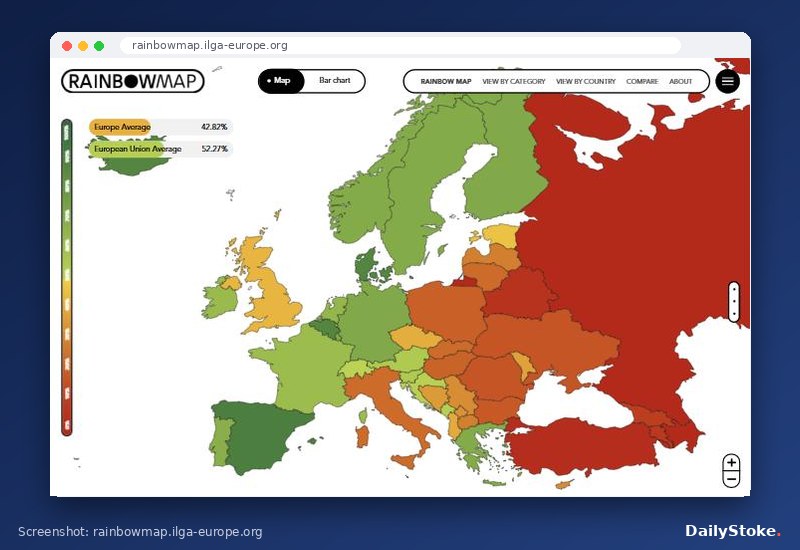
Where LGBTQ+ Rights Stand for Travellers in 2027
The map has shifted this year. Spain ended Malta’s decade at the top of ILGA-Europe’s Rainbow Map with 89%, while the United Kingdom sits in the middle of the table at 44%. Iceland leads the Spartacus Gay Travel Index on its own, out of 217 countries and regions. Thailand’s Marriage Equality Act, in force since January 2025, has made it the first country in Southeast Asia where same-sex couples can marry.
Pride itself is spreading south. Cape Town holds a month of Pride in February before becoming the first African host of WorldPride in 2028, and EuroPride lands in Turin in June. Elsewhere the picture is mixed: ILGA-Europe reports progress in some countries and stagnation or rollback in others, including draft laws in Portugal that would weaken trans and intersex protections.
Queer Travel FAQs: Pride, Rankings and Safety
What is the most gay friendly city in the world?
There is no official city ranking, but Madrid has the strongest case for 2027: Spain tops the Rainbow Map and shares second place on the Spartacus index, Chueca is one of the world’s liveliest gay neighbourhoods, and MADO is one of Europe’s biggest Prides.
Is there a WorldPride in 2027?
No. WorldPride took place in Amsterdam in 2026, and the next edition is in Cape Town from 28 September to 14 October 2028. EuroPride 2027 is in Turin from 18 to 26 June.
When is Sydney Mardi Gras 2027?
The festival runs from 12 February to 7 March 2027, and the Parade is on Saturday 6 March 2027 along Oxford Street, Flinders Street and Anzac Parade.
Is Bangkok gay friendly?
By regional standards, very. Same-sex marriage has been legal in Thailand since January 2025 and the bars around Silom are busy every night, though trans people still cannot change their legal gender.
Where does the UK rank for LGBTQ+ rights?
On the Rainbow Map 2026 the United Kingdom scores 44%, around the middle of the 49 countries covered and far behind Spain’s 89%. London remains a major gay city, but it fell outside our top ten on the country-level evidence.