The first wave you actually ride is rarely pretty. It is usually a crumbling line of whitewater, knee high, and you stand for perhaps three seconds before toppling sideways into the shallows. Then you turn round, grinning, and paddle back out for another.
Surfing has a reputation for being hard to learn, and it is. It is also one of the most rewarding sports there is, and Britain is a better place to start than many people realise, from the beaches of Cornwall and Devon to the reefs of the north-east and an inland wave pool on the edge of Bristol.
This guide covers what you need to know before your first session: how to learn, how to stay safe, the basic technique, the kit worth buying, and how to watch the world’s best surfers and pick up a few ideas from them.

Where to learn
Book a lesson. It is the single best decision a new surfer can make. A good instructor will choose a safe beach for the conditions, give you the right board and wetsuit, teach you the pop-up on the sand and push you into your first waves. Plenty of beginners manage to stand during their first lesson.
Look for a school whose instructors hold recognised coaching and beach lifeguard qualifications, with small groups and kit included in the price. Group lessons are cheapest, and a block of three or four over a long weekend gives you a far better start than a one-off.
Learning in a wave pool
The alternative to the sea is a wave pool. The Wave, at Easter Compton on the northern edge of Bristol, opened in 2019 and uses technology from the Spanish company Wavegarden. Its waves range from gentle whitewater around half a metre high for beginners up to two-metre barrels for experts.
The great advantage is repetition. In the sea you might wait 20 minutes for a decent wave; in a pool the waves arrive on a timetable, all roughly the same shape, so you can practise the pop-up over and over. The downside is cost, and you still need to learn to read the ocean before you head to the beach on your own.
A typical first day might look like this: a morning lesson on the beginner whitewater at The Wave, a bowl of chips in the café, then an afternoon session that ends with three or four waves ridden on your feet. By the end you will know whether you are hooked.
Staying safe in the sea
The ocean is not a swimming pool, and beginners need to understand a few things before going out alone.
What the beach flags mean
On lifeguarded British beaches, the RNLI uses a simple flag system:
- Red and yellow flags mark the safest area for swimming and bodyboarding.
- Black and white chequered flags mark the area for surfboards, stand-up paddleboards and other non-powered craft. You should not swim there.
- A red flag means the water is dangerous. Do not go in under any circumstances.
So surfers belong between the chequered flags, not among the swimmers.
Rip currents
Rips are strong currents running out to sea, and they are the biggest danger on British beaches. Ironically, experienced surfers often use them to get back out beyond the breaking waves. Beginners should avoid them.
If you are caught in one, the RNLI’s advice is clear. Don’t try to fight it. Stay with your board, which will keep you afloat. If you can stand, wade. If you can, paddle parallel to the shore until you are out of the current, then head in. Raise a hand and shout for help.
Without a board, follow the RLSS UK “Float to Live” advice: lean back, keep your ears in the water, control your breathing and wait for the panic to pass.
If you see someone in trouble, alert the lifeguards or call 999 or 112 and ask for the coastguard.
Can you surf if you’re not a strong swimmer?
You should be able to swim confidently before you surf, ideally a few hundred metres without stopping and comfortably in water over your head. A lesson in waist-deep whitewater is safe for most people, but the moment you paddle out further, your swimming is your safety net. If yours needs work, our swimming questions answered guide covers breathing, technique and getting over a fear of water.
Basic technique
Paddling
Lie on the board with your chest raised slightly and your toes near the tail. If the nose dips under, move back; if it sticks up high, move forward. Paddle with long, alternating arm strokes, cupped hands reaching deep. Most of surfing is paddling, which is why it is so tiring at first.
Catching a wave
Beginners start in the whitewater, the broken foam rolling towards the shore. Point the board straight at the beach, look over your shoulder for a wave, and start paddling hard a few seconds before it reaches you. When you feel the board pick up speed and the wave take over, it is time to stand.
The pop-up
The pop-up is the move from lying to standing in one quick motion. Practise it on the sand until it feels automatic:
- Place your hands flat on the board beside your ribs, as if starting a press-up.
- Push up sharply, lifting your chest.
- Bring your back foot across the board near the tail, then your front foot forward between your hands.
- Stand with knees bent, feet shoulder-width apart, arms out for balance and eyes looking forward, not down.
Left foot forward is “regular”, right foot forward is “goofy”. Neither is better. The usual faults are standing up too slowly, kneeling on the way up and looking at your feet, which is where you will go.
Going along the wave
Once you can ride straight in, start leaning gently to make the board travel along the wave rather than straight at the beach. This is “trimming”, and it is the first step towards riding unbroken waves, known as “green” waves.
Surf etiquette
Surfing has unwritten rules, and breaking them is the fastest way to annoy everyone in the water.
- Don’t drop in. The surfer closest to the breaking part of the wave has priority. If someone is already riding it, don’t take off in front of them.
- Don’t snake. Paddling round someone to steal priority is frowned upon.
- Hold on to your board. A loose board can injure the person behind you.
- Paddle wide. Paddle out around the area where people are riding, not through it.
- Know your limits. Stay in the whitewater or at beginner-friendly breaks until you can turn and stop with confidence.
- Apologise. Everyone gets it wrong now and then. A quick “sorry” goes a long way.
Kit basics
Boards
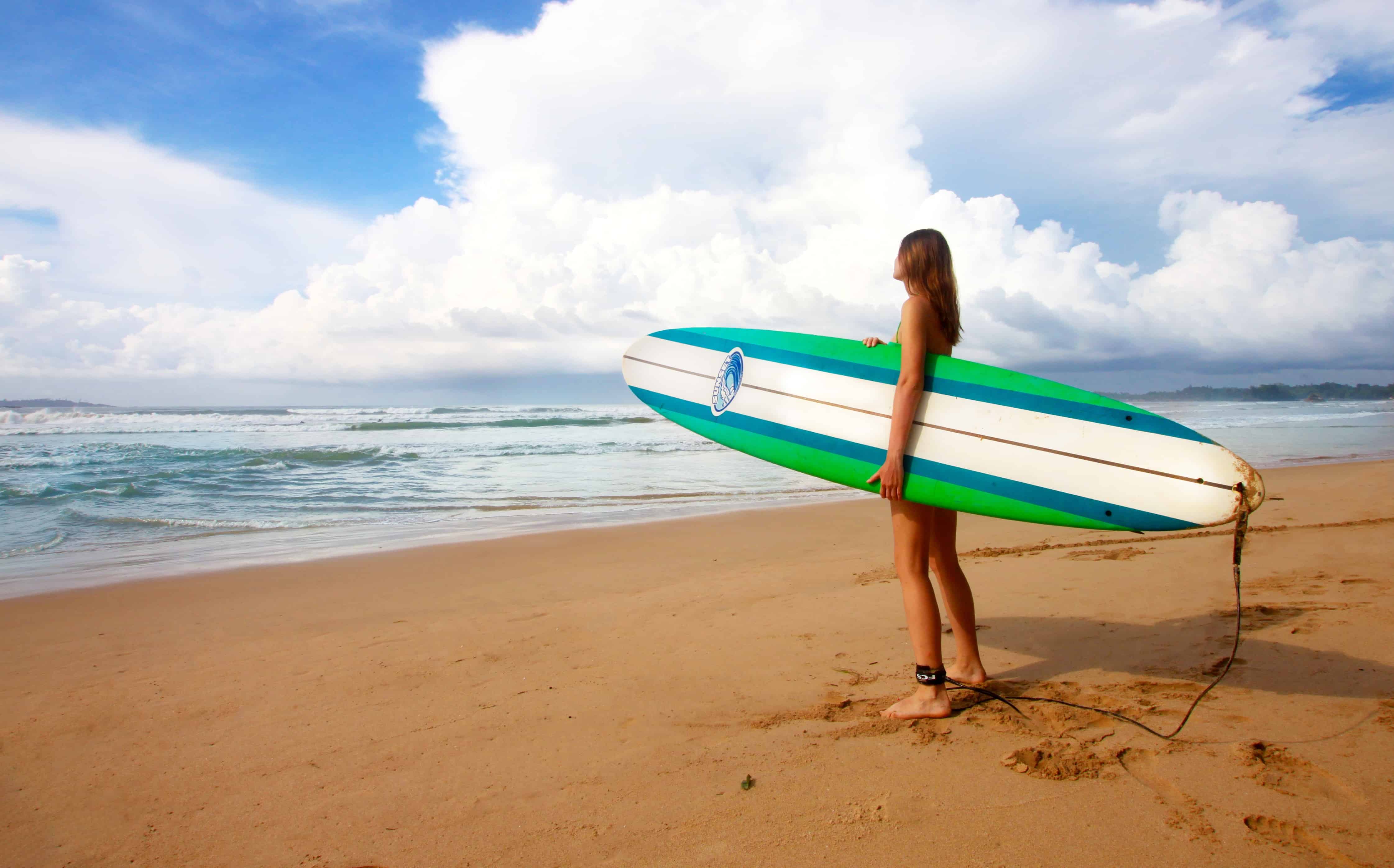
Start on a soft-top, also called a foam board. It is long, wide and thick, which makes it stable and easy to paddle, and the soft deck hurts far less when it hits you. Most schools use boards around eight or nine feet long. Volume, measured in litres, is the key figure: more volume means more float.
Resist the temptation to buy a short, pointed performance board early on. A beginner on a board that is too small catches fewer waves and progresses more slowly. Many surfers ride a foam board for their first season, then move to a longer, rounder hard board such as a “mini-mal” or longboard.
Wetsuits
British waters are cold for most of the year. As a rough guide, many surfers wear a 3/2mm suit in summer and a 5/4mm or 5/3mm in winter, the figures referring to the thickness of the neoprene on the body and limbs. Boots, gloves and a hood make winter sessions possible.
Fit matters more than brand. A wetsuit should be snug with no baggy areas where water can pool, yet allow you to raise your arms over your head.
Leash, wax and the rest
A leash attaches the board to your ankle so it does not wash away. Hard boards need wax for grip. Add sun cream, a towel or changing robe and a flask of something hot, and you are set.
Our sailing and surf gear guide goes into more detail on boards, wetsuits and board bags.

Should surfers wear helmets?
Helmets are still unusual in surfing, but the Australian surfer Owen Wright helped change attitudes. In December 2015 he wiped out at Banzai Pipeline in Hawaii and suffered a traumatic brain injury that left him having to relearn how to talk, walk and surf.
He returned to the Championship Tour, won the 2019 event at Teahupo’o in Tahiti and spoke afterwards about wanting to protect his health, becoming one of the sport’s most visible advocates for helmets. He went on to win bronze at Tokyo 2020, Australia’s first Olympic surfing medal.
For beginners in small whitewater, a helmet is not essential. For anyone surfing over shallow reef or rocks, or coming back from a head injury, it is worth considering.
Watching the best surfers
Watching professionals is one of the best ways to learn: their positioning, timing and how they read a wave.
The World Surf League Championship Tour
The World Surf League (WSL) runs the elite Championship Tour. The 2026 season has 12 events, after a planned stop in Abu Dhabi was cancelled, starting at Bells Beach in Australia in April and taking in Margaret River, the Gold Coast, Raglan in New Zealand, El Salvador, Brazil, Teahupo’o, Cloudbreak in Fiji, Lower Trestles in California, Supertubos in Portugal and Cloud 9 in the Philippines.
The format has changed. From 2026, the one-day WSL Finals is gone and the tour returns to a season-long points race, with surfers counting their best nine of 12 results. The world titles will be decided at the Pipe Masters at Banzai Pipeline in Hawaii, which has a waiting period from 8 to 20 December and carries one and a half times the points of a standard event. The field is cut after the ninth event, from 36 men and 24 women to 24 men and 16 women.
The 2025 world champions were Yago Dora of Brazil and Molly Picklum of Australia. Recent title winners also include John John Florence and Caitlin Simmers (2024), and Filipe Toledo and Caroline Marks (2023). Carissa Moore of Hawaii, a five-time world champion and winner in 2019 and 2021, has returned to the tour in 2026.
Events are streamed live on the WSL website and app.
Surfing at the Olympics
Surfing made its Olympic debut at Tokyo 2020. At Paris 2024 the event was held 15,000km from the French capital, at the fearsome reef pass of Teahupo’o in Tahiti. Kauli Vaast of France and Caroline Marks of the United States won gold.
At Los Angeles 2028, surfing moves to Trestles State Beach in San Clemente, California, with 48 surfers, 24 men and 24 women.
More surfing, less working
Surfers have always bent their lives around the tide chart, and some employers have tried to meet them halfway. In 2019 the BBC reported on Cre8tion, a branding agency with offices in Cardiff and Bristol, which had moved staff to a four-day pattern with alternate Fridays off. Its chief executive, Darrell Irwin, argued that giving people a day back to “go surfing or read a book all day” helped retain younger staff. Business group CBI Wales said at the time there was not yet enough evidence to support a four-day week on the same pay.
The debate about shorter working weeks has continued since. For surfers, the appeal is obvious: an empty Friday morning line-up beats a crowded Saturday every time.
Planning your first surf trip
Once you can catch whitewater waves consistently, a surf trip is the fastest way to improve: a week of surfing every day does more than a year of occasional weekends. Look for destinations with gentle, sandy beach breaks, warm water and plenty of surf schools. Our surf trips guide has ideas, and you will find more on the sport in our Water & Sport section.
Surfing is hard on the shoulders and lungs, so regular swimming makes a real difference. Our swimming for health guide explains how to build fitness in the pool.
Frequently asked questions
How long does it take to learn to surf?
Many people manage to stand in their first lesson. Catching unbroken waves and riding along them usually takes weeks or months of regular surfing, depending on how often you get in the water.
How fit do you need to be to surf?
You need to be a confident swimmer and reasonably fit, as paddling is hard work. Swimming, shoulder exercises and yoga all help.
What is the best surfboard for a beginner?
A soft-top foam board of around eight to nine feet, with plenty of volume. It is stable, easy to paddle and forgiving.
What wetsuit do I need for surfing in the UK?
Typically a 3/2mm in summer and a 5/4mm or 5/3mm in winter, with boots, gloves and a hood in the coldest months.
Can I learn to surf at The Wave in Bristol?
Yes. The Wave has gentle whitewater for beginners, and its predictable waves make it a good place to practise the pop-up.
What does “dropping in” mean?
Taking off on a wave that another surfer is already riding, or has priority on. It is the biggest breach of surf etiquette.
Where should I surf on a lifeguarded beach?
Between the black and white chequered flags. The red and yellow flagged zone is for swimmers and bodyboarders.
What should I do if I get caught in a rip?
Don’t fight it. Stay with your board, paddle parallel to the shore until you are free, and raise a hand and shout for help.
When is the best time of year to surf in the UK?
Autumn often brings the best combination of warmer water, after the summer, and more consistent swell. Summer is gentler and suits complete beginners.
Where can I watch professional surfing?
The WSL streams Championship Tour events live on its website and app. In 2026 the world titles are decided at the Pipe Masters in Hawaii in December.