Verdict: The Muse S Athena is the most accurate sleep tracker most people can buy without a referral, because it reads brain waves rather than guessing from your pulse. A 2026 lab study of the Muse S found substantial agreement with a hospital sleep test. But it costs £404.49 in the UK ($474.99 in the US), puts some sleep tools behind a subscription, lasts one night per charge and asks you to sleep in a headband. For most people a ring is good enough; for the curious few, this is the real thing.
- Product: Muse S Athena
- Maker: Interaxon Inc., Toronto, Canada
- Price: £404.49 at UK retailer Healf; $474.99 on Muse’s US store; €449.99 in Europe
- Subscription: Muse Premium, $12.99 a month or $49.99 a year on Muse’s own site (optional)
- Sensors: 4-channel dry EEG, 5-optode fNIRS, PPG heart rate, accelerometer and gyroscope
- Battery: Up to about 10 hours; roughly 3 hours to charge
- Weight: About 41g, according to outliyr
- Launched: March 2025
- Warranty: One year
What the Muse S Athena does
Muse started as a meditation headband: dry sensors on the forehead and behind the ears read your brain’s electrical activity (EEG) and turn it into sound feedback, such as weather that calms as your mind settles. The S series is the soft fabric version designed to be worn in bed. The Athena, announced on 18 March 2025, adds fNIRS, functional near-infrared spectroscopy, which shines light into the frontal cortex to estimate changes in blood oxygenation, the same principle as a pulse oximeter on your finger.
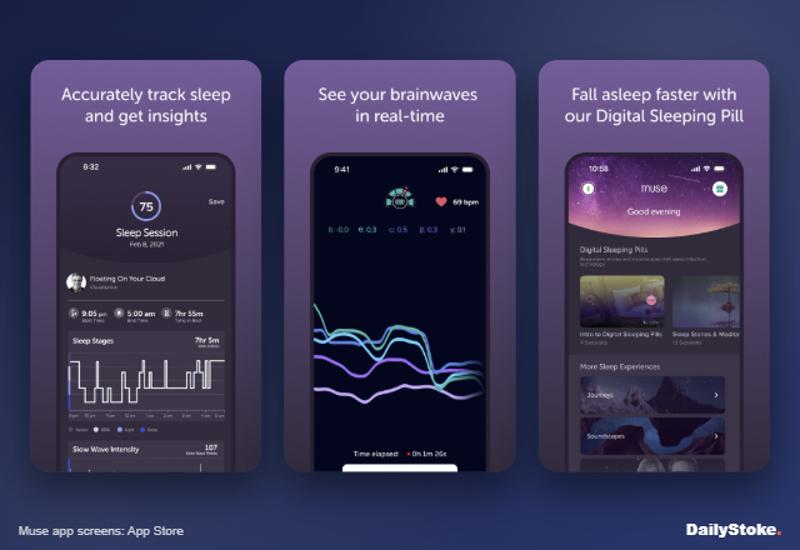
For sleep, the Athena records brain waves, heart rate, movement, breathing and position all night, then reports time in light, deep and REM sleep. Muse also says it can help detect early signs of sleep apnoea through brain oxygenation and blood oxygen monitoring. Interaxon’s launch claims, including that the Muse S is “the most accurate sleep tracker outside the lab”, are company statements; the independent evidence is below.
Three sleep features go beyond tracking. Sleep Assist plays sounds or guided meditations as you fall asleep and adjusts the volume to your brain activity. Deep Sleep Boost plays soft sounds during deep sleep, intended to reinforce it, and stops as you surface. Smart Wakeup tries to wake you during light sleep within a window you choose.
What the evidence says
This is where the Athena earns its place. Rings and watches infer sleep stages from heart rhythm and movement; an EEG headband measures the brain signal that sleep scorers actually use.
In 2026, a team from the University of Ottawa, the Royal Ottawa Mental Health Centre and other Canadian institutions, led by Malika Lanthier, published a validation of the Muse-S headband in SLEEP Advances (doi.org/10.1093/sleepadvances/zpaf089). Fifty-six adults slept a night in a lab wired for full polysomnography while wearing the Muse-S; 47 gave good-quality recordings, and 17% had a sleep-related breathing disorder. A technologist scored the PSG blind to the Muse’s automated results.
Overall agreement was substantial, with a Cohen’s kappa of 0.76. It was near-perfect for wake and REM, substantial for N2 and deep sleep, and fair for N1, the lightest stage. Accuracy ran from 88% to 96% across stages. On average the Muse put total sleep time 6 minutes above PSG and deep sleep 15 minutes above. People with breathing disorders gave similar results.
For comparison, the ring and watch studies we cover report four-stage kappas between about 0.2 and 0.65 (see our sleep tracker accuracy guide). Three caveats matter. The paper describes the device only as the Muse-S headband and does not name the generation, so it may not have been the Athena. The participants were mostly young, with an average age of 32, and the authors call for testing across ages and in people with neurological conditions. And Interaxon supplied the headbands and the automated sleep scoring, though it did not fund the study and, according to the paper, saw none of the PSG data beyond lights-off and lights-on times.
The apnoea claim has no published validation that we found. Treat it as a prompt, not a test.
Price and plans
In the UK, wellness retailer Healf sells the Athena at £404.49. Muse’s own store charges $474.99 in the US, and Tom’s Guide listed it at €449.99 for European buyers. It comes with a one-year warranty, and Muse’s store offers a 30-day money-back guarantee. The free app covers core tracking and brain-wave feedback, including Sleep Assist and Deep Sleep Boost. Muse Premium adds a library of more than 500 guided meditations, Smart Wakeup and the Enso AI coach. Muse’s site lists it at $12.99 a month or $49.99 a year; the yearly price inside the iPhone app is higher, so it pays to compare before subscribing.
In the UK the headband alone costs more than a Silver Oura Ring 5 at £399, before any subscription.
What we liked
Brain-wave accuracy. No other consumer sleep tracker in our coverage has published PSG agreement this strong. If you want to know how much REM you actually get, this is the only kind of device that measures it directly.
It catches the brief wakings. The Tom’s Guide tester found the headband picked up short wake-ups that a Withings Sleep Mat missed, consistent with the near-perfect wake agreement in the lab study.
Deep Sleep Boost is interesting. The same tester reported feeling fresher and waking less often with it on, though the volume needed tuning. That is one person’s experience, not evidence, but the idea of sound timed to deep sleep is grounded in sleep research.
Meditation tools by day. The EEG and fNIRS feedback make it a capable meditation and focus trainer, so it is not a single-purpose purchase.
What we did not like
It is a headband. Light and washable, but it can get hot on warm nights, and outliyr’s reviewer found it too cumbersome to sleep in regularly. Sixteen per cent of recordings in the lab study were not of good enough quality to use, so expect the odd lost night at home too.
One night per charge. About 10 hours of battery means charging every day and putting it on just before bed.
Setup takes patience. Getting a good signal behind the ears can take several minutes, according to Tom’s Guide.
One sleep feature costs extra. Smart Wakeup sits behind Premium, though Sleep Assist and Deep Sleep Boost are free.
The data can overwhelm. Reviewers found the app’s charts hard to interpret without the guides or the AI assistant. outliyr also flagged a bright LED that is unwelcome in a dark room.
Health notes
The Muse S Athena is a wellness product. It cannot diagnose sleep apnoea, insomnia or any neurological condition, and its apnoea “signs” have not been validated publicly. If you snore with pauses in breathing, have daytime sleepiness, or have struggled with sleep for months, see your GP for assessment and, if needed, a referral for a sleep study. If you have epilepsy or another neurological condition, ask your doctor before using any neurofeedback device.
How the Muse S Athena compares
Muse S Athena vs Oura Ring 5. Oura is invisible by comparison, lasts six to nine days and has a polished app, but estimates stages from pulse and movement. Muse measures them. See our Oura Ring review.
Muse S Athena vs RingConn Gen 3. RingConn costs less, has no subscription and lasts up to 14 days. It is a trend tracker; the Muse is a measurement tool. See our RingConn review.
Muse S Athena vs a clinical sleep study. A hospital or home PSG, arranged through your GP, records breathing, oxygen and muscle activity as well as EEG and is the only route to a diagnosis.
Who should buy the Muse S Athena
Buy it if you are fascinated by your own sleep architecture, meditate regularly, and will tolerate a headband for a few nights a week. Skip it if you want effortless nightly tracking, hate charging gadgets daily, or are hoping it will diagnose a sleep problem. For most people, a ring from our best smart rings guide is the more practical choice.
Muse S Athena FAQs
How accurate is the Muse S for sleep?
In a 2026 SLEEP Advances study of 47 usable recordings, the Muse-S agreed with polysomnography with a kappa of 0.76, which is substantial, and was near-perfect for wake and REM. That is higher than any published ring or watch study we have seen.
Do I need Muse Premium?
Not for basic sleep tracking and brain-wave feedback. Premium adds Smart Wakeup, the full meditation library and the Enso AI coach.
How long does the Muse S Athena battery last?
About 10 hours, enough for one night. It charges in around three hours over USB-C.
Can the Muse S Athena detect sleep apnoea?
Muse says it can help spot early signs, but we found no published validation, and it is not a diagnostic test. See your GP if you are concerned.
Is the Muse S Athena comfortable to sleep in?
Opinions differ. Tom’s Guide’s reviewer rarely noticed it; outliyr’s found it too cumbersome. It can feel hot on warm nights.