A valley forecast tells you whether to take a brolly into town. A mountain forecast tells you whether the wind on the ridge will knock you over, where the cloud base sits and how low the freezing level will fall by late afternoon. That is the difference between the weather app on your home screen and the ones walkers and skiers actually rely on.
We compared six forecasts for hills and snow, mixing official British services with apps that show what the weather models are doing. Most experienced hillgoers check at least two, and so should you. Prices come from official sites and the UK App Store; where we could only confirm a US price, we say so.
Mountain weather apps at a glance
| Rank | Forecast | Price | Best for | Standout fact |
|---|---|---|---|---|
| 1 | Met Office (app and mountain forecasts) | Free | UK hillwalking | Ten mountain areas with freezing levels at 300m steps |
| 2 | MWIS | Free to read | Scottish and English hills in winter | Written by meteorologists who are also mountaineers |
| 3 | Windy | Free; Premium from £2.99 (UK App Store) | Comparing models and summit winds | More than 50 weather maps and 67,000+ webcams |
| 4 | Mountain-Forecast.com | Free; Premium £24.99 a year (UK App Store) | Summit-by-summit forecasts worldwide | More than 11,000 summits |
| 5 | OpenSnow | Free trial; Base £49.99 a year (UK App Store) | Skiers chasing powder | Human forecasters writing daily snow reports |
| 6 | Meteoblue | Free; ad-free £6.99 (UK App Store) | Seeing forecast uncertainty | Multimodel meteogram comparing several models |
How we chose these mountain forecasts
We looked for forecasts that answer hill questions: summit wind and gusts, wind chill, cloud base, freezing level, snowfall and the chance of thunderstorms. We favoured forecasts written or checked by meteorologists, then added model-based apps that show how confident a forecast is. Prices and features come from each provider’s site and store listings; ratings from the App Store and Google Play. Accuracy claims are the providers’ own unless stated, as no independent body ranks mountain forecasts.
The best weather apps for hikers and skiers, ranked
1. Met Office
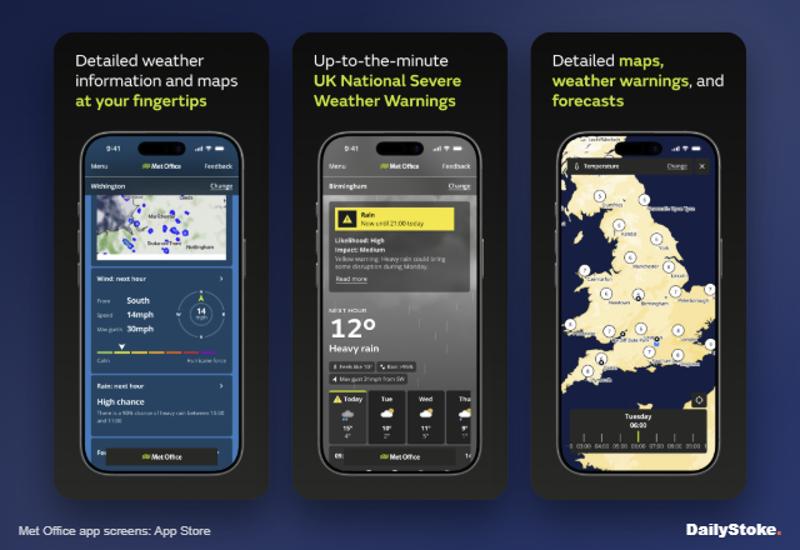
Britain’s national weather service publishes free mountain forecasts for ten areas: the Brecon Beacons, Snowdonia, the Peak District, the Yorkshire Dales, the Lake District, the Mourne Mountains, the Southwest Highlands, South Grampian and the Southeast Highlands, North Grampian, and the Northwest Highlands. Each includes a meteorologist’s written forecast, risk levels for nine mountain hazards, and a table of wind, gusts, temperature, “feels like” temperature and freezing level at different heights.
Forecasts are issued before 6pm each day for the evening and the next two days, with a brief outlook for three more, and updated before 6am. Ground conditions are added for the Lake District and Snowdonia from October to April. The Met Office says its mountain forecasts are on its website and in its app, which also gives seven-day forecasts for individual summits. The app needs a signal.
Price: free.
Pros
- Official UK warnings plus specialist mountain forecasts
- Freezing level and wind at height
- Summit forecasts in the app
Cons
- Online only
- Area forecasts cover a broad region, not your exact ridge
2. MWIS
The Mountain Weather Information Service, founded by Geoff Monk in 2003, writes forecasts for ten UK mountain areas: the Northwest Highlands, the West Highlands, the Cairngorms and Monadhliath, the Southeastern Highlands, the Southern Uplands, the Lake District, the Yorkshire Dales and North Pennines, the Peak District, Eryri (Snowdonia) and the Brecon Beacons. Its team includes professional meteorologists with mountaineering experience, and the five Scottish forecasts have been funded by sportscotland since 2007.
MWIS is written for hill decisions in plain, practical sentences: how hard the wind will make walking, how likely you are to be in cloud, how cold it will feel. It produces forecasts 365 days a year, and many Scottish walkers check it alongside the Met Office. It is free to read on its website, supported by sponsorship.
Price: free to read.
Pros
- Written by mountain-savvy meteorologists
- Focus on effects on walkers, not just numbers
- Strong in Scotland
Cons
- Website rather than a dedicated app
- Fewer areas than general forecast apps
3. Windy
Windy turns weather models into animated maps. Its biggest strength for hillgoers is model comparison: check ECMWF, GFS, ICON and regional models for the same summit and see whether they agree. The UK App Store listing promises more than 50 weather maps, more than 15 weather models and more than 67,000 webcams, and the free version is ad-free.
Premium adds one-hour forecast steps, 15-day outlooks, more frequent updates and longer radar and satellite loops. It needs a connection, and the busy interface takes time to learn. Windyty, the Prague company behind Windy, has owned a majority stake in Meteoblue since 2024.
Read our full Windy review.
Price: free; Premium £2.99, £22.99 or £34.90 on the UK App Store, depending on the plan.
Pros
- Compare models side by side
- Wind, gusts and cloud at altitude
- No adverts
Cons
- Hourly steps need Premium
- No offline forecasts
4. Mountain-Forecast.com
Mountain-Forecast.com, from Meteo365 Ltd, the company behind Snow-Forecast.com, gives forecasts for more than 11,000 summits worldwide at several elevations, from the valley floor to the peak. It is the quickest way to see what the wind and temperature will do on Ben Nevis, Mont Blanc or Kilimanjaro on a particular day.
The app has topographic and satellite maps, GPX route import, hour-by-hour detail and four updates a day. Its version notes say six-day forecasts are free, while the 16-day forecast and offline maps and forecasts sit behind the MountainPro subscription. The UK App Store shows 4.9/5 from 395 ratings.
Price: free; Premium £3.99 a month or £24.99 a year (UK App Store).
Pros
- Summit forecasts at several elevations
- Covers mountains worldwide
- Offline forecasts on Premium
Cons
- Automated model output, not a human forecast
- Long-range forecasts behind a paywall
5. OpenSnow
OpenSnow is the skier’s weather app. Founded in 2011 by Joel Gratz and Andrew Murray in Colorado, it pairs automated forecasts with daily written reports from forecasters, including a Europe Daily Snow covering the Alps and Pyrenees. Its PEAKS model aims to forecast for a mountain’s actual elevation rather than the nearest town.
Since the 2025 to 2026 season it has two tiers. Base, at £49.99 a year on the UK App Store, covers forecasts and the expert reports. Premium, at $99.99, adds 11 to 15 day forecasts, multi-model comparison, global radar and severe weather alerts. A five-day free trial needs no card.
Read our full OpenSnow review.
Price: Base £49.99 a year (UK App Store); OpenSnow quotes Premium at $99.99 a year and family plans at $89.99 and $179.99.
Pros
- Human forecasters explain the snow
- Snow-specific forecasts by resort
- Free trial without a card
Cons
- US-centric, with fewer European reports
- Prices rose sharply for 2025 to 2026
6. Meteoblue
Meteoblue is a Swiss forecaster with a scientist’s app. Its multimodel meteogram plots several models on one chart, so you can see at a glance whether rain on Saturday is a certainty or a coin toss. The app covers more than six million locations, with 14-day forecasts, rain radar, satellite cloud maps and a “where2go” tool that finds the nearest sunshine.
The UK App Store listing scores 4.7/5 from about 4,800 ratings, and the app recently added Apple Watch support. Since 2024 Meteoblue has been majority-owned by Windyty, the company behind Windy.
Price: free; Premium without ads £6.99 (UK App Store), described as an annual subscription.
Pros
- Multimodel meteogram shows uncertainty
- Recently viewed forecasts available offline
- Activity views for hiking and skiing
Cons
- Adverts in the free version
- Charts take practice to read
Which forecast for which trip
| Trip | Check first | Then cross-check with |
|---|---|---|
| Lake District or Snowdonia day walk | Met Office mountain forecast | MWIS |
| Scottish Munro in winter | MWIS | Met Office, plus the Scottish Avalanche Information Service |
| Alpine hut-to-hut trek | Mountain-Forecast.com for summits | Meteoblue multimodel meteogram |
| Ski week in the Alps | OpenSnow Europe Daily Snow | Meteoblue or Windy for wind and freezing level |
| Sailing or coastal walk | Windy for wind and gusts | Met Office |
A simple habit works well: read a written forecast for the area, then open a model app to see how confident that forecast is. If the two disagree, assume the worse of the two and carry the kit for it.
Choosing a mountain forecast: what matters
Wind at height. Summit gusts decide more days out than rain. Check wind at the highest point of your route, not in the car park.
Freezing level and wind chill. In spring and autumn, a mild valley can sit under a summit in sub-zero wind chill.
Cloud base. If the summits are in cloud, navigation gets harder. MWIS gives a chance of cloud-free summits, and the Met Office’s written forecast covers cloud and visibility.
Agreement between forecasts. When the Met Office, MWIS and the models in Windy or Meteoblue agree, trust the forecast more. When they disagree, plan a lower alternative.
Avalanche information. In Scotland, check the Scottish Avalanche Information Service; abroad, the national avalanche bulletin. A weather app is not an avalanche forecast.
What to ignore. A sunny icon for the nearest town says almost nothing about a ridge 900 metres above it.
Mountain weather FAQs
What is the most accurate weather forecast for UK mountains?
No forecast is always right, but the Met Office mountain forecasts and MWIS are written by meteorologists for the hills and are the standard references for British walkers. Many people check both.
Is MWIS free?
Yes, MWIS forecasts are free to read on its website. The Scottish forecasts are funded by sportscotland and the rest by sponsorship.
Which weather app is best for skiing?
OpenSnow for snow forecasts written by people, especially in North America. In Europe, combine it with Mountain-Forecast.com or Meteoblue and the local avalanche bulletin.
Does the Met Office app have mountain forecasts?
Yes. The Met Office says its mountain forecasts are available on its website and in its app, alongside forecasts for individual summits.
Can I get a mountain forecast offline?
Mountain-Forecast.com offers offline forecasts on Premium, and Meteoblue keeps recently viewed forecasts. Otherwise, check before you lose signal and screenshot the forecast.
Is Windy good for hiking?
Yes, for summit winds and seeing how much the models agree. Pair it with a written forecast such as the Met Office or MWIS.
More on DailyStoke
Windy review · OpenSnow review · Best hiking apps compared · OS Maps review · Travel insurance · Travel apps, reviewed