The short answer: Meshtastic is free, open-source software that turns small, cheap LoRa radios into a text-messaging network that needs no mobile signal, no internet and no subscription. Each radio pairs with your phone by Bluetooth and relays messages for everyone else on the mesh, so a group can stay in touch across a valley, a festival site or a stretch of coast. In the UK and EU it runs licence-free in the 868 MHz band, within strict power and duty-cycle limits. It is a brilliant hobby and a useful group tool, but it is not an emergency service: nobody is obliged to be listening, and it cannot reach 999.
If you need a guaranteed way to call for help beyond phone signal, you want a satellite communicator or a recent phone with satellite SOS. Meshtastic is for chatting, coordinating and experimenting, and it is fun to do so.
How Meshtastic works
Meshtastic uses LoRa, short for long range, a radio technique designed to send small amounts of data a long way on very little power. According to the Meshtastic project’s own introduction, radios rebroadcast the messages they hear, forming a mesh so that people at the far edge of the group still receive them. There is no central router and no company in the middle.
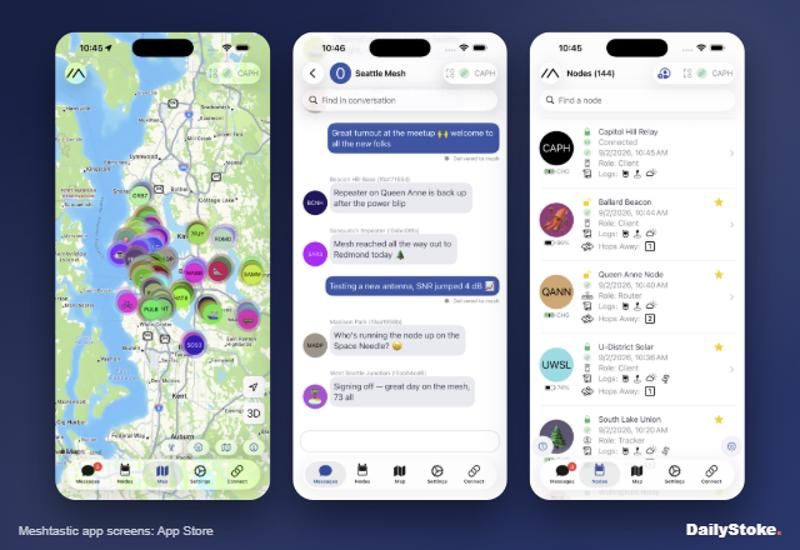
In practice you buy a small radio, called a node, flash or receive it with Meshtastic firmware, and pair it with the free Meshtastic app on your phone. You type messages in the app; the node sends them over LoRa. Nearby nodes repeat them. By default each message can be relayed up to three times (the hop limit), with a maximum of seven, according to the Meshtastic LoRa configuration documentation. Some nodes have their own screens and keyboards, so a phone is not strictly needed.
Many nodes include GPS, so the app can show where the other members of your group are on a map. That is handy on a group walk, a sailing regatta or a multi-day event where people spread out.
What range can you expect?
Range depends almost entirely on height and line of sight. The Meshtastic project cites a ground-to-ground record of 331km, set between mountain-top nodes, but that is the extreme end. Between two handhelds at waist height in hilly or wooded country, expect far less, often just a few kilometres. The mesh is what extends this: a node left on a hilltop or a window ledge can link people who could never reach each other directly. In some areas, enthusiasts already run fixed nodes on rooftops, so a new node may join an existing community mesh as soon as it is switched on.
Is Meshtastic legal in the UK and EU?
Yes, used within the rules. Meshtastic in Europe uses the licence-exempt 868 MHz short-range device band. The key sub-band is 869.40 to 869.65 MHz, which Ofcom’s IR 2030 licence-exempt short range devices interface requirement (entry IR2030/1/19) allows at up to 500 mW effective radiated power with a duty cycle of no more than 10 per cent, or equivalent interference-mitigation techniques. Across the EU the same band follows the CEPT’s ERC Recommendation 70-03.
Meshtastic’s EU_868 region setting matches that sub-band. The firmware enforces the duty cycle, calculated over a rolling hour, and a node that hits the limit simply stops transmitting until it is allowed again. The firmware’s power ceiling for EU_868 is 27 dBm, roughly 500 mW, but the project is clear that this is a software ceiling, not your legal limit: if you fit a high-gain antenna, your effective radiated power can exceed 500 mW, so turn the transmit power down to compensate.
Four practical rules for UK and European users:
- Buy 868 MHz hardware. Many nodes come in 868 MHz and 915 MHz versions. The 915 MHz versions are built for the US band, where the rules allow far more transmit time; they are the wrong choice for Britain and Europe.
- Set the region to EU_868. Nodes will not transmit until a region is chosen. Never select US in Britain.
- Leave the duty-cycle limit alone. Meshtastic offers an “override duty cycle” setting; the documentation warns it may break regulations.
- Ham mode is different. Licensed radio amateurs can run Meshtastic under their licence with different rules, but encryption is not permitted in that mode.
There is also an EU_433 region at 433 to 434 MHz with a 10 dBm power limit, which suits short-range use but is rarely the best choice for hiking groups.
Meshtastic vs other off-grid options
| Option | Upfront cost | Running cost | Reaches 999 or rescue? | Best for |
|---|---|---|---|---|
| Meshtastic node | From about £38 per person | None | No | Group chat and location sharing off-grid |
| PMR446 walkie-talkie | Low | None | No | Instant voice within a group |
| Phone satellite SOS | Built into recent iPhone and Pixel | Free for now | Yes | Emergencies beyond signal |
| Satellite communicator | £149 to £439.99 | Monthly plan | Yes, via 24/7 centre | Remote trips, SOS and two-way texting |
Meshtastic’s strengths are cost, battery life and the fact that once you own the radios, nothing else is ever charged. Its weakness is that your message only reaches people with nodes in range of the mesh. A Garmin inReach or ZOLEO can reach anyone, anywhere, and above all a staffed SOS centre.
Why Meshtastic is not an emergency service
This point matters enough for its own section. Meshtastic has no connection to 999, 112, the Coastguard or Mountain Rescue. Nobody monitors public channels for distress calls, nodes on the mesh belong to hobbyists who may be asleep or away, and a message can fail silently if no one is in range. The Meshtastic documentation itself does not present the system as a safety device.
In an emergency:
- Call 999 or 112 if you have any phone signal. Your phone will send its precise location automatically.
- Use satellite SOS on a compatible phone or a dedicated satellite communicator if you have no signal.
- Use Meshtastic only to tell your own group what is happening, never instead of the above.
Our guide to the best emergency apps covers how to set up your phone properly before you go.
What kit do you need?
Meshtastic runs on a wide range of LoRa hardware. Popular starting points include Seeed Studio’s SenseCAP Card Tracker T1000-E, a credit-card-sized node with GPS that weighs 32g, is rated IP65 and ships with Meshtastic preloaded. The Pi Hut listed it at £38.40 in October 2026. Other common choices are development boards from Heltec and LilyGO and modular RAK WisBlock kits, which suit tinkerers who want to choose their own case, antenna and battery.
What to look for:
- 868 MHz version for the UK and EU.
- GPS if you want location sharing.
- A sealed case for outdoor use; bare boards need a box.
- Battery size. LoRa sips power, but GPS and screens use more.
- A decent antenna. The single biggest upgrade for range, within the power limit.
The Meshtastic app is free on iOS and Android, and there is also a web client for computers.
Privacy and security
Meshtastic encrypts messages, but understand how. The default public channel uses a key that is widely known, so anyone with a node can read it; treat it like a public chat room. For private group conversations, create your own channel with its own key and share it only with your group. Since firmware 2.5, released in September 2024, direct messages between two nodes are also encrypted using public-key cryptography (an X25519 key exchange), so only the recipient can read them. Location sharing broadcasts your position to everyone on the channel, so switch it off on public channels if you do not want to be mapped.
Who Meshtastic suits
Meshtastic is ideal for a family or club walking in an area with poor coverage, for event marshals, for sailors and paddlers who want to keep in touch across a bay, and for anyone who enjoys radio as a hobby. It rewards people who like to tinker and is improving quickly. It is less suited to someone who just wants something that works out of the box for solo safety; a satellite messenger is the right tool there. An alternative open-source project, MeshCore, takes a different approach to routing on similar hardware, and some UK communities run both.
Meshtastic FAQs
Do I need a licence to use Meshtastic in the UK?
No, provided you use 868 MHz hardware on the EU_868 setting and stay within the licence-exempt limits in Ofcom’s IR 2030: up to 500 mW effective radiated power and a 10 per cent duty cycle in the 869.40 to 869.65 MHz band. Licensed radio amateurs can use other frequencies under their own licence.
Can Meshtastic contact emergency services?
No. It has no link to 999, 112 or any rescue service, and no one is required to monitor it. Call 999 or 112 first, or use satellite SOS on your phone or a satellite communicator when there is no signal.
How far can Meshtastic reach?
It depends on height and terrain. Handheld to handheld in hills or woods, a few kilometres is typical; with nodes on high ground, much more. The project cites a 331km record between elevated nodes.
Does Meshtastic need a phone?
Not always. Most people pair a node with the Meshtastic phone app over Bluetooth, but some nodes have built-in screens and keyboards, and nodes relay messages for others with no phone attached.
Is Meshtastic secure?
Messages on the default public channel can be read by anyone with a node. Create a private channel with its own key for group chats, and avoid sharing your location on public channels.
Can I use a 915 MHz Meshtastic device in the UK?
You should not. Meshtastic’s 915 MHz settings follow US rules, which are far looser than the UK’s licence-exempt limits, so using one here risks breaking them. Buy an 868 MHz model and set the region to EU_868.