A smart ring does most of what a fitness watch does overnight, minus the screen and the strap marks. It reads your pulse, heart rate variability, skin temperature and movement from the underside of a finger, then turns those signals into a sleep score and a morning verdict on how ready you are for the day. For people who hate wearing a watch in bed, it is the most comfortable sleep tracker you can buy.
This guide is for anyone choosing their first ring or weighing whether to pay a monthly membership on top of the hardware. We ranked six rings on the things that change your experience after the first week: what you pay over two years, how long the battery lasts, which phones they work with, and how much published evidence sits behind the sleep data.
Smart rings compared at a glance
| Rank | Ring | UK price | Best for | Standout fact |
|---|---|---|---|---|
| 1 | Oura Ring 5 | From £399, plus £5.99 a month | Best overall sleep and recovery app | Weighs from 2g and is 2.28mm thick |
| 2 | RingConn Gen 3 | From $349 (RingConn lists no £ price) | No subscription, long battery | Rated up to 14 days per charge |
| 3 | Ultrahuman Ring Pro | £429 at UK pre-order, with charging case | Battery life and data storage | Up to 15 days, 45 days with the charging case |
| 4 | Samsung Galaxy Ring | £399 RRP, often £299 | Samsung phone owners | No subscription, Android only |
| 5 | Oura Ring 4 | Launched at £349, now under £250 at retailers | Oura’s app for less | Same software features as Ring 5 |
| 6 | RingConn Gen 2 Air | From about £164 | Lowest cost of entry | Up to 10 days, no membership |
How we chose and what we tested
We have not run these rings through our own lab. This ranking is built from official product pages and UK retailer listings checked on 29 October 2026, published independent reviews (TechRadar, Tech Advisor, Engadget, Tom’s Guide), owner feedback and, for the sleep claims, peer-reviewed validation studies against polysomnography, the hospital sleep test. Where a UK price was not published, we say so rather than converting dollars and guessing.
We weighted four things: total two-year cost, battery life in real use, phone compatibility, and evidence. On evidence, Oura is ahead simply because it has been studied most. A 2024 study of 96 adults in Sleep Medicine found the Oura Gen3 detected sleep correctly 94.4% of the time but caught wake only about 73% of the time. That pattern, good at sleep and weaker at spotting wakefulness, applies to every ring here. Our full breakdown of the research is in how accurate are sleep trackers.
The best smart rings, ranked
1. Oura Ring 5
Oura launched the Ring 5 on 4 June 2026, and its headline is size: Oura says it is about 40% smaller than the Ring 4, at 6.09mm wide and 2.28mm thick, weighing from 2g. It is titanium inside and out, water resistant to 100m, and rated for six to nine days per charge depending on ring size. Engadget, testing a pre-release unit, found Oura’s battery estimate conservative.
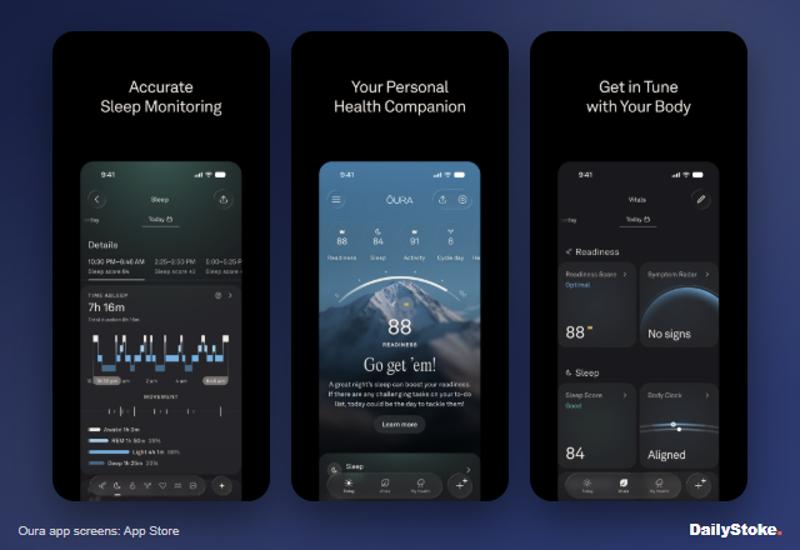
The app remains the reason to buy. Sleep, Readiness and Activity scores are presented cleanly, and Oura has the deepest research base of any ring maker. The catch is the membership: £5.99 a month or £69.99 a year, without which you lose most of the analysis. Some new features, including Health Radar and the blood pressure signals, launched only in the US, India and the UAE, so UK buyers pay the same price for a slightly smaller feature set.
Price: £399 (Silver, Black), £499 (Gold, Stealth, Brushed Silver, Deep Rose), plus membership
Pros
- Smallest, lightest ring here
- Most published validation research
- Polished, readable app
Cons
- £69.99 a year membership on top
- Some health features not live in the UK
Read our full Oura Ring review.
2. RingConn Gen 3
RingConn’s pitch is simple: the hardware costs less than Oura’s and there is no subscription. The Gen 3, launched in May 2026, is rated for up to 14 days with vibration alerts off, and TechRadar got close to 12.5 days with everything switched on. It adds a small vibration motor for health, inactivity and low-battery alerts, which no Oura ring offers.
It also tracks signs linked to sleep apnoea and offers “vascular insights”, which uses blood pressure readings you enter from a separate cuff to spot longer-term patterns. The ring does not measure blood pressure itself, and the apnoea feature is a risk indicator, not a diagnostic tool. The app is clean but less polished than Oura’s, and TechRadar found sleep scores broadly in line with a Whoop 5.0.
Price: from $349 on RingConn’s own store, which does not list sterling prices; UK buyers can order it through Amazon UK
Pros
- No subscription
- Close to two weeks per charge
- Haptic alerts
Cons
- App less refined than Oura’s
- Small upgrade over the Gen 2
Read our full RingConn review.
3. Ultrahuman Ring Pro
The Ultrahuman Ring Pro, announced in February 2026, leads on stamina: up to 15 days per charge, and up to 45 days between wall sockets using the Pro charging case, which also has Find My Case and Qi wireless charging. The ring stores up to 250 days of data, handy if you forget to sync on a long trip. It is titanium, water resistant to 100m and comes in sizes 5 to 14.
There is no subscription for the core features, though some specialist add-ons cost extra. Ultrahuman’s legal fight with Oura is a US matter: an earlier import ban covered the Ring Air, and Oura filed a fresh complaint over the Pro in October 2026. None of this affects UK buyers directly, but it is worth knowing the brand’s US future is unsettled.
Price: £429 at UK pre-order according to Tech Advisor, bundled with the Pro charging case; Ultrahuman’s global store lists the same bundle at $479
Pros
- Longest battery life here
- No mandatory membership
- Huge on-ring data storage
Cons
- Heavier and thicker than Oura (2.65mm)
- Paid add-ons for some features
4. Samsung Galaxy Ring
Samsung’s ring launched at £399 in 2024 and has regularly been cut to £299 on Samsung’s UK store this year. There is no subscription. Samsung claims up to seven days per charge. It works with Android phones running Android 11 or later, but not with iPhones, and some features, including Energy Score, Galaxy AI health tips, Find My Ring and the double-pinch gesture, need a Samsung phone.
As a sleep tracker it plugs neatly into Samsung Health, which suits people already wearing a Galaxy Watch by day. The weakness is age: the ring has not had a hardware update since 2024, and Samsung has confirmed a Galaxy Ring 2 is in development. If you are not in a hurry, that is a reason to wait.
Price: £399 RRP, often £299 on offer
Pros
- No subscription
- Best fit for Samsung phones and watches
Cons
- No iPhone support
- Ageing hardware with a successor coming
5. Oura Ring 4
The Ring 4 launched at £349 and has since been cut hard at UK retailers: Argos listed it at £244 when we checked, and price comparison site PriceSpy showed it for less at Amazon UK. Oura has pushed most of the Ring 5’s new software to it, including live workout tracking. It is larger and slightly shorter-lived on battery (Oura rates the Ring 5 at about a day more), but the sensors and app are the same family.
If you can live with a thicker band, the Ring 4 is the cheaper way into Oura’s ecosystem. Watch for retailer deals: it has been discounted at Boots, Currys and Amazon UK. The membership cost is identical, so the saving is on the hardware only.
Price: £244 at Argos (launched at £349), plus £5.99 a month or £69.99 a year
Pros
- Oura app for well over £100 less than a Ring 5
- Gets most Ring 5 software features
Cons
- Bulkier than Ring 5
- Same membership cost
See how it compares in our Oura Ring review.
6. RingConn Gen 2 Air
The cheapest serious ring here. Tech Advisor listed it at £239 at launch, but UK prices have fallen: PriceSpy showed it from £163.90 when we checked (RingConn sells it for $199 in the US), with up to 10 days of battery and no subscription. It tracks heart rate, HRV, blood oxygen, skin temperature and breathing rate around the clock, and weighs 2.5g to 4g.
What you give up: the sleep apnoea monitoring found on the Gen 2 and Gen 3, a charging case, and much choice of finish (two colours). Syncing is slow and the app needs polish, according to Tech Advisor’s reviewer, who still gave it an Editors’ Choice. For a first ring that costs nothing after the day you buy it, it is a sensible start.
Price: from about £164 at UK retailers (£239 at launch)
Pros
- Lowest total cost
- No membership
Cons
- No apnoea monitoring
- Slow sync, basic app
More detail in our RingConn review.
Smart ring buying guide: what matters and what to ignore
Count the subscription. Over two years, an Oura Ring 5 in Silver costs £399 plus £139.98 in membership, so roughly £539. A RingConn or Galaxy Ring costs the sticker price and nothing more. That gap is the single biggest difference between brands.
Size before you buy. Ring sizes do not match jewellers’ sizes. Oura, Samsung and RingConn all offer sizing kits; wear the dummy ring for a full day and night, because fingers swell overnight and in warm weather. A snug fit gives cleaner readings than a loose one.
Check your phone. The Galaxy Ring does not work with iPhones. Oura, RingConn and Ultrahuman support iOS and Android.
Treat health flags as prompts, not diagnoses. Sleep apnoea alerts, temperature trends and blood pressure “signals” are screening hints at best. If a ring suggests repeated breathing disturbances, or your partner notices you stop breathing or gasp at night, see your GP, who can refer you for a proper sleep study.
Ignore the readiness number on its own. Scores compress lots of data into one figure. The trend over weeks, and your resting heart rate and heart rate variability, tell you more than any single morning.
Do not expect a watch. Rings have no screen, limited workout tracking and no GPS. If you train seriously, a sports smartwatch by day and a ring at night is a common pairing.
Smart ring FAQs
Which smart ring is most accurate for sleep?
Oura has the most published validation. A 2024 Sleep Medicine study found 94.4% sensitivity for sleep against polysomnography, and a 2024 Sensors study (funded by Oura) rated its stage agreement above an Apple Watch and a Fitbit. Other rings have far fewer published studies, which is not the same as being less accurate.
Do I need an Oura membership?
Without it, you see only basic scores. Most of the sleep, readiness and trend detail sits behind the £5.99 a month or £69.99 a year membership, and the first month is included for new members.
Which smart ring has no subscription?
RingConn (Gen 3, Gen 2, Gen 2 Air), the Samsung Galaxy Ring and the Ultrahuman Ring Pro all work without a monthly fee. Ultrahuman sells some optional paid add-ons.
Can a smart ring detect sleep apnoea?
Some rings flag signs associated with it, such as blood oxygen dips and breathing changes, but none here is a diagnostic test. If you snore heavily, wake unrefreshed or are told you stop breathing, see your GP.
Do smart rings work with iPhone?
Oura, RingConn and Ultrahuman do. The Samsung Galaxy Ring needs an Android phone running Android 11 or later.
How long do smart ring batteries last?
From about seven days (Galaxy Ring, Oura Ring 4) to two weeks (RingConn Gen 3, Ultrahuman Ring Pro). Larger sizes hold bigger batteries, and features such as continuous blood oxygen tracking drain them faster.