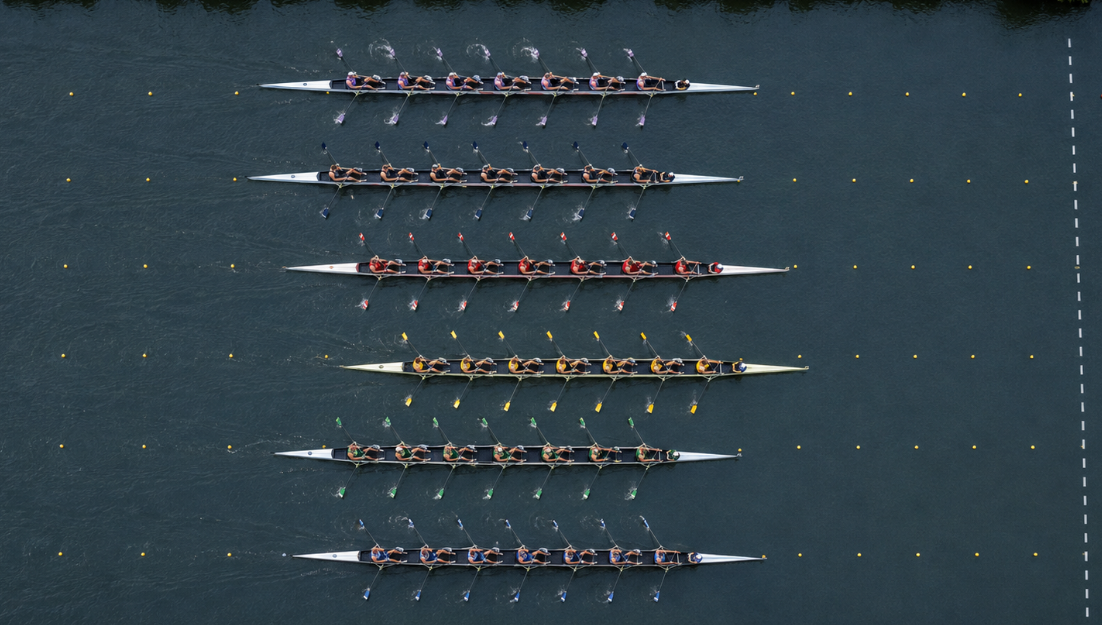
The 2026 World Rowing Championships take place in Amsterdam from 24 to 30 August, with Great Britain arriving as one of the strongest teams in the competition.
Britain won six gold medals at the final World Cup regatta in Lucerne. That form will attract betting interest, although UK bookmakers may not release extensive rowing markets until the crews and progression rounds are confirmed.
If you only watch one day, choose Sunday 30 August. The men’s and women’s eights, both single-sculls finals and the new mixed events are packed into a medal session lasting a little over an hour.
World Rowing Championships 2026 at a glance
- Dates: 24–30 August 2026
- Location: Bosbaan, Amsterdamse Bos
- Race distance: 2,000 metres
- First medal races: Thursday 27 August
- Main finals: Friday 28 to Sunday 30 August
- Best session for casual viewers: Sunday afternoon
- Local time: CEST, one hour ahead of the UK
- Official information: World Rowing
The championships include 12 Olympic boat classes, four international lightweight classes, five Paralympic classes and two mixed events.
Why Great Britain starts among the strongest teams
Great Britain topped the medal table at the final World Cup regatta in Lucerne, winning six golds, one silver and one bronze.
The men’s four produced one of the clearest British form lines. It won at both Seville and Lucerne, controlling the middle of each race before holding off the closing crews.
Both British quadruple sculls also won in Lucerne. The women’s quad included Imogen Grant, the Paris 2024 lightweight double-sculls champion, while the new men’s combination held off a fast Dutch finish.
Lauren Henry won the women’s single sculls for the second time during the World Cup season. Britain also took gold in the women’s eight, leading from the start and holding off Australia.
These results make Britain a reasonable starting point when the betting markets open. They do not make every British crew an automatic bet. World Cup line-ups can change, and several countries build their training specifically around the World Championships rather than the earlier series.
The British crews and races to watch
Men’s four
The British men’s four has been the country’s most consistent crew in 2026.
It won decisively in Seville and followed that with another victory in Lucerne. Romania, France and the United States were much closer during the closing stages of the Lucerne final, but Britain had already created enough of an advantage.
The men’s four final is scheduled for 10.38am BST on Saturday 29 August.
Women’s single sculls
Lauren Henry won in Seville by just 0.14 seconds before producing a more controlled victory in Lucerne.
Her strongest opposition could include 2025 world champion Fiona Murtagh of Ireland, Australia’s Tara Rigney and Lithuania’s Viktorija Senkutė. The final takes place at 12.49pm BST on Sunday.
This is a less predictable market than the men’s single, which may produce more attractive odds but also carries more uncertainty.
Men’s quadruple sculls
Britain’s new-look men’s quad defeated the Netherlands and Germany in Lucerne. The crew established its position early and then survived a strong Dutch finish.
Italy should also remain part of the discussion after winning the 2025 world title. Final crew selections will matter more than results achieved by a previous combination.
The final is scheduled for 11.05am BST on Saturday.
Men’s eight
The Netherlands will begin as the likely favourite on home water. The Dutch crew won the 2025 world title and both World Cup regattas it entered in 2026.
Great Britain reduced the gap to 0.24 seconds in Lucerne. The Dutch had the stronger start, while Britain gradually moved through the field during the middle 1,000 metres.
The final begins at 12.38pm BST on Sunday and should be one of the best races of the championships.
The World Rowing Championships schedule
The opening days are largely devoted to heats and progression rounds. The medal races become concentrated from Thursday onwards.
| Date | Main events |
|---|---|
| Monday 24 August | Heats for pairs, double sculls and lightweight single sculls |
| Tuesday 25 August | Fours and quadruple-sculls heats; pairs and doubles quarter-finals |
| Wednesday 26 August | Single-sculls heats; pairs and doubles semi-finals |
| Thursday 27 August | Lightweight and para-rowing finals; fours and quads semi-finals |
| Friday 28 August | Men’s and women’s pairs and double-sculls finals |
| Saturday 29 August | Fours and quadruple-sculls finals; single-sculls semi-finals; eights heats |
| Sunday 30 August | Eights, single-sculls and mixed-event finals |
Times remain provisional. Check the official Amsterdam timetable before each session.
UK betting guide to the World Rowing Championships
Rowing markets tend to appear later than markets for football, tennis or horse racing. Some UK bookmakers may only cover the highest-profile finals, particularly the single sculls and eights.
Possible markets include:
- Outright gold-medal winner
- Podium finish
- Head-to-head crew match-ups
- Winning margin
- National medal totals
- Individual final markets
Availability differs between bookmakers. Check that the operator offers the boat class you want before opening or funding an account specifically for the championships.
Wait for the final crews
The name of the country is not enough when assessing a rowing bet.
Crews can change between the World Cups and the World Championships. An athlete may move into another boat, return from injury or lose a seat during the final selection process.
This matters most in the fours, quadruple sculls and eights. A strong rowing nation may replace several athletes while keeping the same boat class, but the new combination may not immediately have the same timing.
Check the final entries and compare them with the crews that raced in Seville, Plovdiv and Lucerne.
What the heats can tell you
The early races provide useful evidence, particularly if betting remains open between rounds.
Look beyond the finishing order. Check:
- Position at each 500-metre split
- Whether a crew continued pushing to the line
- Stroke rate through the middle 1,000 metres
- Performance against crews racing in similar conditions
- Wind direction and lane exposure
- Whether qualification was already secure
The fastest heat winner is not automatically the strongest crew. A boat with a comfortable lead may ease its effort over the final 250 metres, while another may need a full sprint simply to qualify.
Times from different sessions should not be compared without considering the conditions. A tailwind can make an entire session several seconds faster.
Early favourites and betting questions
Oliver Zeidler, men’s single sculls
Germany’s Olympic champion won convincingly at both Seville and Lucerne. He is likely to be one of the shortest-priced favourites when the men’s single market opens.
The question is whether the price leaves any value. A very likely winner can still be a poor bet when the odds are too short.
Netherlands, men’s eight
The Netherlands has the strongest recent record and the advantage of racing at home. Britain’s improvement in Lucerne makes a short Dutch price less straightforward than the form table initially suggests.
A head-to-head or winning-margin market may be more interesting than backing the Dutch crew outright.
Great Britain, men’s four
Two World Cup victories make Britain the form crew. Confirm that the Amsterdam line-up matches the successful World Cup combination before betting.
Lauren Henry, women’s single sculls
Henry’s two victories deserve attention, but the margins and quality of the opposition make this a competitive event rather than a clear one-boat market.
United States, women’s four
The United States produced a powerful second half to win in Lucerne after Australia led through the opening 1,500 metres. Another close contest is possible if both countries retain those combinations.
Understanding decimal odds
UK bookmakers generally display decimal or fractional odds. Decimal prices make the implied probability easier to calculate.
- Odds of 1.50 imply roughly a 67 per cent chance
- Odds of 2.00 imply a 50 per cent chance
- Odds of 3.00 imply roughly a 33 per cent chance
These percentages do not account for the bookmaker’s margin.
The aim is not simply to identify the crew most likely to win. It is to decide whether the price accurately reflects that crew’s chance.
Betting mistakes to avoid
- Betting before the final crew lists are confirmed
- Comparing race times recorded in different wind conditions
- Assuming every heat winner raced at maximum effort
- Backing a home crew solely because it has local support
- Combining several short-priced favourites in an accumulator
- Chasing losses during the finals
- Betting on an unfamiliar classification without checking the rules
- Ignoring each-way place terms in small fields
The single sculls, fours and eights are generally easier for an occasional viewer to research than lightly covered international or para classes.
Sculling and sweep rowing
The basic difference between rowing events is easier than the event codes make it appear.
In sculling, every rower holds two oars, one in each hand. In sweep rowing, each rower holds one larger oar with both hands.
| Code | Boat | Athletes | Type |
|---|---|---|---|
| 1x | Single sculls | 1 | Sculling |
| 2x | Double sculls | 2 | Sculling |
| 4x | Quadruple sculls | 4 | Sculling |
| 2- | Pair | 2 | Sweep |
| 4- | Four | 4 | Sweep |
| 8+ | Eight | 8 plus coxswain | Sweep |
The x indicates sculling. A plus sign means the boat has a coxswain. A minus sign means it does not.
A double and a pair both contain two rowers, but they are different events. Each athlete in a double uses two oars. Each athlete in a pair uses one.
What the coxswain does
The coxswain sits in the eight facing the direction of travel.
The role involves steering the boat, monitoring rhythm, communicating the race plan and choosing when to ask the crew for a change in effort.
The other rowers face backwards. They can sense nearby boats, but the coxswain has the clearest view of the entire race.
How a 2,000-metre race develops
Split times are recorded every 500 metres.
The opening section includes the starting strokes, a rapid acceleration and the transition into a sustainable race rhythm. Some crews attack this section aggressively; others accept a small early deficit.
The middle 1,000 metres often decides the race. A planned push may not involve a dramatic rise in stroke rate. The crew instead tries to increase the distance travelled with each stroke while maintaining clean timing.
The final 500 metres is easier to read. Stroke rates rise, technical mistakes become more visible and crews with energy remaining begin moving through the field.
Do not assume the leader at 500 metres will win. The 1,000- and 1,500-metre splits provide a better indication of whether that lead is secure.
A finals and B finals
The A final decides the medals and normally contains the six fastest remaining boats.
The B final determines positions seven to 12. Winning the B final therefore means finishing seventh overall, not winning the championship.
This distinction is important when several races on the programme are described as finals.
How to watch in the UK
A complete UK broadcast schedule had not been published as of 10 August.
The World Rowing event page should provide live results, start lists and links to official coverage. World Rowing normally publishes a separate viewing guide shortly before its major regattas.
Check for UK television or streaming restrictions before relying on an international feed. This section should be updated when the final UK rights information is announced.
Attending the Bosbaan
The Bosbaan is in Amsterd