
America’s longevity retreats split into two camps. Some sell data: hundreds of biomarkers, scans and a thick results binder. Others sell habit change: a strict menu, a lot of walking and doctors who measure your cholesterol before and after. The price gap between them is smaller than you might expect. The gap in evidence is not.
We compared the four US programs with a serious health component beyond massages and yoga: Canyon Ranch’s LONGEVITY8 in Tucson, the Pritikin Longevity Center near Miami, Sensei Lānaʻi in Hawaii and the Sleep Lab at Equinox Hotel New York, plus Canyon Ranch’s brand-new Texas resort. For each one we looked at what you actually receive, what it costs in full and whether the program has shown specific health outcomes, rather than simply how many things it measures.
Why US Longevity Programs Are Worth Comparing
I’ve stayed at Chenot Palace Weggis and Clinique La Prairie in Switzerland, where the week revolved around very little food or a great many tests. The US market is interesting because it puts both philosophies side by side on home soil. Canyon Ranch charges $22,000 for four or five days built around diagnostics. Pritikin charges about a quarter of that for a week built around a diet and exercise program that Medicare has covered, in its cardiac rehabilitation form, since 2010.
So the useful question is this: do you need more information about your body, or help changing what you do with it? Most of us, if we’re honest, need the second more.
What Is a Longevity Retreat in the US, Exactly?
There is no legal definition. In practice, the US properties fall into three groups:
- Medical assessment retreats: physician-led programs with laboratory testing and imaging, such as Canyon Ranch LONGEVITY8.
- Structured lifestyle medicine: residential programs where doctors supervise a prescribed diet and exercise regime and measure the results, such as Pritikin.
- Wellness and recovery hotels: luxury stays with coaching, fitness testing, sleep technology or cryotherapy but no medical program, such as Sensei Lānaʻi and Equinox.
None of the US programs we reviewed is built on a fasting-mimicking diet of the Chenot kind. If that’s what you’re after, our European longevity retreats comparison covers it.
US Longevity Retreats at a Glance
Prices are published starting rates checked in October 2026. They are not quotes for specific dates.
| Property | Location | Program | Stay | Published price | What the price covers | Medical input | Key diagnostics | Main evidence limitation |
|---|---|---|---|---|---|---|---|---|
| Canyon Ranch Tucson | Arizona | LONGEVITY8 | 4 or 5 nights, fixed dates | $22,000 single; $20,000 per person sharing; $40,000 per couple | Room, all meals, program, round-trip transfers; taxes extra | Physician consultation, virtual follow-ups | 200+ blood and urine biomarkers, DEXA, VO2 max, ECG, carotid ultrasound, CGM, sleep screening, genetics, cancer panel | No published outcome data for the program; several tests add little for healthy adults |
| Pritikin Longevity Center | Doral, Florida | Longevity Program | By the week | Summer from $5,900 a week (stays of 2+ weeks) | Room, all meals, classes, testing, physician consultations | Board-certified cardiologists and endocrinologists, per Pritikin | Exercise tolerance test, blood panels, DEXA | Strong short-term risk-factor data, mostly from uncontrolled before-and-after studies |
| Sensei Lānaʻi | Lānaʻi, Hawaii | Optimal Well-Being Program | 5 nights (other packages from 2 nights) | Rooms from $1,340 a night single, $1,700 double | Room, activity credit, Honolulu flights; meals extra unless you add dining | Exercise physiologist and Sensei Guide; no physician listed | VO2 max, gait analysis, vertical jump, WHOOP strap | Coaching program, not medical care |
| Equinox Hotel New York | Manhattan | The Sleep Lab | 2 nights minimum | From $1,700 a night plus taxes | Room with sleep technology and rituals | None; designed with sleep scientist Matthew Walker | Bedside sleep-stage tracking | Consumer sleep tracking is not a diagnosis |
| Canyon Ranch Austin | Spicewood, Texas | New resort, opened October 2026 | Varies | Not yet published in a form we could verify | Varies by package | 12,000 sq ft medical center | Not yet detailed | Too new to assess |
How We Researched US Longevity Retreats
This is a research-led comparison. We have not stayed at Canyon Ranch, Pritikin or Sensei. Our information comes from the properties’ current program pages, press releases, published studies, federal guidance from the US Preventive Services Task Force (USPSTF), FDA and CMS, and independent reporting. I did stay at Equinox Hotel New York, though not in a Sleep Lab room, and I say so where it matters.
Prices were checked in October 2026. Where a property no longer publishes a full rate card, we say what we could verify and when it was published.
The US Programs Compared
1. Canyon Ranch Tucson: LONGEVITY8
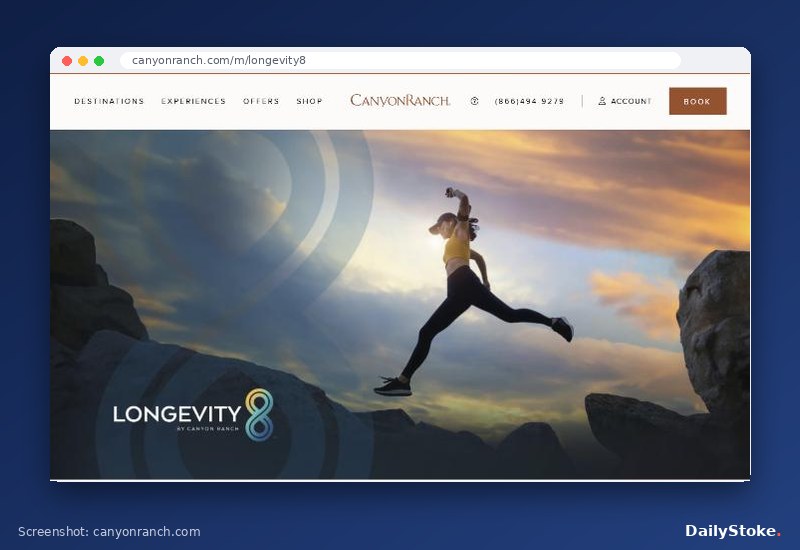
Built around: a four-day, or slower five-day, assessment at Canyon Ranch’s Longevity Center in Tucson, organized around eight principles: integrative medicine, mobility, mental health, spirituality, strength and endurance, nutrition, sleep and the outdoors.
Who supervises it: the medical director is Dr. Stephen C. Brewer, MD, a family and integrative medicine physician, with Dr. Diane Downing, MD, a board-certified family physician. The wider team includes a chiropractic sports physician, sports scientists, dietitians, a mental health therapist and spiritual wellness providers.
What’s included: 15+ diagnostic tests covering 200+ biomarkers, from a laboratory profile, genetic testing and a cancer screening panel to an ECG, carotid ultrasound, DEXA, VO2 max, sleep screening and a continuous glucose monitor. There are 18 one-to-one consultations, a pre-stay video call and five virtual follow-ups.
Low-calorie diet? No. Meals and snacks are included and the nutrition work is advisory.
What makes it different: the breadth. No other US resort we found packs this much testing into four days.
Claims that need stronger evidence: Canyon Ranch’s chief executive described it at launch in 2024 as a road map “to help people live younger, and longer.” We found no published study showing the program does either. Some of the tests, as we explain below, have little screening value in people without symptoms.
Price: $22,000 single, $20,000 per person sharing or $40,000 per couple, excluding taxes; a non-participating companion pays $5,000 (checked October 2026). The price rose from $20,000 single at launch in November 2024.
- Pros: genuinely long consultations; DEXA, VO2 max and laboratory results give a solid baseline; meals, room and transfers included.
- Cons: many results will fall outside reference ranges simply by chance; follow-up is virtual and limited; no repeat testing listed.
Our full analysis is in the Canyon Ranch LONGEVITY8 review.
2. Pritikin Longevity Center: Lifestyle Medicine Near Miami
Built around: a very low-fat, high-fiber diet, daily exercise and education, delivered on an 800-acre resort property in Doral, Miami. Pritikin says the program has been running for 50 years, and it is still sold as a residential, week-by-week stay.
Who supervises it: Pritikin says its physicians are board-certified cardiologists, endocrinologists and other specialists, working with exercise physiologists, psychologists and registered dietitians. It does not name them on its program pages.
What’s included: up to 90 minutes of physician consultations, an exercise tolerance test, blood panels and a DEXA scan, plus 24 small-group training sessions, 80+ elective exercise classes, physician master classes, nutrition workshops, a cooking school and all meals. Sleep apnea screening and “advanced medical testing” are add-ons.
Low-calorie diet? Not a fasting regime, but a strict one: low in fat, salt and refined sugar, with generous portions of vegetables, whole grains and legumes.
What makes it different: the evidence. Pritikin is one of very few US programs with a long research record. A study of 4,587 adults who attended its three-week residential program, published by R. James Barnard in the Archives of Internal Medicine in 1991, recorded average falls of about a quarter in total and LDL cholesterol and about a third in triglycerides. HDL cholesterol fell too, which is a less welcome result. In 2010, the Centers for Medicare & Medicaid Services approved the Pritikin Program as one of three intensive cardiac rehabilitation programs eligible for Medicare coverage.
Claims that need stronger evidence: most Pritikin studies measure people before and after their own stay, without a control group, and over weeks rather than years. Its headline figures (83% off blood pressure medication, 74% off diabetes medication) are not linked to specific studies on its website. The benefits depend on keeping the habits at home.
Price: Pritikin’s site quotes summer rates from $5,900 a week for stays of two weeks or more. Its last full published rate card, for 2025, priced a first week in a Deluxe Room from $5,707 to $6,635 per person sharing and $6,920 to $8,860 single, depending on season, with cheaper second weeks. Current rates for other seasons are on request (checked October 2026).
- Pros: the strongest outcome evidence in this guide; physician-led; a realistic training ground for cooking and exercise habits.
- Cons: the diet is hard to sustain for some people; less luxurious than its rivals; research mostly short-term and uncontrolled.
3. Sensei Lānaʻi, A Four Seasons Resort: Coaching in Paradise
Built around: the “Sensei Way” of movement, nutrition and rest, at a resort on Lānaʻi founded by Oracle’s Larry Ellison and oncologist Dr. David Agus. Expect a private spa hale, hiking, yoga and a Nobu restaurant.
Who supervises it: a Sensei Guide and fitness, nutrition and mindset specialists. The program pages list no physicians.
What’s included: the five-night Optimal Well-Being Program for one includes a fitness assessment with an exercise physiologist (VO2 max, gait analysis and vertical jump), three private sessions on mindset, nutrition and fitness, a closing “My Plan” session with a written report, a 120-minute Thermal Body Mapping or massage, an activity credit, and a WHOOP strap with a six-month membership. Round-trip flights from Honolulu are included for arrivals by the end of 2027.
Low-calorie diet? No. Meals aren’t part of the room rate; all-inclusive dining at Sensei by Nobu costs $375 per guest per day.
What makes it different: it treats data as a coaching tool rather than a diagnosis, and it’s the most relaxing setting in this guide.
Claims that need stronger evidence: none that are medical, which is to its credit. A WHOOP strap and a VO2 max test are useful for training; they are not a health check.
Price: rooms from $1,340 a night single or $1,700 double, excluding taxes and fees; dining $375 per guest per day (checked October 2026). The Optimal Well-Being package is sold at a nightly rate that varies by date.
- Pros: excellent fitness testing and coaching; no pressure to buy medical extras; flights from Honolulu included.
- Cons: no medical assessment; meals cost extra; guests must be at least 16.
4. Equinox Hotel New York: The Sleep Lab and a Very Good Gym
Built around: fitness, recovery and sleep in a Hudson Yards tower above Equinox’s huge fitness club. The Sleep Lab, launched in July 2025, is four Premier King rooms fitted with an adaptive, temperature-controlled mattress that tracks sleep stages, automated light and sound, a contrast shower that runs as cold as 46°F and guided rituals designed with sleep scientist Dr. Matthew Walker. Guests can join his sleep studies, with data held in what Equinox calls its Data Vault.
Who supervises it: nobody medical. This is hospitality, not a clinic.
What it’s like: I stayed at the hotel in a standard room, not the Sleep Lab. The health focus runs through everything, from the vast, well-equipped gym with views over Hudson Yards to a minibar stocked with wellness shots, energy bars and supplements alongside the usual options. We tried the cryotherapy chamber, which felt more carefully run than some we’d tried elsewhere, and were then asked for a 20% tip on a three-minute treatment. The Electric Lemon restaurant upstairs was the highlight: health-conscious food that didn’t feel like a punishment.
Low-calorie diet? No. That’s rather the point.
Claims that need stronger evidence: cryotherapy marketing tends to promise more than the research shows, and bedside sleep tracking can’t diagnose a sleep disorder. See our guide to how accurate sleep trackers are.
Price: Sleep Lab from $1,700 a night plus taxes, two-night minimum (checked October 2026). Whole-body cryotherapy is $70 for three minutes on the April 2026 spa menu, with a 20% gratuity added to each service.
- Pros: the best hotel gym we know; healthy food you’d actually choose; no rigid program.
- Cons: Sleep Lab pricing is steep for what is essentially smart bedding; treatments and tips add up.
The Equinox Hotel New York review covers the stay in detail.
5. Canyon Ranch Austin: The Newcomer in Texas Hill Country
Canyon Ranch opened its Texas resort on October 15, 2026, on more than 600 acres near Lake Travis in Spicewood, about an hour from downtown Austin. It has 141 rooms, a 40,000-square-foot spa that Canyon Ranch calls the largest in Texas, and a 12,000-square-foot medical center with physicians and clinicians. Programming covers brain health, sleep, preventive medicine, metabolic health and women’s health through what it calls the Women’s Wellness Collective.
It’s too new to judge, and we couldn’t find published package prices or a full test menu.
Price: varies by package; some consultations and treatments are charged separately.
Diagnostics or Lifestyle Medicine: What the Evidence Says
The most useful way to compare these programs is to ask a simple question of every test: would a competent doctor change anything about your care after seeing the result?
Some tests pass easily. Cardiorespiratory fitness is one of the strongest predictors of survival we have. In a study of 122,007 patients who took treadmill tests at the Cleveland Clinic, published by Kyle Mandsager and colleagues in JAMA Network Open in 2018, lower fitness carried a mortality risk comparable to smoking or diabetes. The study was observational, so it can’t prove that getting fitter adds years. But a VO2 max test gives you a meaningful, trainable number.
DEXA is similarly useful for measuring muscle and fat and for bone density, which has an established screening role in older women and others at higher fracture risk. Blood pressure, lipids, HbA1c and kidney function are standard clinical measures with clear treatment thresholds.
Other tests are weaker as screening tools in people without symptoms:
- Resting or exercise ECG: the USPSTF recommends against ECG screening in low-risk adults without symptoms, and says the evidence is insufficient for those at higher risk.
- Carotid intima-media thickness: a meta-analysis of 45,828 people in 14 cohorts, by Hester Den Ruijter and colleagues in JAMA in 2012, found that adding CIMT to a standard risk score improved risk classification by just 0.8%, which the authors judged “unlikely to be of clinical importance.”
- Sleep apnea screening without symptoms: the USPSTF found insufficient evidence to recommend it in 2022. If you snore heavily or wake exhausted, a home sleep test is a reasonable step; if you don’t, its value is less clear.
- Continuous glucose monitors in people without diabetes: interesting for seeing how meals affect you, but the evidence that this improves long-term health is preliminary. Over-the-counter sensors are now sold directly; we compare two in Stelo vs Lingo.
- Biological-age and genetic scores: these vary in validation and in what you can do with the result. Our guide to longevity clinic tests and biomarkers goes through them one by one.
Pritikin’s numbers, by contrast, are outcomes: falls in LDL cholesterol, triglycerides and blood pressure that matter clinically. That doesn’t mean a week there guarantees anything. But it’s a different kind of evidence from a longer list of things measured.
How we rate the main claims
| Intervention or claim | Where you’ll find it | Our classification | Note |
|---|---|---|---|
| Intensive diet and exercise to lower cholesterol, blood pressure and glucose | Pritikin; nutrition coaching at Canyon Ranch | Established for a defined indication | Cardiometabolic risk factors and cardiac rehabilitation |
| VO2 max and DEXA testing | Canyon Ranch, Pritikin (DEXA), Sensei (VO2 max) | Established for a defined indication | Fitness assessment, training plans and bone density |
| ECG screening in low-risk adults | Canyon Ranch | Evidence of limited or no benefit | USPSTF grade D |
| CIMT for cardiovascular risk prediction | Canyon Ranch | Evidence of limited or no benefit | 0.8% better risk classification |
| CGM for people without diabetes | Canyon Ranch | Plausible mechanism, uncertain benefit | No long-term outcome data |
| Home sleep screening without symptoms | Canyon Ranch, Pritikin add-on | Insufficient evidence | Helpful if you have symptoms |
| Smart mattresses and sleep rituals | Equinox Sleep Lab | Subjective wellness benefit | |
| Whole-body cryotherapy | Equinox | Subjective wellness benefit | Short-term recovery effects only |
| “Live younger, and longer” program claims | Canyon Ranch | Insufficient evidence | No published program outcomes |
Licensing, Regulation and the Questions Americans Rarely Ask
Physicians in the US are licensed by state medical boards, so the first question is simply who is a doctor. At Canyon Ranch the two physicians are MDs, the sports medicine specialist is a chiropractor and the nutrition team are dietitians. All useful, but not interchangeable.
Treatments are a different matter. The FDA says the only stem cell products it has approved are blood-forming cells from umbilical cord blood, for disorders of blood production, and that there are no FDA-approved exosome products. None of the US programs above advertises stem cell treatments, but if a US clinic or hotel spa offers them for aging, that alone tells you something. Hyperbaric oxygen, likewise, is an established hospital treatment for a defined set of problems, such as decompression sickness, carbon monoxide poisoning and some non-healing diabetic wounds. Healthy aging is not one of them.
Two more questions are worth asking in writing. Who holds your health data, and can you delete it? And what happens if a test finds something unexpected: does the retreat refer you, and does it share results with your own doctor?
What US Longevity Retreats Really Cost
Headline prices hide very different inclusions. Here’s what a single traveler pays for roughly a week, using published prices checked in October 2026, before flights to the property.
| Program | Program fee | Room | Food | Consultations | Common extras | Indicative total |
|---|---|---|---|---|---|---|
| Canyon Ranch LONGEVITY8 (4 or 5 nights) | Included | Included | Included | 18 included | Extra spa services, taxes, gratuities | $22,000 plus taxes |
| Pritikin (1 week, single) | Included | Included | Included | Up to 90 minutes included | Advanced testing, sleep apnea screening, extra training | About $6,900 to $8,900 on the 2025 rate card; summer from $5,900 a week for 2+ weeks |
| Sensei Lānaʻi (5 nights, one guest) | Package rate | Included in package rate | $375 a day if you add dining | Coaching sessions included | Spa beyond credits, taxes, resort fees | At least $8,575 at the entry room rate plus dining, before taxes and fees |
| Equinox Sleep Lab (2 nights) | None | $1,700 a night | Extra | None | Spa, cryotherapy, tips | From $3,400 plus taxes |
Per day, Canyon Ranch is the most expensive by a distance. Per hour of physician time, it may not be: 18 consultations is more contact than most people get from their doctor in years. That’s the honest case for it, and we make it in our LONGEVITY8 review.
Which US Longevity Retreat Suits Which Goal?
You have high cholesterol, raised blood pressure or prediabetes and want to change your habits: Pritikin. It’s the program built for exactly that, with the evidence to show it.
You want a thorough baseline assessment and long conversations with doctors: Canyon Ranch LONGEVITY8, provided you go in knowing that more results also means more borderline findings.
You want to get fitter and learn from your own data, somewhere beautiful: Sensei Lānaʻi.
You want a healthy city break with great training and good food: Equinox Hotel New York. Skip the Sleep Lab unless the money genuinely doesn’t matter.
You simply want a restful holiday: none of these is required. A good hotel, a daily walk and an early night are a perfectly respectable alternative.
If you’re weighing the whole idea, our analysis of whether longevity retreats are worth it compares the same money spent on preventive care, coaching and a normal holiday.
Before You Book: Six Questions to Ask
- Which of these tests are clinically indicated for me, given my history?
- Who reviews my results, and what are their qualifications?
- What happens if something abnormal or unexpected turns up?
- Will my results be shared with my own doctor, in a format they can use?
- Is any testing repeated after I go home, and is it included?
- What are the deposit, cancellation and refund terms?
If you have a heart condition, diabetes treated with medication, are pregnant or have a history of eating disorders, speak to your own doctor before any program involving exercise testing, dietary change or supplements. None of these retreats is a substitute for ongoing medical care.
Longevity Travel in America in 2027: Bigger Resorts, Same Science
In 2027 the US longevity market looks more like a hospitality category than a medical one. Canyon Ranch opened its Texas Hill Country resort in October 2026 with a 12,000-square-foot medical center, and its LONGEVITY8 program runs on fixed dates through the first half of the year at $22,000, up from $20,000 when it launched in November 2024. Equinox has put sleep at the center of its hotel brand, building on the Sleep Lab it introduced in New York with Matthew Walker.
The regulatory picture hasn’t moved to match the marketing. The FDA still recognizes only cord-blood stem cell products for blood disorders and no exosome products at all, and the USPSTF still advises against routine ECG screening for low-risk adults.
US Longevity Retreats: Questions Answered
What is the best longevity retreat in the US?
It depends on your goal. For proven short-term improvements in cholesterol, blood pressure and blood sugar, Pritikin has the strongest evidence. For the most comprehensive medical assessment, Canyon Ranch LONGEVITY8 tests more than any rival we found. Sensei Lānaʻi is the best for fitness coaching in a resort setting.
How much does a longevity retreat cost in the US?
From about $3,400 for two nights in Equinox’s Sleep Lab to $22,000 for Canyon Ranch’s four- or five-day LONGEVITY8. A week at Pritikin cost roughly $5,700 to $8,900 on its 2025 rate card, including room, meals and testing. Flights, taxes and gratuities are extra everywhere.
Is Pritikin covered by Medicare?
The residential resort stay is a private purchase. Separately, CMS has approved the Pritikin Program as an intensive cardiac rehabilitation program since 2010, which Medicare can cover for eligible heart patients at approved facilities. Ask your cardiologist whether you qualify.
Do US longevity retreats use fasting diets?
None of the programs in this guide is built on fasting. Pritikin uses a strict low-fat, high-fiber diet; Canyon Ranch and Sensei offer normal meals with nutrition advice. Fasting-mimicking programs are mostly a European specialty.
Can I get the same tests without going to a retreat?
Many of them, yes. DEXA scans and VO2 max tests are sold individually by sports-performance clinics, and broad blood panels by subscription testing companies. What you won’t get is 18 consultations in four days, which is the main thing a program like LONGEVITY8 sells.