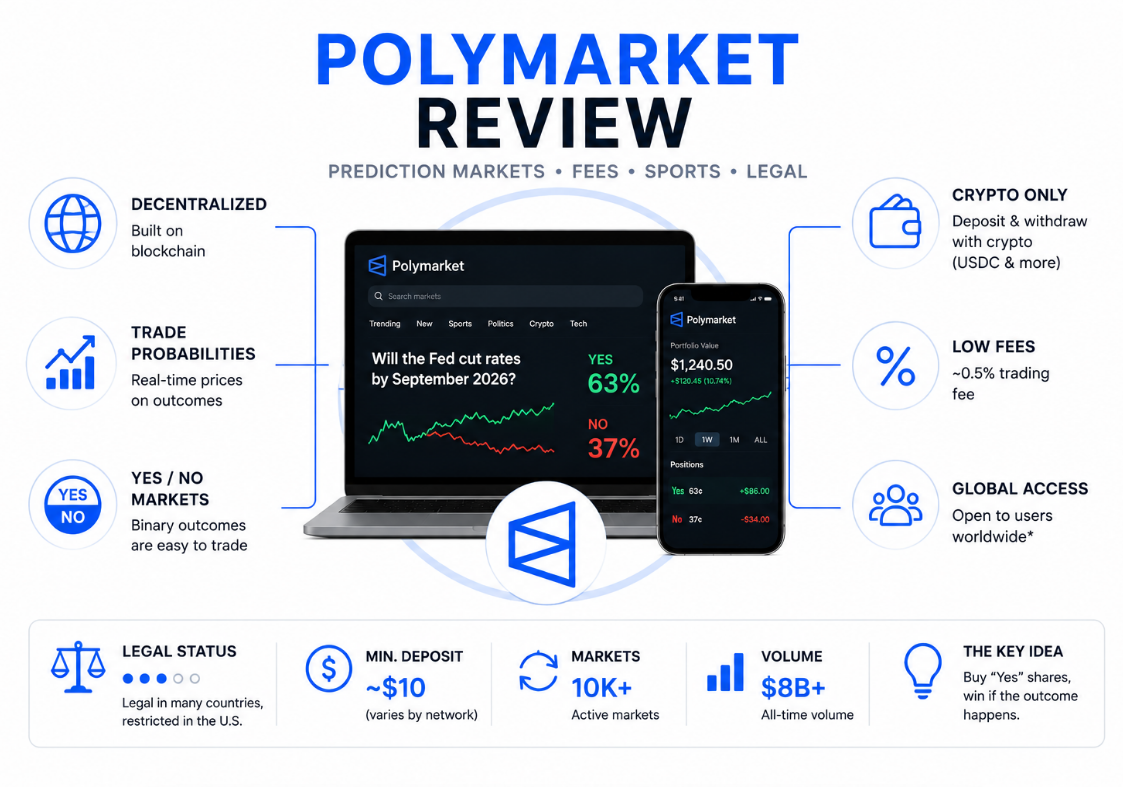
Polymarket became one of the most recognizable names in prediction markets by letting users trade on politics, sports, economics, crypto and major news events.
For Americans in 2026, however, there is an important distinction:
Polymarket US and Polymarket.com are separate products.
Polymarket.com is the international crypto-based platform. US residents cannot use it to deposit or trade.
Polymarket US is the company’s regulated American exchange. It operates in US dollars under Commodity Futures Trading Commission oversight and currently focuses heavily on sports event contracts. (help.polymarket.com)
The basic concept is straightforward.
You buy and sell contracts based on whether an event will happen. A Yes contract trading at 60 cents represents a market-implied probability of roughly 60%. If the outcome occurs, the contract settles at $1. If it does not, it settles at $0. (docs.polymarket.us)
But as with Kalshi, the interesting part is what happens beneath that simple interface.
Polymarket US uses an order book, so liquidity affects execution. Trading fees depend on the contract price. Traders adding liquidity can receive rebates. Positions can be sold before settlement. And sports contracts remain part of a wider legal fight over whether federally regulated prediction markets can also be restricted by individual states.
Our review process: DailyStoke has not opened and funded a Polymarket US account for this review. Our assessment is based on Polymarket US documentation, CFTC filings, court developments and independent reporting, checked in August 2026.
| Polymarket US | Details |
|---|---|
| Platform Type | Prediction market exchange |
| Regulator | Commodity Futures Trading Commission |
| Trading Currency | US dollars |
| Contract Payout | Normally $1 if correct, $0 if incorrect |
| Sports Markets | Yes |
| New User Incentive | $20 credit for qualifying first deposits through eligible partners/ISVs |
| Qualifying Deposit | At least $1 under the published incentive |
| Trading Fees | Variable by contract price |
| Maker Rebate | 25% of the equivalent taker fee |
| Funding Methods | ACH, debit/credit card and Apple Pay |
| US App | iPhone |
| Android | Coming soon |
| Best For | Sports prediction markets and users who want to trade positions rather than place conventional bets |
What Is Polymarket US?
Polymarket US is a CFTC-regulated prediction market exchange.
Each market asks a question about a future outcome.
For example:
- Will a particular NFL team win?
- Will an NBA game exceed a specified total?
- Will a team win its division?
- Will a player or team win a championship?
Contracts are generally priced between $0 and $1.
Suppose a Yes contract is trading at $0.40.
If you buy 10 contracts, their underlying cost is $4 before fees.
If the event resolves Yes, they settle at $10 in total.
If the event resolves No, they settle at $0.
That means the contract price can be interpreted as a rough market probability:
- 20 cents ≈ 20%
- 50 cents ≈ 50%
- 80 cents ≈ 80%
These are market-implied probabilities, not objective forecasts. Prices simply reflect where buyers and sellers are currently willing to trade.
Polymarket US vs Polymarket.com
This is probably the most important thing for American readers to understand.
The international Polymarket product and Polymarket US share a brand but operate differently.
Polymarket.com
The international platform:
- Uses blockchain technology
- Is crypto-based
- Is accessed through a web browser
- Is not available for US residents to deposit or trade
Polymarket US
The American product:
- Trades in US dollars
- Operates as a CFTC-regulated exchange
- Uses a separate account system
- Currently requires US users to trade through the Polymarket US app
Accounts are not connected between the two products. (help.polymarket.com)
This distinction matters because many older Polymarket reviews still discuss wallets, USDC deposits and blockchain transactions as though those apply to American users.
They do not necessarily apply to Polymarket US.
Polymarket Sports Markets
Sports is currently one of the main areas available through Polymarket US.
The platform lists markets across leagues and sports including:
NFL, NBA, NHL, MLB, MLS, college basketball, tennis, golf and more.
Polymarket US currently supports several familiar sports market types:
- Winner markets
- Spreads
- Totals
- Futures
Its API documentation also supports sports props as a market category. (docs.polymarket.us)
A Winner contract works similarly to a sportsbook moneyline.
Spread contracts ask whether a team will cover a specified margin.
Totals are based on whether the combined score finishes over or under a particular number.
Futures cover longer-term outcomes such as championship winners or tournament results. (docs.polymarket.us)
The difference from a sportsbook is how those prices are formed.
Polymarket does not simply publish a fixed set of odds and take the opposite side. Traders interact through the exchange’s order book.
That means liquidity and the bid-ask spread matter.
Why Liquidity Matters
A Polymarket contract might show a recent trade at 60 cents.
That does not necessarily mean you can buy an unlimited number of contracts at exactly 60 cents.
The order book contains bids and offers from other traders at different prices.
Polymarket’s own market data tracks measures including:
- Best bid
- Best ask
- Bid-ask spread
- Current liquidity
- 24-hour volume
- Weekly and monthly volume
Those figures can tell you more about the real tradability of a contract than the last traded price alone. (docs.polymarket.us)
This also matters when you want to exit.
Polymarket allows traders to sell positions before the final result is known.
If you buy at 40 cents and the market later moves to 70 cents, you may be able to sell and lock in a profit without waiting for settlement.
But another trader needs to be willing to take the other side.
A highly active sports market may be easy to exit. A niche contract with a wider spread may require you to accept a worse price.
For larger positions, checking liquidity and spread before entering is therefore important.
Polymarket Fees Explained
Polymarket US uses a variable trading-fee formula rather than a flat commission.
Its current exchange-wide formula is:
Fee = 0.05 × contracts × price × (1 − price)
Fees are highest around a 50-cent contract and fall as prices approach either $0 or $1. (docs.polymarket.us)
For example, buying 100 contracts at 50 cents gives a contract value of $50.
The current taker fee is $1.25.
So the total immediate cost would be $51.25.
By comparison, 100 contracts at 20 cents carry a current taker fee of $0.80.
This means the apparent contract price does not tell you the full cost of an immediately executed trade.
Maker Rebates
Polymarket also rewards users who add liquidity.
A taker accepts an existing order in the market.
A maker places an order that remains on the order book and is later accepted by somebody else.
Under the current general schedule, makers receive a rebate equal to 25% of the equivalent taker fee.
At a 50-cent price, for example, 100 maker contracts currently earn approximately $0.31 in rebate. (docs.polymarket.us)
That creates a meaningful difference between simply accepting the current price and patiently placing your own order.
For occasional users, the amounts may be small.
For frequent traders, order type can materially change total costs.
Polymarket New Customer Bonus
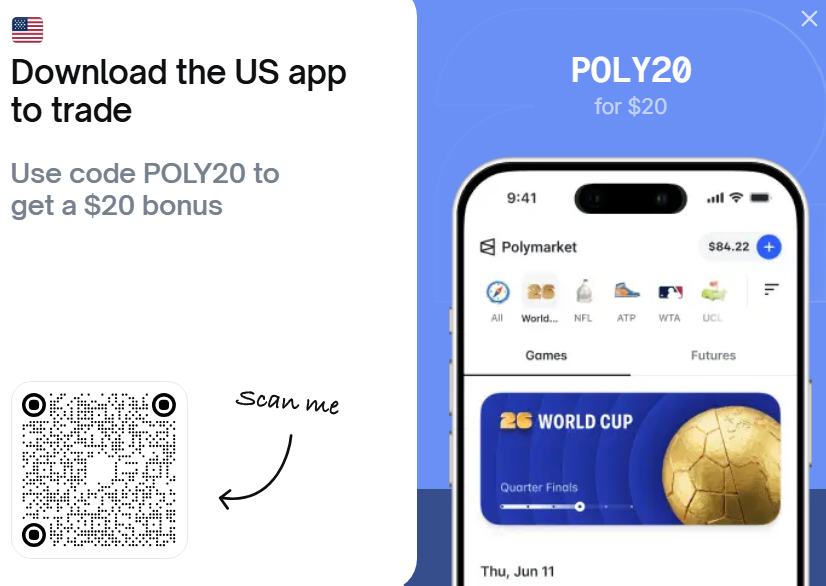
Polymarket US currently documents a $20 first-deposit incentive for qualifying new users.
The published program applies to new participants who onboard through an eligible Independent Software Vendor, or ISV, and deposit at least $1.
Polymarket says the $20 incentive credit is then applied to the account within 30 days after the requirements are satisfied. (docs.polymarket.us)
This is not necessarily the same as one universal Polymarket promo code.
Individual partners can use their own links or codes, and incentives can change.
DailyStoke would therefore recommend checking the exact offer attached to the signup link rather than relying on an older promo code found elsewhere.
Polymarket US also runs separate programs rewarding trading volume and liquidity provision.
Those are more relevant to active traders than to someone simply opening an account for the first time.
Polymarket Trading Incentives
Polymarket has put substantial emphasis on building liquidity.
Its current incentive programs include:
Volume incentives — rewards based on eligible trading activity.
Liquidity incentives — rewards for placing competitive resting orders.
Fill incentives — rewards when resting orders actually execute.
Market-maker incentives — formal programs for approved professional liquidity providers.
In June 2026, Polymarket US also filed a new Daily Trading Incentive Program with the CFTC designed to encourage customers to deposit and trade across multiple days rather than simply receive a one-time signup reward.
These programs help explain why makers can sometimes receive better economics than users who repeatedly accept existing offers.
For an ordinary user, however, trading fees, market liquidity and the first-deposit incentive are more important than professional market-maker programs.
How Sports Markets Settle
Sports contracts use detailed settlement rules.
This is an area where reading the rules matters.
Polymarket US specifies how markets handle situations such as:
- Overtime
- Extra innings
- Penalty shootouts
- Ties
- Postponements
- Forfeits
- Player withdrawals
- No contests
- Replayed games
For standard game-level contracts, overtime and equivalent extra periods are generally included unless the specific contract says otherwise. (docs.polymarket.us)
A soccer market with a Draw option may settle based on regulation time rather than extra time.
A UFC fight declared a no contest may settle using the last fair market price rather than simply paying either side $1.
Those details can change the outcome of a trade.
The rule here is simple:
Do not trade a specialized market based only on its headline. Read the contract terms first.
Deposits and Withdrawals at Poly Market
Polymarket US uses conventional US payment methods rather than requiring crypto.
Its current payment infrastructure supports:
- ACH bank transfers
- Debit and credit cards
- Apple Pay
ACH is processed through Aeropay, while card and Apple Pay transactions are handled through Checkout.com.
Polymarket’s current documentation describes ACH transfers as typically taking one to three business days, while card and Apple Pay transactions can be instant.
Withdrawals can also be processed through supported bank and card channels.
Payment documentation is currently marked as beta and subject to change, so available limits and processing rules should be checked inside the account before moving larger amounts.
Polymarket Mobile App
US customers currently use the Polymarket US iPhone app.
The Android version is listed as coming soon.
Importantly, American users cannot simply use Polymarket.com through a desktop browser as an alternative. Polymarket explicitly states that US residents cannot deposit or trade on the international website.
This is a practical disadvantage compared with platforms offering full desktop trading to US customers.
For someone who prefers a large desktop interface for following multiple markets and order books, the current app-only setup is limiting.
Is Polymarket US Regulated?
Yes, though the regulatory history is unusual.
In January 2022, the CFTC fined the original Polymarket operation $1.4 million for offering off-exchange event-based binary options without the required exchange registration. Polymarket agreed to wind down non-compliant markets and cease the violations identified by the regulator.
That historical enforcement action should not be confused with the regulatory status of today’s US platform.
In 2025, Polymarket acquired QCEX, including QCX llc and QC Clearing llc, for $112 million as part of its return to the US market. QCX llc had received CFTC Designated Contract Market status on July 9, 2025 and now operates as Polymarket US.
Polymarket US also operates with a regulated clearing structure through Polymarket Clearing.
So today’s US service is fundamentally different from the unregistered product addressed by the 2022 enforcement action.
Is Polymarket Legal in Every State?
Again, this is more complicated. Polymarket US is federally regulated.
But the question of whether states can separately apply gambling laws to sports prediction contracts remains unresolved.
Prediction-market operators and the CFTC argue that event contracts traded on federally regulated exchanges fall under federal commodities law.
States argue that sports contracts function as sports betting and should therefore require state gambling licenses and comply with state betting restrictions.
Courts are divided.
In Minnesota, a federal judge temporarily blocked a state law banning prediction markets in July 2026. Polymarket, Kalshi and the CFTC were among the parties challenging the law, and the judge found they were likely to succeed on the federal-jurisdiction argument. The underlying case continues.
Utah went the other way. In August, a federal judge ruled that Utah could enforce its anti-gambling laws against prediction markets such as Kalshi and Polymarket.
Other states have also challenged prediction-market sports contracts, creating an increasingly fragmented legal picture.
This means we would not describe Polymarket sports markets as simply legal in all 50 states.
The federal exchange registration is clear. The extent to which states can restrict individual contracts remains contested.
Users should check current availability from their location before depositing or trading.
What Else Can You Trade?
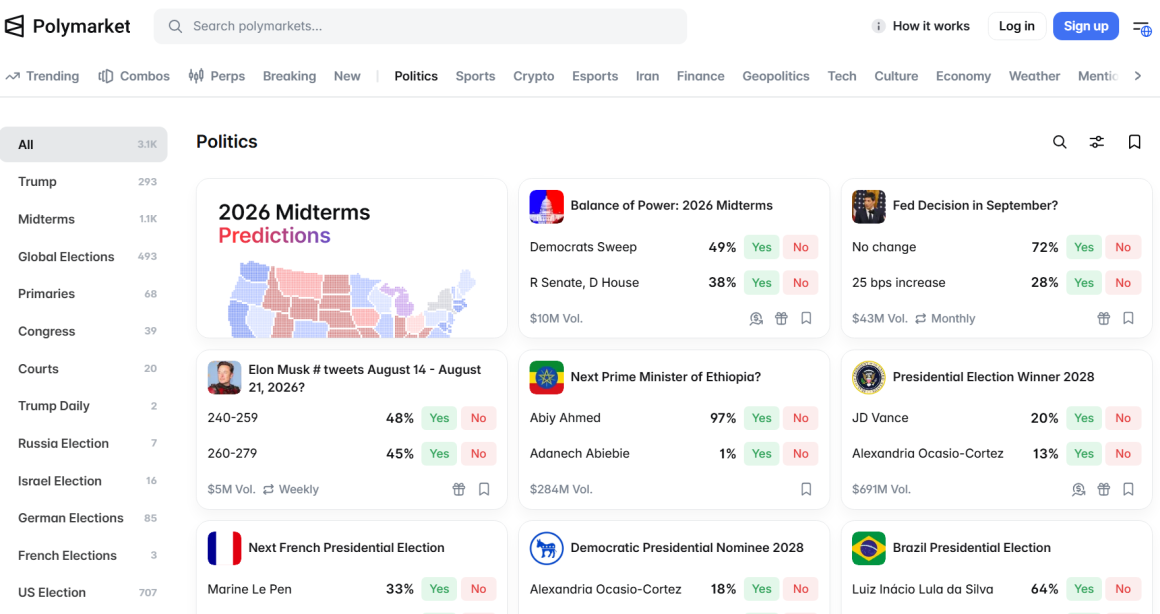
The international Polymarket platform is famous for markets covering politics, economics, crypto, entertainment and current events.
The US product began with a stronger sports focus but is expanding.
Polymarket US documentation has listed politics, culture, finance and economics as additional categories, and 2026 CFTC filings show the exchange self-certifying new non-sports event contracts.
That broader range is likely to become one of Polymarket’s strongest differentiators if the US product develops toward the variety available internationally.
For now, sports remains the most mature part of the US offering.
Responsible Trading
Prediction contracts can lose their full purchase value.
If you pay 70 cents for a Yes contract and the market ultimately resolves No, that contract settles at zero.
A high market probability also does not make an outcome certain.
A contract priced at 90 cents still reflects an outcome the market believes has roughly a 10% chance of failing.
Liquidity introduces another risk.
You may theoretically be able to sell before settlement, but there is no guarantee you can exit a large position at the headline market price.
For that reason, users should consider:
- Maximum possible loss
- Trading fees
- Market liquidity
- Bid-ask spread
- Settlement rules
before committing significant money.
Polymarket FAQs
Is Polymarket a sportsbook?
No. Polymarket US is a CFTC-regulated prediction market exchange. Sports markets can resemble sportsbook bets, but contracts are traded through an exchange against other participants.
Can Americans use Polymarket?
Yes, through Polymarket US where available.
US residents cannot deposit or trade through the international Polymarket.com platform. (help.polymarket.com)
Does Polymarket have a signup bonus?
Polymarket US currently documents a $20 incentive credit for qualifying new users who onboard through an eligible partner/ISV and deposit at least $1. Individual partner offers may vary. (docs.polymarket.us)
How much does a Polymarket contract pay?
A normal winning contract settles at $1, while a losing contract settles at $0.
Your actual profit depends on the price you paid and applicable fees.
Does Polymarket charge fees?
Yes.
The current taker-fee formula varies according to the contract price, with fees highest around 50 cents. Traders who add liquidity receive a maker rebate equal to 25% of the equivalent taker fee. (docs.polymarket.us)
Can you sell a Polymarket trade early?
Yes, if sufficient liquidity exists.
You can sell contracts before settlement at the prices other traders are willing to pay.
Is Polymarket legal in the US?
Polymarket US is a federally regulated CFTC Designated Contract Market.
However, several states are challenging whether sports prediction contracts must also comply with state gambling laws. Courts have reached conflicting conclusions, so market availability can differ by location.
Is Polymarket available on Android?
Not yet.
As of August 2026, Polymarket US is available on iPhone and says an Android app is coming soon.
Is Polymarket Worth Using?
Polymarket is most interesting for users who like the idea of trading an event rather than simply betting on it.
Sports markets are familiar enough for someone coming from a sportsbook. You can trade winners, spreads, totals and futures. It especially makes sense for Americans who live in a state without regluated sports betting like California, Texas or Georgia or where it is not easy to bet like in Florida.
But the exchange structure adds another layer.
Prices move as other users trade. Positions can be sold before settlement. Limit orders allow users to choose their own price. Liquidity affects execution. And traders who add liquidity can receive rebates instead of simply paying the standard taker fee.
That creates real advantages for users who understand market mechanics.
There are drawbacks.
Fees are less immediately intuitive than sportsbook odds. Liquidity matters. Settlement rules can be more technical than expected. The current US product is app-focused and less mature than international Polymarket. And the state-level legal position of sports prediction markets remains unsettled in 2026.
Polymarket therefore makes less sense for someone who simply wants to bet $20 on a football team and immediately see a fixed payout.
For someone interested in probabilities, market movement and actively managing positions as new information arrives, Polymarket US is a genuinely different alternative.