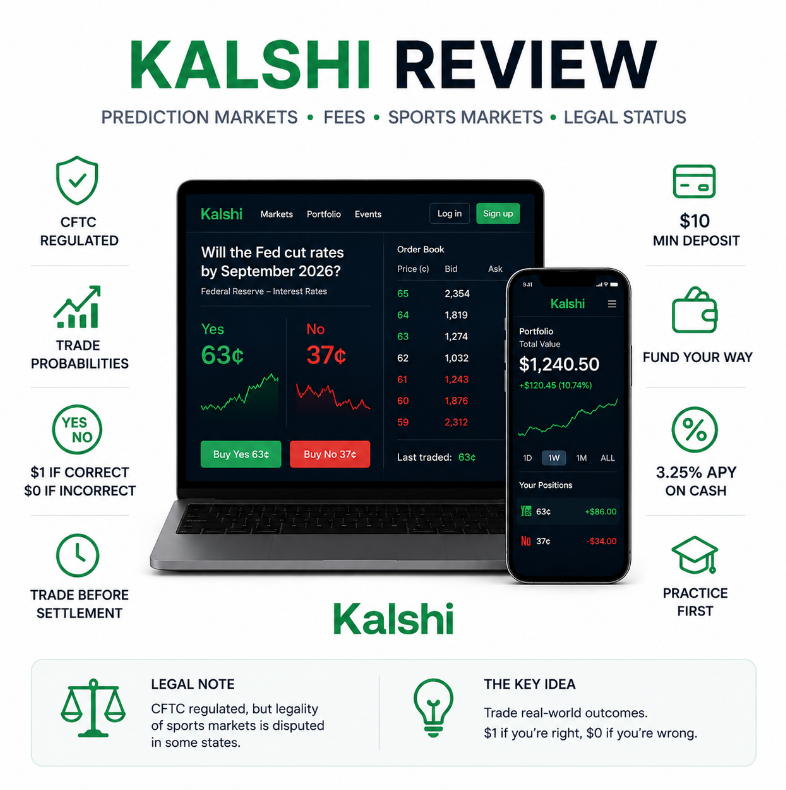
Kalshi has become one of the biggest names in prediction markets, letting users trade on everything from sports and elections to inflation, weather, crypto, entertainment and technology.
Instead of betting with a sportsbook, you buy and sell contracts based on whether something will happen.
A contract priced at 60 cents roughly represents a market-implied 60% chance. If you buy it and the event resolves in your favor, the contract is worth $1. If you are wrong, it settles at $0.
Kalshi uses an exchange order book, so liquidity matters. Trading fees vary according to contract prices, some limit orders can avoid the standard trading fee, and positions can be sold before an event settles.
Kalshi is also regulated federally by the Commodity Futures Trading Commission (CFTC) as a derivatives exchange. The legal position of its sports markets is more complicated, however. States and the federal government are fighting over whether sports prediction contracts should be treated as federally regulated derivatives or state-regulated gambling, and courts have reached conflicting conclusions.
Our review process: DailyStoke has not opened and funded a Kalshi account for this review. Our assessment is based on Kalshi’s current product documentation, CFTC records, court developments and independent reporting, checked in August 2026.
| Kalshi | Details |
|---|---|
| Platform Type | Prediction market exchange |
| Regulator | Commodity Futures Trading Commission |
| Minimum Age | 18+ |
| Contract Payout | Normally $1 if correct, $0 if incorrect |
| Sports Markets | Yes |
| Promo Code | No universal public code; referral offers vary |
| Minimum Deposit | $10; $1,000 for wire transfers |
| Trading Fees | Variable by price and market |
| Limit Orders | Can reduce or sometimes avoid trading fees |
| Funding Methods | ACH, debit card, Apple Pay, Google Pay, PayPal, Venmo, Cash App, crypto and wire |
| Interest | 3.25% variable APY for eligible US balances of $250+ |
| Demo Account | Yes |
| Best For | Trading probabilities across sports and real-world events |
What Is Kalshi?
Kalshi describes itself as a prediction market exchange.
Users can buy contracts based on questions such as:
- Will inflation exceed a certain level?
- Will a particular team win?
- Who will win an election?
- Will Bitcoin reach a specified price?
Each contract has a price determined by buyers and sellers.
Suppose a Yes contract is available at $0.40. If you buy 10 contracts, their underlying cost is $4 before fees. If Yes wins, they settle for $10. If No wins, they settle for zero.
That makes prices easy to read as rough probabilities:
- 20 cents ≈ 20%
- 50 cents ≈ 50%
- 80 cents ≈ 80%
But these are market-implied probabilities, not objective forecasts. Prices represent what traders are currently willing to pay and can be affected by liquidity, breaking news and large orders.
Kalshi Sports Markets
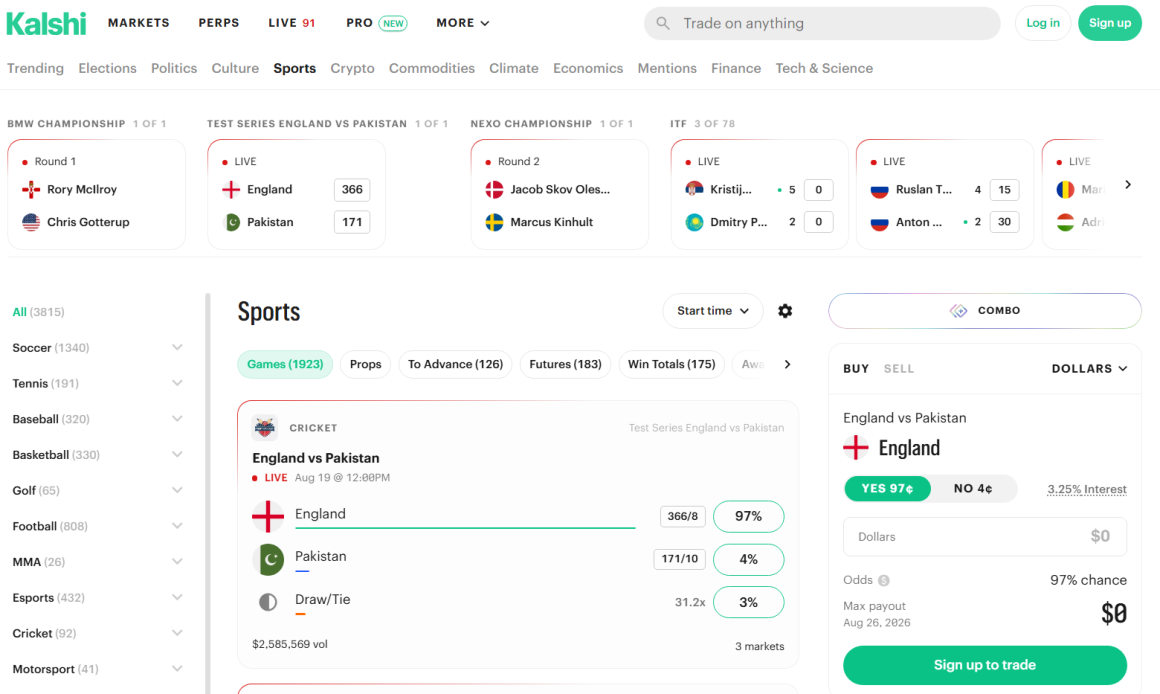
Sports has become a major part of Kalshi.
The platform lists event contracts across major US and international sports, with markets that can resemble familiar sportsbook products such as game winners, totals, spreads, futures and more specialized outcomes.
The practical difference is how the price is created.
At a sportsbook, the operator generally quotes the odds. On Kalshi, buyers and sellers interact through an order book and determine the market price.
That makes understanding liquidity, order types and fees more important than it is when simply accepting a sportsbook’s displayed odds.
Why Liquidity Matters
Kalshi’s order book shows how many contracts traders are willing to buy or sell at different prices.
A market may display Yes at 70 cents without there necessarily being enough contracts available for a large trade at exactly that price.
If you place a large Quick Order, different parts of the trade may therefore execute at different prices.
Kalshi gives an example in its own trading documentation: if 500 contracts are available at 10 cents and the next 500 at 12 cents, buying 1,000 would produce an average price of 11 cents.
The same principle matters when selling.
You can exit a Kalshi position before settlement, but another participant must be willing to buy it. In an active NFL or election market, liquidity may be substantial. A niche contract may have a wider bid-ask spread and fewer buyers.
For larger trades, checking order-book depth rather than only the headline price is therefore important.
Kalshi Fees Explained
Kalshi does not use a flat trading commission.
For standard event contracts, its general taker-fee formula is:
0.07 × contracts × price × (1 − price)
Fees are highest around the middle of the probability range and become smaller as the contract approaches either $0 or $1.
Under the current general schedule, buying 100 contracts at 50 cents carries a $1.75 trading fee.
So although the contracts themselves cost $50, an immediately executed order would cost approximately $51.75 under the standard fee schedule.
At 20 cents, the equivalent fee on 100 contracts falls to $1.12.
Limit Orders Can Cost Less
Instead of immediately accepting an available price, users can place a limit order specifying what they are prepared to pay.
If that order remains on the book and another trader later accepts it, Kalshi generally does not charge its standard taker fee.
Certain markets have separate maker fees. The general maker formula is currently:
0.0175 × contracts × price × (1 − price)
Kalshi publishes which markets are subject to these maker fees.
For regular traders, the difference matters. Someone repeatedly taking available prices may spend more in fees than someone prepared to use resting limit orders.
Kalshi Promo Codes and Referral Bonuses
There is no single permanent Kalshi promo code or signup bonus that should be treated as universal in 2026.
Kalshi operates referral programs where the reward and required trading activity can vary.
A referral code can normally be entered during registration. In some cases, users can add one within 72 hours of opening an account, provided they have not already made their first deposit.
Referral credits are also not equivalent to ordinary cash. The promotional balance generally needs to be used for trading, while profits generated from it can become withdrawable.
Current Kalshi guidance says referral credits generally expire seven days after being issued unless the individual promotion states otherwise.
That makes it worth checking the live offer rather than relying on older pages advertising a fixed Kalshi bonus.
What Can You Trade on Kalshi?
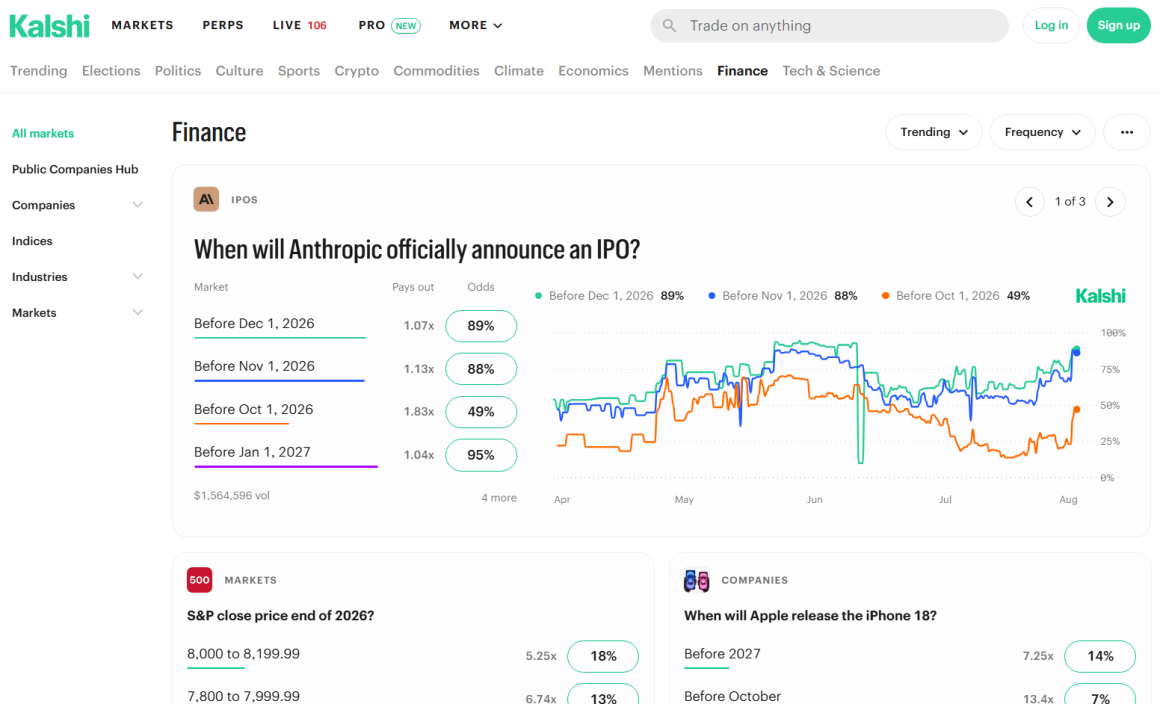
Sports gets much of the attention, but Kalshi’s breadth is one of its strongest features.
Markets cover areas including:
Sports, politics and elections, economics, financial markets, crypto, commodities, weather and climate, technology, science, entertainment and culture.
Individual contracts can be remarkably specific. Kalshi has listed markets on inflation releases, Federal Reserve decisions, music charts, AI models, court cases, crypto prices and temperature records.
One important rule applies across all of them: read the settlement criteria before trading.
The market headline alone does not necessarily tell you exactly how the outcome will be determined.
Each market specifies its resolution source, measurement period and other conditions. An apparently obvious event can have detailed settlement rules covering timing, revised data or unusual outcomes.
For meaningful trades, those rules matter as much as your prediction.
Kalshi’s 3.25% APY
A genuinely unusual feature is interest on eligible Kalshi balances.
Kalshi currently advertises a 3.25% variable annual percentage yield for eligible US customers with at least $250 in qualifying portfolio value.
The eligible amount can include available cash and the value of qualifying open positions. Interest accrues daily and is normally paid monthly.
The 3.25% rate is variable and can change.
For someone holding longer-duration contracts, however, this is useful. Capital committed to eligible positions can potentially continue earning interest while the event remains unresolved.
Traditional sportsbook balances generally do not offer anything comparable.
Deposits and Withdrawals
Kalshi supports a broad selection of funding methods, including:
- ACH bank transfer
- Debit card
- Apple Pay and Google Pay through eligible cards
- PayPal
- Venmo
- Cash App for deposits
- Cryptocurrency
- Wire transfer
The normal minimum deposit is $10, while wire transfers have a $1,000 minimum.
Payment availability can vary by location and account type.
Recently deposited money can also be subject to temporary security holds before it becomes withdrawable. Users planning to move money in and out quickly should check the hold attached to their chosen payment method.
Is Kalshi Regulated?
Yes. KalshiEX llc has been a CFTC-designated contract market since November 2020. That means it operates under a federal derivatives-market regulatory framework rather than a conventional state sportsbook license.
This distinction is important because it sits at the center of one of the biggest US gambling and financial-regulation disputes of 2026.
Is Kalshi Legal in Every State?
There is no simple nationwide answer for every Kalshi market.
Kalshi and the CFTC maintain that federally designated event contracts fall under the Commodity Exchange Act and the CFTC’s exclusive jurisdiction.
A growing number of states argue that sports contracts in particular function as sports betting and must comply with state gambling laws.
The courts have not agreed on one interpretation.
In Arizona, a federal judge temporarily blocked the state from enforcing its gambling laws against prediction-market operators on April 10, 2026, and paused a criminal case against Kalshi. The court found that the CFTC had shown a reasonable likelihood of succeeding with its argument that federal law preempts Arizona’s restrictions. The case itself is not finally resolved.
In Minnesota, a federal judge temporarily blocked the state’s new prediction-market ban on July 27. The court found that the CFTC, Kalshi and Polymarket were likely to succeed in their challenge and that allowing the law to take effect could cause irreparable harm. That lawsuit also remains ongoing.
Utah moved in the opposite direction. In August, a federal judge rejected Kalshi’s request to prevent Utah from enforcing its anti-gambling laws. Kalshi said it planned to appeal.
New York has separately sued Kalshi, alleging that it operates an illegal and unlicensed gambling business. Kalshi rejects that characterization and argues that states cannot shut down a federally regulated exchange.
Other courts have also split. Recent rulings have favored states in jurisdictions including Nevada and Massachusetts, while Kalshi has won favorable preliminary decisions elsewhere.
The important point for users is that none of these individual decisions settles the issue nationally.
We would therefore not rely on a static claim that “Kalshi is legal in all 50 states.” The federal regulatory status is clear, but the interaction between federal derivatives law and individual state gambling laws remains contested.
Check current availability from your location before depositing or trading.
How To Open a Kalshi Account
Individual Kalshi users must be at least 18 years old.
The basic signup process is:
- Create a Kalshi account.
- Provide the required personal details.
- Complete identity verification.
- Add an eligible referral code before depositing if you have one.
- Choose a funding method and deposit at least $10.
- Find a market and read its settlement rules.
- Choose your position and decide whether to use a Quick Order or limit order.
Kalshi may request government-issued identification or additional documents as part of its identity checks.
For new users, understanding Quick Orders and limit orders before committing significant money is worthwhile because they can affect both the execution price and fees.
Can You Try Kalshi Without Real Money?
Yes.
Kalshi provides an official demo environment that lets users explore its market interface and place simulated trades with mock funds.
That is particularly useful here because order books, contract pricing and limit orders are less familiar to many people than conventional sportsbook betting.
Trying the interface first can make it considerably easier to understand what the quoted prices actually mean before real money is involved.
Responsible Trading
A Kalshi event contract can lose its entire purchase value.
If you buy a Yes contract and the market ultimately resolves No, that contract becomes worth zero. Trading fees add to the cost.
The platform offers responsible-trading controls including trading breaks, voluntary self-exclusion and personalized funding caps.
Regardless of whether prediction markets are legally classified as gambling or financial trading, sports and event contracts involve real financial risk. Users should size positions accordingly rather than treating a market-implied probability as a guarantee.
Kalshi FAQs
Is Kalshi a sportsbook?
No. Kalshi is a CFTC-regulated prediction market exchange. Sports contracts can resemble sportsbook bets, but users trade contracts through an exchange rather than placing conventional fixed-odds bets directly against a bookmaker.
How much does a Kalshi contract pay?
A standard binary event contract is normally worth $1 if the selected outcome occurs and $0 if it does not. Your actual profit or loss depends on the price paid and applicable fees.
Does Kalshi charge fees?
Yes. Standard immediately matched trades have variable fees based on the contract price and number of contracts. Fees are highest around 50-cent contracts. Resting limit orders can avoid the standard trading fee, although maker fees apply in specified markets.
Does Kalshi have a promo code?
Kalshi uses referral programs rather than one permanent universal promo code. Reward amounts and qualifying requirements can change, so check the offer attached to your account.
Can you sell a Kalshi trade before it settles?
Yes, provided there is sufficient liquidity. The price you receive depends on the bids available in the order book when you sell.
How old do you have to be to use Kalshi?
Individual users must be at least 18 years old.
Is Kalshi legal?
Kalshi is a federally regulated CFTC-designated contract market. However, several states argue that some of its event contracts, particularly sports markets, fall under state gambling law. Courts have produced conflicting rulings, so availability should be checked by location rather than relying on a blanket nationwide claim.
Is Kalshi Worth Using?
Kalshi is most interesting when you treat it as a market for trading probabilities, rather than simply another place to bet on sports.
Its range is unusually broad. A user can move from an NFL game to an inflation release, an election, a temperature forecast or a technology market from the same account.
The exchange structure also gives users more control. Positions can be sold before settlement, limit orders allow traders to choose their own entry prices, and understanding the order book can reduce trading costs.
There are disadvantages.
Fees take more effort to understand than sportsbook odds. Liquidity can materially affect execution. Settlement rules sometimes require careful reading. And the legal position of sports prediction markets remains unusually unsettled in 2026.
For someone who only wants to put $20 on a football team and immediately know the potential payout, a conventional regulated sportsbook is simpler.
For users interested in market probabilities, changing information and actively managing positions, Kalshi offers something genuinely different.